What happens when reason challenges the foundations of religious authority? In the salons of Enlightenment Paris, d'Holbach helped make that question an urgent intellectual debate.
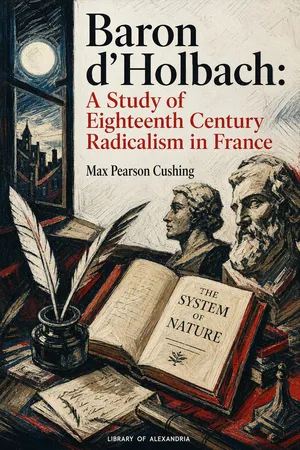
Max Pearson Cushing's Baron d'Holbach: A Study of Eighteenth Century Radicalism in France examines the life and thought of Paul-Henri Thiry, Baron d'Holbach, whose atheism and scientific materialism placed him among the period's most outspoken critics of established belief. Following his path from German roots to French intellectual life, Cushing connects the philosopher's writings with the people and circumstances that shaped them.
At the center of this history are d'Holbach's Parisian salon, his relationships with thinkers including Diderot and Helvétius, and the controversial arguments of The System of Nature. Drawing on letters and Enlightenment publications, Cushing places these ideas within wider disputes over God, nature, morality, and authority. The result is both a portrait of an influential thinker and a study of how radical ideas circulated through conversation, friendship, and print.
What readers find inside:
- A philosophical life - D'Holbach's background and intellectual development reveal the personal setting of his radical commitments.
- Parisian connections - His salon brings into focus the networks through which Enlightenment thinkers exchanged ideas.
- Atheism and materialism - His writings challenge religious explanations of nature and human existence.
- Morality and reason - Debates about the basis of ethical life show what was at stake beyond the question of belief.
- Ideas in conflict - Cushing situates d'Holbach's work within the religious and intellectual controversies of eighteenth-century Europe.
For readers of philosophical biography, students of the French Enlightenment, and anyone interested in the history of secular thought, this study offers a focused encounter with a thinker who questioned inherited certainties. Its subjects remain relevant wherever people debate the relationship between evidence, belief, and public authority.
Step into d'Holbach's intellectual world and explore the arguments that made reason a challenge to established belief.