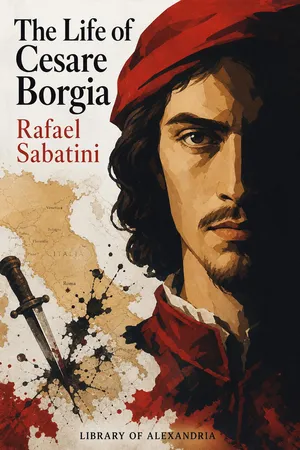
Was he a ruthless opportunist, a gifted ruler, or a man obscured by his own legend? Cesare Borgia's career brings the dangerous politics of Renaissance Italy into sharp focus.
In The Life of Cesare Borgia, Rafael Sabatini follows the son of Pope Alexander VI from his ecclesiastical career to his emergence as a military and political force. His campaigns in the Romagna, his dependence on papal influence, and his shifting alliances reveal a world in which family ambition and affairs of state were inseparable.
Sabatini does more than recount a notorious career: he questions the accusations and inherited judgments that shaped Borgia's reputation. His sympathetic approach invites readers to distinguish evidence from scandal while confronting the violence and calculation of Renaissance statecraft. The result is both a historical biography and an argument about how reputations are made. Borgia's importance to Machiavelli's The Prince gives the story an enduring connection to debates about leadership, necessity, and moral compromise.
What readers find inside:
- From Cardinal to Commander - Borgia's changing career reveals the close ties between church office, family influence, and military ambition.
- Papal Politics - Alexander VI's position forms a crucial foundation for his son's pursuit of power.
- The Romagna Campaigns - Territorial conquest brings the practical demands of rule and warfare into view.
- A Contested Reputation - Sabatini challenges familiar charges and asks how hostile testimony should be weighed.
- Machiavelli's Example - Borgia's methods illuminate the political questions that made him a lasting presence in The Prince.
For readers of Renaissance history, political biography, and accounts of the papacy, this is a compelling encounter with a figure whose achievements and alleged crimes remain difficult to separate.
Enter Renaissance Italy and follow the ascent and collapse of a power built on ambition, alliances, and opportunity.