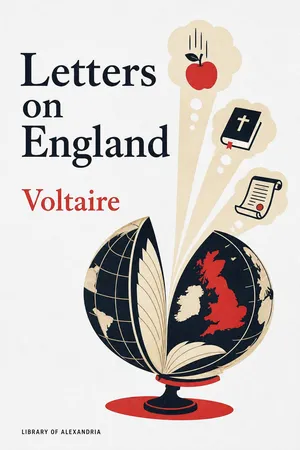
What can a country learn by looking at its neighbour? For Voltaire, British society offered a powerful way to question the habits and authorities of France.
In Letters on England, also known as Philosophical Letters, Voltaire draws on his stay in England to examine religious belief, political institutions, commerce, science, and literature. His subjects range from Quaker practices and religious diversity to Locke's philosophy and Newton's discoveries. Each encounter becomes an opportunity to ask why some ideas flourish while others are held back by custom, censorship, or established power.
Written in the eighteenth century, these essays bring the Enlightenment into sharp focus without turning it into an abstract system. Voltaire's admiration for English institutions doubles as a pointed criticism of French absolutism and intolerance. His wit, comparisons, and appetite for intellectual argument give the work its lasting energy: it invites readers to test inherited assumptions against experience and to consider how a society treats those who think differently.
What readers find inside:
- Religious tolerance - Observations on Quakers and other religious communities explore the relationship between belief and coexistence.
- Government and liberty - British political arrangements provide a contrast to the concentration of royal power in France.
- Science and reason - Newton's achievements show the importance Voltaire places on inquiry and discovery.
- Locke and knowledge - English philosophy opens questions about experience, understanding, and the limits of human certainty.
- Literature and criticism - Reflections on English writing reveal a critic willing to challenge national tastes as well as political habits.
This is rewarding reading for newcomers to Enlightenment philosophy, readers of political and cultural essays, and anyone interested in the history of religious tolerance. Its questions about authority and intellectual independence remain worth debating.
Begin with Voltaire's curious, questioning gaze and discover how looking abroad can change the way we see home.