What kind of thing is something-and what can we truly say about it? Aristotle turns these ordinary questions into a searching inquiry into language and reality.
The Categories examines the basic ways we describe what exists. Aristotle distinguishes individual things from what can be said of them, giving substance a central place in his account. A particular person or horse, for example, is considered differently from a quality it possesses or a relation in which it stands. These distinctions connect familiar speech with fundamental questions about being.
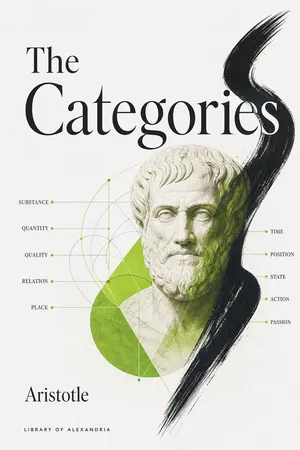
Traditionally placed at the beginning of Aristotle's logical works, this short treatise sets out ten categories, including substance, quantity, quality, relation, place, and time. It also considers opposition, priority, and change. Its lasting interest lies not simply in its scheme of classification, but in the careful habits of thought it encourages: separating a thing from its attributes, noticing different meanings, and asking precisely what a statement asserts. Those questions remain alive in philosophy, language, and debates about how knowledge is organized.
What readers find inside:
- Substance and Attributes - Aristotle distinguishes individual beings from the characteristics that belong to them.
- Ten Basic Divisions - The treatise explores different kinds of predicates, from quantity and quality to action and being acted upon.
- Words and Things - Distinctions in naming and definition reveal why similar expressions need not mean the same thing.
- Relations and Opposites - Discussions of comparison and opposition sharpen the differences between several kinds of claims.
- Foundations of Inquiry - The work brings logic and metaphysics together through close attention to what can be said about a subject.
For students of ancient Greek philosophy, readers interested in logic and language, and curious thinkers drawn to the structure of everyday reasoning, this is a compact encounter with enduring philosophical problems.
Begin with Aristotle's basic distinctions and discover how much there is to question in the simplest statement.