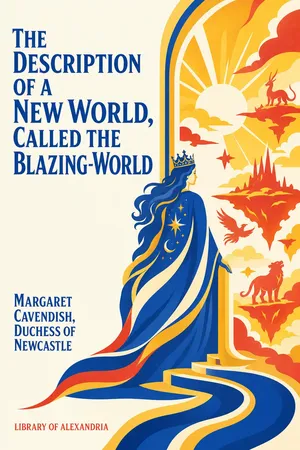
What if entering another universe gave a woman the power to reshape knowledge and government? A seventeenth-century imagination makes that question startlingly alive.
Margaret Cavendish's The Description of a New World, Called the Blazing-World follows a young woman carried into a strange realm connected to her own world at the pole. There she becomes empress of a society populated by animal-like peoples whose different forms accompany different fields of learning. Her inquiries into nature, religion, and political order turn an extraordinary voyage into an experiment in how a world might be understood and ruled.
First published in 1666, this early work of science fiction brings together utopian invention, philosophical debate, and fantastic adventure. Cavendish gives a woman commanding authority in intellectual and political life while also exploring the attractions and tensions of absolute power. The result is not a simple blueprint for an ideal society, but an inventive encounter with scientific disagreement, sovereignty, and the mind's capacity to construct worlds of its own.
What readers find inside:
- An empress's authority - A female ruler directs inquiries and makes decisions at the center of an imagined political order.
- Fantastic societies - Animal-like inhabitants make the unfamiliar realm a setting for both wonder and intellectual debate.
- Science under scrutiny - Questions about observation, instruments, and competing explanations expose the uncertainties of knowledge.
- World-making imagination - Fantasy becomes a way to test philosophical ideas and consider the scope of creative power.
- Gender and sovereignty - The story places female intellectual ambition alongside enduring questions about monarchy and obedience.
A rewarding choice for readers of early science fiction, feminist literary classics, and philosophical fantasy, this unusual work offers a direct encounter with an imagination unwilling to accept the limits imposed on it.
Enter Cavendish's extraordinary realm and discover how boldly an imagined universe can question our own.