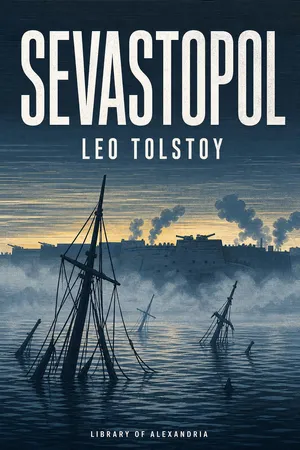
What does courage look like when no one is watching? In a city under siege, Tolstoy finds answers far removed from the glory of official reports.
Drawing on his own service as an artillery officer during the Crimean War, Leo Tolstoy brings readers into the hospitals, streets, and defensive bastions of Sevastopol. Its three sketches move from December 1854 through May and August 1855, tracing both the ordeal of the besieged port and the inner lives of those fighting to hold it. The result blends eyewitness observation with fiction to reveal war at its most intimate and unsettling.
The December sketch leads readers from the harbor into hospital wards and onto the fourth bastion. May turns a sharply ironic eye on officers whose ambition and vanity complicate their ideas of bravery. August follows the brothers Mikhail Kozeltzoff and Volodya as the siege approaches its devastating conclusion. Throughout, Tolstoy measures patriotic language against bodily suffering, private fear, and the quiet endurance of ordinary soldiers. His attention to self-deception and conflicting motives makes these early stories compelling explorations of human behavior under extreme pressure.
What readers find inside:
- A besieged city - Three connected sketches depict Sevastopol at different stages of the Crimean War.
- Battlefield realities - Hospital scenes and battered defenses strip away romantic notions of combat.
- Courage and vanity - Officers and soldiers expose the gap between public displays of bravery and private experience.
- Two brothers - Mikhail and Volodya bring contrasting perspectives to the siege's final days.
- Psychological realism - Fear, pride, duty, and compassion emerge through close observation of thought and action.
For readers of classic Russian fiction, military literature, and stories that question the human cost of war, this is an absorbing encounter with Tolstoy's developing art.
Step inside the besieged city and discover the people behind the language of battle.