eBook - ePub
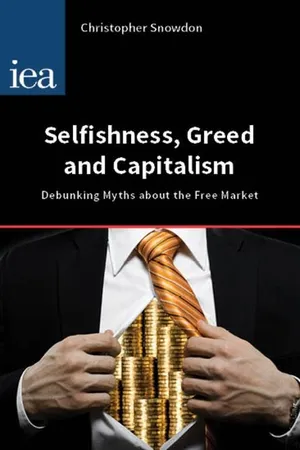
Selfishness, Greed and Capitalism
Debunking Myths about the Free Market
- 230 pages
- English
- ePUB (mobile friendly)
- Available on iOS & Android
eBook - ePub
About this book
This IEA publication deals head-on with a number of widely quoted myths about the market economy. In the case of the philosophical myths, such as the idea that economists believe that everybody is greedy, the author, Christopher Snowdon, carefully and entertainingly unpicks the misguided ideas that have taken hold. The author then moves on and effectively disposes of a number of economic myths using empirical evidence that is often ignored by commentators.
Information
Print ISBN
9780255366779
Edition
1Part 1
The Straw Men
1. Capitalism relies on greed and selfishness
In his best-selling book 23 Things They Don’t Tell You About Capitalism, Ha-Joon Chang says that free-market economists regard people as ‘tunnel-visioned self-seeking robots’, ‘totally selfish’ and ‘selfish, amoral agents’ (Chang 2010: 46, 47, 50). ‘Free-market ideology,’ he claims, ‘is built on the belief that people won’t do anything “good” unless they are paid for it or punished for not doing it’ (255). Richard Murphy, who bills himself as the UK’s number one economics blogger, claims that economists assume people to be entirely self-interested and that their self-interest manifests itself in the desire for ever-greater consumption of material goods. He says that economics, as taught in schools and universities, is ‘predicated on the belief that human beings’ behaviour is solely focused on maximising their own individual returns; that businesses maximise their profit and that everything that indicates success in life depends on consuming more’ (Murphy 2011: 12).
If this is a fair representation of what economics is all about, economics is obviously flawed. We can all readily think of acts of altruism which contradict the theory of total selfishness, and none of us feel that we are wholly driven by consumerism. If free-market economics is based on the belief that everybody is relentlessly greedy all the time, it is not just simplistic but wrong. Chang (2010: 255) writes:
People are not as much propelled by material self-interest as free-market textbooks claim. If the real world were as full of rational self-seeking agents as the one depicted in those textbooks, it would collapse under the weight of continuous cheating, monitoring, punishment and bargaining.
The task of debunking free-market economics is therefore an easy one. If economists believe that everybody is selfish and greedy all the time, it only requires a few examples of selflessness and altruism to undermine the entire field. The problem is that they do not believe that.
Incentives and the invisible hand
The straw man claim made by critics of the free market comes in two parts. Firstly, that economists believe that everybody is utterly selfish and, secondly, that capitalism requires people to be utterly selfish.
On the first point, Chang argues that ‘Free market economics starts from the assumption that all economic agents are selfish, as summed up in Adam Smith’s assessment of the butcher, the brewer and the baker’ (Chang 2010: 43). This is a reference to the famous line in Adam Smith’s The Wealth of Nations (1776): ‘It is not from the benevolence of the butcher, the brewer, or the baker that we expect our dinner, but from their regard of their own interest’ (Smith 1957: 13).1 It is questionable whether someone who does not want to work for free is ‘selfish’, as Chang puts it, and it is puzzling why Smith’s obvious truism should invite scorn. It is surely self-evident that butchers, brewers and bakers do not supply us with their products out of the goodness of their hearts. ‘[M]an has almost constant occasion for the help of others,’ wrote Smith, but ‘it is vain for him to expect it from their benevolence only’ (Smith 1957: 13).
In normal economic transactions, we expect each party to seek an outcome that benefits them, but this does not imply that people are entirely self-interested when they are not making economic transactions (such as spending time with friends and family), nor does it imply that altruistic behaviour such as giving to charity is abnormal. Like Chang, many critics of capitalism use ‘self-interest’ and ‘selfishness’ (or ‘greed’) interchangeably, but they are quite different. Selfishness implies indulging oneself at another’s expense, but free-market transactions only take place when two self-interested parties see a mutual benefit.
Self-interest should not be conflated with avarice. If I decide to have apple juice instead of orange juice with my breakfast I am acting in my self-interest, but unless I snatch it from a thirsty child I can hardly be accused of selfishness. Neither is taking a holiday or an education course generally selfish, but these things may still be a legitimate pursuit of self-interest. The desire to fulfil wants and needs in no way implies greed. Adam Smith wrote of the ‘uniform, constant, and uninterrupted effort of every man to better his condition’ (Smith 1957: 306). Self-interest can mean wanting to provide a better life for ourselves and our families, but it can encompass altruism and a host of non-financial ambitions.
Many argue that self-interest should not be seen in purely economic terms, but, instead, as a broader term to describe our goals and aspirations. Milton and Rose Friedman, for example, wrote (Friedman and Friedman 1980: 27):
Narrow preoccupation with the economic market has led to a narrow interpretation of self-interest as myopic selfishness, as exclusive concern with immediate material rewards. Economics has been berated for allegedly drawing far-reaching conclusions from a wholly unrealistic ‘economic man’ who is little more than a calculating machine, responding only to monetary stimuli. That is a great mistake. Self-interest is not myopic selfishness. It is whatever it is that interests the participants, whatever they value, whatever goals they pursue. The scientist seeking to advance the frontiers of his discipline, the missionary seeking to convert infidels to the true faith, the philanthropist seeking to bring comfort to the needy – all are pursuing their interests, as they see them, as they judge them by their own values.
Adam Smith never suggested that financial self-interest is, or ought to be, our sole motivation in life. He taught philosophy at the University of Edinburgh and wrote at length about ethics and altruism. In his earlier book The Theory of Moral Sentiments,2 Smith expanded on his view that humans were profoundly driven by empathy for their fellow man (Smith 1759: 1):
How selfish soever man may be supposed, there are evidently some principles in his nature, which interest him in the fortune of others, and render their happiness necessary to him, though he derives nothing from it, except the pleasure of seeing it.
Anyone familiar with Smith’s life and work knows that he was by no means entirely driven by financial self-interest, nor did he assume that anybody else was. He was acutely aware that there was more to life than material possessions and he wrote a whole book about it, but The Wealth of Nations is not that book. The Wealth of Nations is about economics, and financial self-interest cannot be ignored in a book about economics. The fundamental aim of any business is to turn a profit. The butcher might occasionally give a day’s takings to charity and the baker may sometimes offer a loaf for free, but altruism of this sort cannot be the core activity of a business and they are not assumptions upon which a sound economic theory can be based.
The crucial point is that in a free market it makes no difference whether the entrepreneur is impeccably well-intentioned or unashamedly self-serving. Introducing the famous phrase ‘the invisible hand’, Smith (1957: 400) wrote:
by directing that industry in such a manner as its produce may be of the greatest value, he intends only his own gain, and he is in this, as in many other cases, led by an invisible hand to promote an end which was no part of his intention.
Here are two of Smith’s key lessons. Firstly, that each person can best pursue their own interests by serving the interests of others – there is no need for force or central planning. By pursuing ‘his own gain’, the individual adds value to the economy and benefits his fellow man. The benefits extend to people he has never met and whose company he may not enjoy. The self-interest of the butcher and the brewer makes life easier for those who do not want to slaughter their own livestock and make their own beer. The butcher does not have to go to the trouble of baking his own bread, and the baker can use the profit he makes to buy from the brewer. The profit motive ensures a supply of bread, meat and beer at a lower cost and of a better quality than each worker could provide for himself.
The second lesson is that these mutual benefits come about despite the individual being an unwitting and unconscious player. The profit motive provides incentives for people to do good even when they are not trying to. A selfish and uncharitable entrepreneur can benefit society by meeting the wants and needs of his customers. Indeed, he will have to meet their wants and needs if he is to prosper in business. He may understand the laws of economics or may be totally ignorant, but so long as he labours for himself, he ‘necessarily labours to render the annual revenue of the society as great as he can’ even though he ‘neither intends to promote the public interest, nor knows how much he is promoting it.’
Smith’s great heresy was to show that there is nothing grubby or disreputable about selling at a profit. Friedrich Hayek believed that Smith’s ideas ‘offended a deeply ingrained instinct that man … should aim at doing a visible good to his known fellows (the “neighbour” of the Bible). These are the feelings that still, under the name of “social justice”, govern all socialist demands and easily engage the sympathies of all good men, but which are irreconcilable with the open society to which today all the inhabitants of the West owe the general level of their wealth’ (Hayek 1991: 118). Today, even those critics who concede that capitalism successfully creates growth and prosperity retain their disgust at the mechanism of self-interest that drives it. Skidelsky and Skidelsky (2012: 5), for example, complain that ‘the present system relies on motives of greed and acquisitiveness, which are morally repugnant.’
Many people find it incongruous that noble ends can result from ignoble – or at least morally neutral – motives. ‘The public has severe doubts about how much it can count on profit-seeking business to produce socially beneficial outcomes,’ writes Bryan Caplan. ‘They focus on the motives of business, and neglect the discipline imposed by competition’ (Caplan 2007: 30; emphasis in the original). The observation that man can help others by helping himself is easily mistaken for a celebration of greed and selfishness. And since greed is morally objectionable, nothing good should come of it – the best intentions should result in the best outcomes. But Smith showed this to be untrue. Not only did those who worked for profit often do good for society, but those who professed to be working for society often did ill. ‘I have never known much good done by those who affected to trade for the public good,’ he wrote (Smith 1957: 400). The reasons for this are discussed in the next chapter.
In short, the pursuit of self-interest is not the same as greed. The brewer, the baker and the butcher may not be providing beer, meat and bread motivated by the needs of others. However, there is nothing grubby, ignoble or even necessarily greedy about pursuing a business or career to provide for one’s...
Table of contents
- The author
- Foreword
- Preface
- Summary
- Part 1
- 1. Capitalism relies on greed and selfishness
- 2. Economists believe people are perfectly rational
- 3. Economists think GDP is all that matters
- 4. Economists think we live in a free market
- Part 2
- 5. The rich get richer and the poor get poorer
- 6. We are working ever longer hours
- 7. Rich countries will not benefit from more economic growth
- 8. There is a paradox of prosperity
- 9. Inequality is rising in Britain
- 10. Inequality is the cause of health and social problems
- 11. If you’re born poor, you die poor
- References
- About the IEA
Trusted by 375,005 students
Access to over 1.5 million titles for a fair monthly price.
Study more efficiently using our study tools.