eBook - ePub
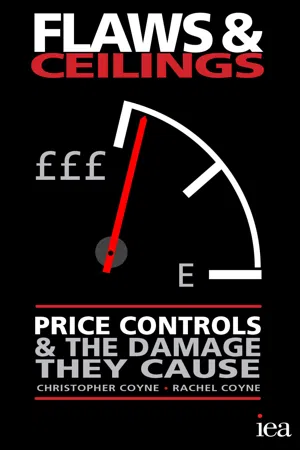
Flaws and Ceilings
Price Controls and the Damage They Cause
- 224 pages
- English
- ePUB (mobile friendly)
- Available on iOS & Android
eBook - ePub
Flaws and Ceilings
Price Controls and the Damage They Cause
About this book
Price controls across many sectors are currently being hotly debated. New controls in the housing market, more onerous minimum wages, minimum prices for alcohol, and freezes on energy prices are very high up the agenda of most politicians at the moment. Even without any further controls, wages, university fees, railway fares and many financial products already have their prices at least partly determined by politicians rather than by supply and demand in the market. Indeed, barely a sector of the UK economy is unaffected in one way or another by government controls on prices. This book demonstrates why economists do not like price controls and shows why they are widely regarded as being amongst the most damaging political interventions in markets. The authors analyse, in a very readable fashion, the damage they cause. Crucially, the authors also explain why, despite universal criticism from economists, price controls are so popular amongst politicians.
Information
Edition
1Table of contents
- The authors
- Foreword
- Summary
- 1. Introduction
- 2. The economics of price controls
- 3. Price ceilings: ancient and modern
- 4. The simple economics of wage floors
- 5. The flaws in rent ceilings
- 6. Energy price caps
- 7. Regulation of rail fares
- 8. Price ceilings in financial markets
- 9. University price controls
- 10. Minimum unit pricing
- About the IEA
Trusted by 375,005 students
Access to over 1.5 million titles for a fair monthly price.
Study more efficiently using our study tools.