- 190 pages
- English
- ePUB (mobile friendly)
- Available on iOS & Android
eBook - ePub
About this book
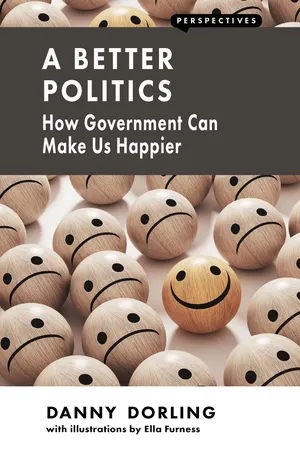
The aim of this book is to inspire a better politics: one that will enable future generations to be happier. Greater well-being and better health should be the goals, rather than wealth maximization. We need to value healthcare more than hedge funds, caring above careers, relationships more than real estate. The book is about what makes most of us happier, but it is also about the collective good. We cannot truly be happy if those around us are not happy. The evidence for a successful politics that would promote happiness and health is examined, and policies that take account of this evidence are suggested. Government can and should work to make us happier.
Trusted by 375,005 students
Access to over 1.5 million titles for a fair monthly price.
Study more efficiently using our study tools.
Information
Publisher
London Publishing PartnershipYear
2016Print ISBN
9781907994531
Edition
1eBook ISBN
9781907994548
Chapter 1
Introduction
To make a real difference we need to shift common sense, change the terms of debate and shape a new political terrain.
The aim of this book is to inspire a better politics: one that will enable future generations to be happier, with goals of greater well-being and better health, rather than wealth maximization. Happiness does not mean being ecstatic: it is the avoidance of misery, the gaining of long-term life satisfaction, the feeling of fulfilment, of worth, of kindness, of usefulness and of love. We need new measures of what matters most to us.
The book is also about ‘the collective good’. We cannot truly be happy if those around us are not happy. Not just our family and friends, but our fellow citizens, whose lives are entwined with ours and will affect us for good or ill at some point. This book looks at evidence and suggests policies that take account of that evidence. We live in an information-rich, ‘scientific’ world, but this is a recent phenomenon. Yet while we might not fully understand climate change or subatomic physics, we should now find it easier to understand what makes us happy; and we can also compare ourselves with other nations on key measures of health and well-being.
Politicians often say that they are addressing the issues that matter most to people. But they rely on opinion surveys in which the questions have been predetermined. What have people themselves said, unprompted, about what is most important to them or their family? How do their answers relate to how happy and healthy those same people are?
Being happy is not the be-all and end-all, but it’s better to be happier if you can. Politicians often promise that if they are elected they will ensure that the electorate will be ‘better off’ than if the other lot are elected; but do politicians actually know what it is that makes people happy? Other academics have approached this question in many very different ways.4
This book begins with statistical evidence from a scientific paper. Yet although almost all of the facts presented in these pages are referenced, it is not a research-based volume. Instead, this book is a collection of ideas – based mostly on the work of others, including much readily available evidence – on what policies could best safeguard us (better than current policies) from what the evidence indicates harms us the most.
Before going any further, why might you want to consider the arguments and evidence presented in this book? One reason is that, while it isn’t exactly a new phenomenon, inequality in our society is getting worse – particularly when we look at the growing gap between the very wealthy and the rest, including those with least. This matters because it appears that growing inequality can make it harder to enact the policies that could most improve our happiness.
When it was first observed that despite rising average material wealth, people were not happier than their parents had been, researchers in economics – not in psychology, sociology or politics – began to ask why. Recently, many economists have pointed out that old economic growth models, those used by both the left and the right, were failing.5 The new models concern findings that could not have been made a generation ago, because then it was true that well-being was generally increased by having more material goods. A generation ago, what people needed above all else was a good enough home to live in and the means to be able to keep it warm. A generation or so before that, most people in the UK did not have spare clothes, or enough money to eat well most of the time. In our generation, many of us eat too much. Most people, although far from all, now have enough.
Recent research has shown that now, living in a country with higher levels of well-organized collective spending produces a happier population; and that when countries are compared, public policies such as social insurance and employment protection are among the most important factors in predicting well-being among citizens. This may come as a surprise if you think that being taxed as little as possible is what gives people the most economic freedom and leads to them enjoying ‘life, liberty and the pursuit of happiness’ to the fullest. It is worth reflecting that Thomas Jefferson wrote those famous words into the American Constitution. Many believe that he took inspiration for this from John Locke, who had written, in his ‘Essay concerning human understanding’, that ‘The highest perfection of intellectual nature lies in a careful and constant pursuit of true and solid happiness.’
Economist Benjamin Radcliff summarized his research findings on this for an American audience:
The differences in your feeling of well-being living in a Scandinavian country (where welfare programs are large) versus the US are going to be larger than the individual factors in your life. The political differences trump all the individual things you’re supposed to do to make yourself happier – to have fulfilling personal relationships, to have a job, to have more income. The political factors swamp all those individual factors. Countries with high levels of gross domestic product consumed by government have higher levels of personal satisfaction.6
Radcliff is correct about the correlations when happiness is measured carefully,7 but of course people do not wake up each day and check how much their government spends and feel happier if taxation and public spending is higher. Living in better-organized (and often higher-taxing) countries makes leading our personal lives easier, allows us to get on with our families, and with other people more widely. (Although there are also societies where overall taxation is lower but where income inequality is lower and well-being is higher than in the UK.8)
Until recently, economists’ models have maximized what they call ‘utility’: the satisfaction achieved from the consumption of a good or service given individual preferences. However, a growing number of economists have, in the last twenty years, started looking at happiness instead.9 Before the 2008 crash, some leading economists began arguing that there were things that were much more important to life and well-being than money. For example, Ann Pettifor10 and Anastasia Nesvetailova11 foresaw the turmoil to come in 2008 and argued that there was a need for new understanding in economics. That new understanding should include a better appreciation of happiness.
Alois Stutzer and Bruno Frey have recently shown that people in more consumerist societies are likely to overestimate how much enjoyment they will gain from the goods they consume, and they discount the harm working too many hours and commuting too much will cause them. As Stutzer and Frey put it, ‘suboptimal choices result’.12 Even more recently, John Helliwell has shown that environmental sustainability depends on well-being:
If people really are happier working together for a worthy purpose, this exposes a multitude of win–win solutions to material problems, thereby building community while meeting material needs.13
This new thinking has wide-reaching implications. It has emerged because we are so much better off, in material ways, than our parents were – and yet no happier.
As happiness economics is based on relating well-being to other life events, economists Gus O’Donnell and Andrew Oswald have recently explained that the new economic research has:
one strength that may not be completely recognized by all economists. People are not asked how much one thing makes them happy compared to another. Deeply complicated cause-and-effect survey questions are thereby largely eschewed, and that is an advantage.14
You do not ask people what they think makes them happy, but instead observe how their levels of happiness change and try to associate that with other changes in their lives at that time.
This book is heavily influenced by happiness economics, but I am not an economist and so it also uses a wider range of sources from the social sciences, humanities and sciences, and includes many examples from current affairs. To present consistent evidence, results from a single survey of happiness are referred to, but it is important to recognize the much wider context to this work. Many recent studies point in similar directions. The sense that it is time we measured success differently is infectious. On 28 June 2012, the General Assembly of the United Nations agreed to pass resolution A/RES/66/281, which states that:
The General Assembly, … Conscious that the pursuit of happiness is a fundamental human goal, … Recognizing also the need for a more inclusive, equitable and balanced approach to economic growth that promotes sustainable development, poverty eradication, happiness and the well-being of all peoples, decides to proclaim 20 March the International Day of Happiness.15
Thomas Jefferson might have approved.
So what does promote happiness? To try to answer this question, in 2006 a colleague and I investigated some data about what is most important to people, and how that might relate to their health and happiness. More recent work by others suggests that what we found a decade ago continues to hold true.16 In Britain, a large household panel study has been conducted annually for the past twenty-five years. In four of those years (September 1992 to December 1995) an unu...
Table of contents
- Foreword
- Chapter 1
- Endnotes
Frequently asked questions
Yes, you can cancel anytime from the Subscription tab in your account settings on the Perlego website. Your subscription will stay active until the end of your current billing period. Learn how to cancel your subscription
No, books cannot be downloaded as external files, such as PDFs, for use outside of Perlego. However, you can download books within the Perlego app for offline reading on mobile or tablet. Learn how to download books offline
Perlego offers two plans: Essential and Complete
- Essential is ideal for learners and professionals who enjoy exploring a wide range of subjects. Access the Essential Library with 800,000+ trusted titles and best-sellers across business, personal growth, and the humanities. Includes unlimited reading time and Standard Read Aloud voice.
- Complete: Perfect for advanced learners and researchers needing full, unrestricted access. Unlock 1.5M+ books across hundreds of subjects, including academic and specialized titles. The Complete Plan also includes advanced features like Premium Read Aloud and Research Assistant.
We are an online textbook subscription service, where you can get access to an entire online library for less than the price of a single book per month. With over 1.5 million books across 990+ topics, we’ve got you covered! Learn about our mission
Look out for the read-aloud symbol on your next book to see if you can listen to it. The read-aloud tool reads text aloud for you, highlighting the text as it is being read. You can pause it, speed it up and slow it down. Learn more about Read Aloud
Yes! You can use the Perlego app on both iOS and Android devices to read anytime, anywhere — even offline. Perfect for commutes or when you’re on the go.
Please note we cannot support devices running on iOS 13 and Android 7 or earlier. Learn more about using the app
Please note we cannot support devices running on iOS 13 and Android 7 or earlier. Learn more about using the app
Yes, you can access A Better Politics by Danny Dorling,Ella Furness in PDF and/or ePUB format, as well as other popular books in Politics & International Relations & Economic Policy. We have over 1.5 million books available in our catalogue for you to explore.