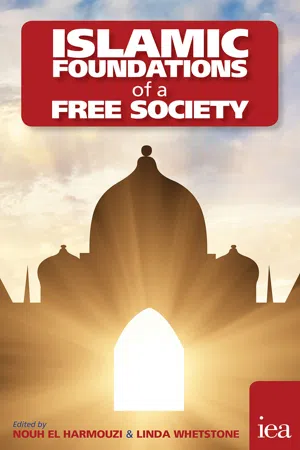
Islam is growing rapidly both in its traditional homelands and in the West. Some in the West view Islam with a mixture of fear and suspicion. However, it is also fair to say that there is widespread ignorance about Islam, and especially about its relationship to political systems and the economy. Is Islam compatible with a free society and a free economy? Is the fact that many Muslim-majority states do not have free economies or polities a result of an incompatibility between Islam and political and economic freedom, or does it result from an unfortunate series of historical events? What role has past colonialism played in encouraging Muslim extremism? Exactly what does Islam have to say about freedom in economic, political and religious life?This book, written by a range of Islamic scholars, sheds a great deal of light on these crucial questions. It is an important book for those in the West who need to understand Islam better. It is also important for those in Muslim countries who can influence the development of political systems and economic policy. The publication of this book could not be more timely.
eBook - PDF
Islamic Foundations of a Free Society
- 212 pages
- English
- PDF
- Available on iOS & Android
eBook - PDF
Islamic Foundations of a Free Society
About this book
Information
Edition
1Table of contents
- _GoBack
- Box 1 The Sunni–Shiite division
- Table 1 2014 Global Innovation Index: top 3 and selected OIC member states
- Table 2 Global Gender Gap Index (GGI) data for selected MENA countries
- Figure 1 Performance of selected OIC member states in HDI and top three performers (2015)
- Figure 2 Female and male labour force participation across MENA
- The authors
- Foreword
- Acknowledgement
- Tables, figures and boxes
- 1 Introduction
- Kathya Berrada and Nouh El Harmouzi
- The contributions of the authors
- 2 The condition of social, political and economic thinking in the Islamic world from a classical liberal perspective
- Atilla Yayla and Bican Şahin
- Freedom, religion and Islam
- Can Islam as a religion be separate from politics?
- The current situation of social, political and economic thought in Islamic countries
- What are the most basic errors in Muslim thought now and how can they be changed?
- Conclusion
- References
- 3 Reason versus tradition, free will versus fate, interpretation versus literalism: intellectual underpinnings of the negative outlook for the Muslim world
- Mustafa Acar
- Introduction
- Miserable outlook of the Muslim world: poverty within abundance?
- Political and intellectual reasons behind the poor performance of Muslim countries
- Main schools of thought in the Muslim world
- Reason versus tradition, Ra’y versus Hadith, free will versus fate, interpretation versus literalism
- Intellectual conflicts with political roots and implications
- Conclusion: destructive consequences of the conflict between reason and tradition
- References
- 4 Welfare beyond the state: ‘ihsani’ societal-based welfare
- Maszlee Malik
- Introduction
- Functioning individuals and ihsani social capital
- A benevolent society as an alternative to the state as provider
- Welfare through waqfs
- The nationalisation of society: can waqfs be revived?
- An effective minimal state
- Conclusion
- References
- 5 The individual, freedom of choice and tolerance in the Quran
- Azhar Aslam
- The individual in the Quran
- Freedom of individual action and choice in the Quran
- No compulsion
- Subtexts
- The Prophet’s Sunna
- Islam and the state
- Tolerance and the present-day state of Muslim societies
- Apostasy
- Conclusion
- References
- 6 Economic freedom: the path to women’s emancipation in the Middle East and North Africa (MENA) region
- Souad Adnane
- Women in development versus gender and development: implications for policy making in the Arab world
- The economic participation of women in the MENA region
- Market-friendly policies and their potential for advancing the position of women in the Arab world
- Gender-sensitive and market-friendly policies: the way forward
- Women’s economic participation in Islam
- Conclusion
- References
- 7 Jihad and political change: a perspective based on Quranic sources
- M. A. Muqtedar Khan
- Colonialism and post-colonialism
- Peace, non-violence and the difficulty of meaningful change
- Jihad for change
- Conflicts in the Islamic world
- The Quran and the way to peace
- Conclusion
- References
- 8 Islam and politics today: the reasons for the rise of jihadism
- Hasan Yücel Başdemir
- The problem
- The political experiences of the Prophet Muhammad and his followers
- Characteristics of the early period state model
- Politics as part of Sharia
- Colonisation and the birth of modern Islamic movements
- From Pan-Islamism to jihadism
- The roots of jihadism and its birth
- The pioneers of the idea of jihadism
- Living out Islam in a free society
- References
- 9 Islam and a free-market economy: are they compatible?
- Hicham El Moussaoui
- The foundations of Islam and a free-market economy are not incompatible
- Explaining the deviation from the pro-market tradition of Islam
- Conclusion
- References
- 10 Islamic finance: between the reality and the ideal
- Youcef Maouchi
- Introduction
- Islamic finance: an overview
- The origins of Islamic finance: the Sharia
- The ideal of Islamic finance
- The reality takes over from the ideal
- Bringing Islamic finance back on track
- Conclusion
- References
- About the IEA
Trusted by 375,005 students
Access to over 1.5 million titles for a fair monthly price.
Study more efficiently using our study tools.