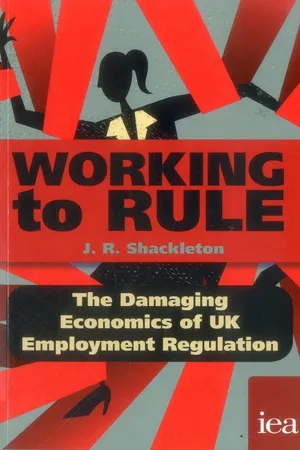
Employment regulation has been growing rapidly. This has not exclusively, or even mainly, come from the European Union. Recent UK governments have added such significant new measures as the National Living Wage, workplace pensions and the Apprenticeship Levy. The costs of such regulation are frequently assumed – by both advocates and opponents – to fall on business profits. This isn't so, except in the very short run. They are instead transferred in part to consumers, but mainly to employees themselves. Mandated benefits – longer holidays or extended maternity leave – mean reduced pay growth and fewer job opportunities. Anti-discrimination laws lead to fewer openings for disadvantaged groups, while employment protection legislation worsens job prospects for the young. Excessive regulation acts as a barrier to entry, shielding incumbents and deterring the foundation of new enterprises. Attempts to restrict new types of employment in the 'gig' economy are counterproductive, serving 'insiders' at the expense of 'outsiders'. This book combines a history of employment laws with detailed analysis of the troublesome effects of various interventions. The author argues for a fundamental rethink. Some basic labour market regulation may still be necessary, but far less than we currently have.
- 284 pages
- English
- ePUB (mobile friendly)
- Available on iOS & Android
eBook - ePub
About this book
Information
Edition
1PART 1
Ideas
- IntroductionBack when trade unions were a power in the land, a phrase activists often bandied around was ‘working to rule’. In a dispute, unions might avoid a strike (and thus lost pay) but still put pressure on management by insisting on a literal reading of contractual rules. UK employers found their room for manoeuvre and innovation was substantially reduced, and productivity was held back.Those days are gone, but in a different sense we are all ‘working to rule’ today: the state places myriad restrictions on the freedom of employers and workers to form contractual arrangements and to change them as economic circumstances alter.Governments seem unable to stop intervening in labour markets. Some such regulation may be beneficial to individuals or groups, and even where there are obvious downsides it may be a reasonable judgement that the benefits of particular interventions outweigh their costs. However, regulation can be carried much further than is economically sensible. Despite occasional acknowledgment that excessive regulation can choke off enterprise and reduce job opportunities – as the current high rates of unemployment in many continental European countries demonstrate – our political classes show no sign of letting this inhibit proposals for further intervention.The recent recession and its labour market consequences have encouraged politicians of all parties, in their never-ending search for scapegoats and easy solutions, to propose further restrictions on employers and employees. The EU referendum result seems to have added further fuel to the fire. In the last few years we have seen legislation or proposals to raise minimum wage rates, put ceilings on company executive and public sector pay, eliminate zero-hours contracts, extend flexible working arrangements, add worker representatives to boards, give longer and better-paid parental leave, impose stronger equality obligations, require firms to pay an apprenticeship levy, provide automatic access to pension schemes and prioritise British workers over those from other countries.This book outlines the historical development of labour market regulation, offers a primer on the UK’s current employment legislation and examines economic theory and international evidence on the effects of different types of intervention.I argue that policymakers often misunderstand the situations which they attempt to regulate. Their interventions do not always benefit those they are intended to help. They have unforeseen and often undesirable consequences, and are usually more costly to implement than anticipated. Compliance is difficult, expensive and in some cases impossible fully to achieve. Loosely drafted legislation increases uncertainty and encourages litigation. The effect may be to reduce overall wages and employment, raise prices, discourage innovation and inhibit economic growth, while particularly penalising young people and others on the fringes of the labour market.But it should also be emphasised that, apart from a narrowly economic calculus, many forms of regulation raise important issues about individual freedom to pursue legitimate personal and societal goals, to enter occupations or to start businesses, and to make use of individual and collective assets in preferred ways.Although there is a classical liberal case – which I will discuss – for complete freedom of contract, few now argue that there should be no employment regulation at all. So we need to go beyond a black-and-white interpretation of government involvement. I therefore attempt to identify what is necessary and what is unnecessary. Recognising that much current legislation – though less than many imagine – ultimately derives from the European Commission, I consider the implications of Brexit for future policy.The problemIn order for people to be able to get jobs, somebody must create opportunities for work. In order for the number of jobs to grow as the population expands, most of this expansion has to come from the private sector,1 primarily from firms and individuals who see employing others2 as a means of generating output which can be sold at a profit sufficient to justify their investment and supervisory commitment. Historically, this has required access to capital, a flair for spotting opportunities to sell goods and services, and the drive and ability to recruit, organise and motivate employees to assist in this endeavour. For their part, potential employees must be able and motivated to supply their skills and effort for an employer whose interests, while different from their own, make mutually beneficial ‘trade’ possible in the labour market.These factors still matter very much. Under modern conditions, however, they are often insufficient. Labour markets have always been regulated, as I shall show, to some degree. But in the last fifty years the range and extent of regulation in the UK has continually expanded. For motives which at first glance seem unimpeachable, governments have laid down conditions under which employment can or cannot take place, and have placed a huge variety of obligations and prohibitions on employers and a significant amount on employees. They have also imposed taxes and other financial imposts on both parties.Potential employers, therefore, nowadays have a complex maze of regulations to navigate when offering employment. Moreover, the effects of government interventions are often poorly understood by the general public. Their alleged benefits are extolled by headline-grabbing politicians, while even the more predictable costs are downplayed. The unintended consequences of intervention only emerge some time afterwards, and often fall on apparently unconnected individuals and areas of the economy. In many cases, however, costs fall heavily on precisely those people whom the legislation was ostensibly intended to benefit.In a world where government intervenes everywhere, the business of creating jobs – and, indeed, of finding employment by individuals – becomes much more difficult. Potential employers are faced with all sorts of constraints on the conditions under which they can employ people: how they recruit them, how much they can pay them, how much they must pay the government, how many hours employees can work, what leave arrangements they must be offered, what kind of safety regime they must operate under, how and under what circumstances unsatisfactory employment contracts can be terminated. Employers must keep extensive records and are required to return a great deal of data to government departments.Compliance with these requirements involves using significant resources in administration and monitoring. The costs of compliance are inflated as firms try to diminish the uncertainty involved in badly drafted and frequently amended3 legislation, which often requires subjective assessments of what constitutes reasonable or appropriate behaviour by employers and employees. In the UK alleged breaches of employment law can lead to employees taking out an employment tribunal case. Although the number of such claims has fallen dramatically since the introduction of charges in 2013, they are still an ever-present danger to employers. They are time-consuming, costly and stressful, and impose a significant burden on employees as well as employers. Their judgements may also lead to unanticipated and expensive extensions of the law beyond what Parliament may have originally intended.This is worth emphasising, for while much business rhetoric focuses on the problems faced by employers, regulation also places restrictions on employees. At a minimum they must be prepared to pay taxes and national insurance; less obviously they must often possess qualifications and submit to checks which the government (rather than the employer) imposes. Such rules can prevent them from competing with others. They may be forbidden from undertaking tasks which they would be capable of and happy to contract to perform. They may not be allowed to negotiate arrangements which do not conform to those mandated by government or imposed on employers by trade union pressures facilitated by government. Employees may be prevented from working the hours they wish to work, and obliged to take leave which they have not chosen. With few exceptions, they cannot waive their employment rights (the cost of which they often largely bear themselves in any case) in order to secure what they would regard as a preferable deal.4 And of course some workers may suffer because of privileges granted to others; for example, employment protection rules which benefit ‘insiders’ – those existing employees with secure jobs – may reduce opportunities for ‘outsiders’ seeking a toehold in the labour market.Employment regulation is often justified in terms of some category of ‘market failure’ – an increasingly popular term which is interpreted to mean that free contracting by individuals and firms leads to economically or socially undesirable outcomes. Such problems are frequently exaggerated. Situations are sometimes honestly misunderstood: with markets already being distorted by pre-existing regulation, deregulation may be more appropriate than further interventions. Proposed regulation can be badly designed, and will not p...
Table of contents
- The author
- Foreword
- Summary
- PART 1
- PART 2
- PART 3
- PART 4
- About the IEA
Trusted by 375,005 students
Access to over 1.5 million titles for a fair monthly price.
Study more efficiently using our study tools.