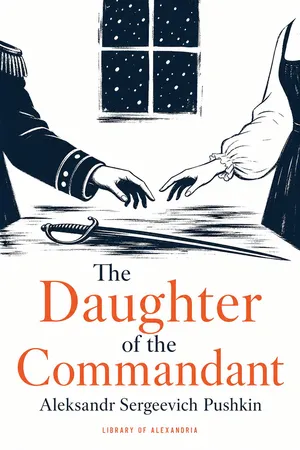
When rebellion reaches a remote frontier fort, a young officer must choose what he will risk for love-and what he will never surrender.
Set during the Pugachev Rebellion in eighteenth-century Russia, Aleksandr Pushkin's The Daughter of the Commandant follows Petr Grineff, a young nobleman sent into military service far from home. At Fort Bélogorsk, he falls in love with Marya, the commandant's daughter. Their hopes are threatened when rebel forces overwhelm the garrison and turn an isolated posting into a place of mortal danger.
Petr's encounters with the rebel leader Pugachev place duty, gratitude, and conscience in uneasy conflict. Capable of both violence and mercy, Pugachev cannot be understood simply as an enemy, yet accepting his help carries risks of its own. As Petr's loyalty to the Empress comes under suspicion, Marya's courage becomes as important as his resolve. Blending swift adventure, restrained romance, and sharp irony, Pushkin makes a historical uprising the setting for an intimate examination of honour under pressure.
What readers find inside:
- Imperial Russia - Life at a frontier garrison meets the upheaval of a peasant rebellion.
- Love Under Threat - Petr and Marya's attachment is tested by violence, separation, and uncertainty.
- A Divided Allegiance - A debt of gratitude complicates a young officer's duty to the crown.
- An Unsettling Rebel - Pugachev's brutality and unexpected generosity give the conflict its moral tension.
- A Test of Character - Petr's movement from youthful inexperience toward responsibility gives the adventure its human weight.
This novel will appeal to readers of classic Russian literature, historical adventures, and love stories shaped by difficult moral choices. Its compact narrative offers both the suspense of personal danger and the quieter drama of keeping faith with another person.
Enter a world where one act of kindness can outlast battle lines, and discover what it costs to remain true.