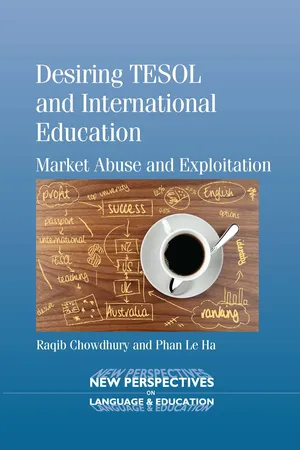
This book addresses how Western universities have constructed themselves as global providers of education, and are driven to be globally competitive. It examines how the term 'international' has been exploited by the market in the form of government educational policies and agencies, host institutions, academia and the mass media. The book explores matters relating to the role of the English language in international education in general and the field of TESOL in particular. It demonstrates how English and TESOL have exercised their symbolic power, coupled with the desire for international education, to create convenient identities for international TESOL students. It also discusses the complexity surrounding and informing these students' painful yet sophisticated appropriation of and resistance to the convenient labels they are subjected to.
eBook - ePub
Desiring TESOL and International Education
Market Abuse and Exploitation
- 280 pages
- English
- ePUB (mobile friendly)
- Available on iOS & Android
eBook - ePub
About this book
Information
Topic
PedagogíaSubtopic
Educación de adultos| 1 | Looking into the Problem |
In this chapter, we set out the context, the rationale as well as the theoretical orientation adopted to understand the principles and aims of this book, by providing a detailed account of situating international education and international students within the context of globalisation, English and the increasingly dominant discourses of marketisation. We do so with a particular focus on the case of Teaching English to Speakers of Other Languages (TESOL), which has emerged as an important field of choice for international students symbiotically accelerated by the growing dominance of English. We review competing discourses of international education and the conditions that shape the emergence and consolidation of certain discourses in opposition to others about international education. We also document regimes of ‘truth’ about international students in academic scholarship and promotional discourses.
We also discuss the impact of these dominant discourses on individuals, in this case TESOL professionals and TESOL international students, and ask – how can they change the social condition in which they find themselves and imagine alternate forms of society when they themselves are the product of these conditions?
We document the paradoxical nature of ‘international’ and ‘international education’, and argue the ways in which these terms have been abused and exploited in favour of consolidating certain ‘truths’ and simultaneously taking away the desired status associated with being international students as promised in promotional discourses.
We will first discuss four major issues to situate the problem we are addressing in this book.
International Education: From Colonisation to Globalisation
The term ‘international education’ is fraught with so much meaning that in itself, decontextualised, it means nothing at all. What is ‘thinkable’ and ‘sayable’ about international education is ultimately shaped by a complex of power relations. At its most obvious, international education is associated with the recruitment of international students (Bennell & Pearce, 1998). It may also refer to transnational education, the broad range of educational activities that cross national borders (Clyne et al., 2001: 111; Ziguras, 2007; Dolby & Rahman, 2008). However, international education is most commonly perceived as a global business consisting of spatially dispersed networks of institutions, academics (both teachers and students) and administrators. A university’s ‘international’ status is determined by its ability to generate income from international sources such as international student fees, franchises, overseas and domestic branch campuses and aid and donations from overseas alumni. An international university’s marketing staff traverse potential hotspots all over the world to engage with prospective students and offer on-the-spot placements offering international education in the politically neutral language of the ‘market’. As well as selling on-campus full-fee programmes, it also provides ‘dot.edu’ online ‘virtual’ courses. Although international universities claim to recognise students as rational, intelligent and choice-exercising individuals, they are still given strong pointers with regard to the latter’s choice of universities by giving them the illusion that they are free to exercise their choice. Such an operation on behalf of the university is strongly related to the themes of creating and sustaining desire, which we will discuss later.
One classic reference to international education is the revenue that it generates and the market it refers to and operates within (Altbach, 2004; Dolby & Rahma, 2011; Frolich, 2006; Harman, 2005; Phan Le Ha, 2013). For example, in the case of Australia today, media releases, policy documents and institutional reports celebrate international education as the second largest service industry, in which full-fee paying international students contribute $7.5 billion a year to the Australian economy (Fullerton, 2005) and around $15.5 billion over 2008 (Gillard, 2009). Even in the face of the global financial crisis (GFC) of 2008–2009, Australia boasted a strong economy, thanks to international education. Indeed, even the subsequent increase in the strength of the Australian dollar did little to discourage students from coming to Australia as a destination of choice for international students. The Organisation for Economic Co-operation and Development (OECD) estimated that about 3.7 million students worldwide were undertaking tertiary studies outside their home countries in 2009, with Australia being the top country of choice. The latest Australian Education International (AEI) monthly summaries of international student enrolment data shows a total of 338,916 enrolments by full-fee paying international students in Australia (March 2013), with 117,101 commencements representing a 3.2% increase over the same period in the previous year, with China (40.0%) and Malaysia (7.2%) being the two largest markets for enrolments. In this report, a concurrent 12% increase in English Language Intensive Course for Overseas Students (ELICOS) courses was attributed to ‘Government reforms introduced in response to the Knight Review of Australia’s student visa system, notably the introduction of streamlined visa processing and new arrangements for post-study work visas’ (AEI, 2013).
In Australia, this growth of international students is widely considered as a success story and is associated with the economic contributions of full-fee paying international students bringing in billions of dollars. As such, international education is vital to Australia’s economic security and foreign policy engagement. According to the advice report from the International Education Advisory Council, entitled ‘Australia – Educating Globally’ (February 2013), international education is the fourth largest export industry, earning $15.7 billion during 2011. The report explains that ‘this is largely driven by the higher education sector, representing 65.6 per cent of total revenue during this period’ (p. 12). Open Doors, an international education online journal in the USA, reported in its issue of 2011 that 764,495 international students studied in the USA in 2010/2011 (3.7% of all enrolments) contributing nearly $22.7 billion to the US economy with a 6% increase from the previous year.
Why do so many students choose international education? As Sidhu (2005: 23) notes, a number of both ‘push’ and ‘pull’ factors are responsible for current consumption trends. While the reduced capacity of local universities in the ‘sending countries’ works as a ‘push’ factor, the marketing and promotional activities of universities in producer countries work as ‘pull’ factors, producing the desire in an affluent middle class to consume a ‘Western’ commodity (Davies, 1997, in Sidhu, 2003: 23; Phan Le Ha, 2013). In the politically neutral language of the market, agency is seen to reside firmly in the ‘sending’ countries and autonomous choosing consumers. No distinction is drawn between ‘push’ and ‘pull’ factors within consumption sites, where they are simply and conveniently constituted as ‘demand’. The increasingly upward trend of international education can also be attributed to other factors influencing students’ choices of study destinations, such as ‘the absorptive capacities of higher education systems of receiving countries’ (Cummings, 1991: 118) and the flexibility of admissions policies and immigration regulations (Cummings, 1991: 117–119).
The literature on international students has been nominalised into four categories: the ‘deficit’, the ‘surplus’, the ‘cosmopolitan, global’ and the ‘self-determined’. At the same time, the past several decades has also basketed the international student into three distinct subjectivities: a passive ‘other’ who is made to believe that he or she needs to be tutored into the ways of the West; an elite ‘other’ whose allegiances are to be cultivated; and a competitive ‘economic subject’ who holds a pragmatic orientation to education. Placing the discursive practices of global English-medium universities under the light of examination, we argue that the academic welfare, teaching and learning processes of the university show little awareness of the fluidity of race, culture and language or hybridity of its international students, whose diversity is ignored and homogenised in popular rhetoric. A consequence of this myopic vision of the university is that students are subjected to constricting, divisive and exclusionary discursive practices that fail to properly acknowledge their complex histories, subjectivities and professional aspirations.
Within this discursive view, international students are assigned all different flat roles, including student/customer/consumer/actor, which are also exploited to consolidate and normalise the commercial interests of institutions. In the process of the universities’ marketing, international students are not only institutionally and discursively patronised but they also paradoxically play a part in the consolidation of a vicious circle. In the context of TESOL, the lure of an international degree in today’s world is the anticipated product of a vast network of advertisements in academia, both in the media and in English language teaching discourses. However, it is also a by-product of the power relations projected by the recipient members of this education system. On the one hand, English is commodified as a product in a market where demand for it is always on the rise, and on the other, consumers, acting as secondary agents, further legitimise and normalise this demand through an unconscious, spontaneous adoption of its discursive maxims.
This can be partly explained by Althusser’s (1970) point about the nature of interpellation, where international students actively play a role in the perpetuation of international TESOL education, as well as globalisation and internationalisation. From the data we draw on, it appears that as much as the ranking and popularity of certain Western universities play an important role, students themselves are prominent in the creation of an artificial preference order and a ranking hierarchy of academic institutes. During (1993: 23) argued that the culture industry uses its own ‘sophisticated ethnographic techniques’ to mediate the concept of the ‘popular’ between producers and consumers. But it also simultaneously generates public desire by marketing its products ‘as if they were already popular’ (During, 1993: 23). In this system, it is convenient for individuals (international students, in this case) to desire polysemic assimilation by entering the ‘symbolic order’ of dominant ideologies, ascribing power to themselves and giving themselves a sense of the world. Although, on the one hand, an institution’s marketing and promotion activities project certain desirable images associated with TESOL international students; they, on the other hand, coincidently make it possible for university stakeholders to exercise their power over the desirable yet vulnerable status of international students. Thus, despite the feeling of being victimised, many international students are well aware of the power that their international student status gives them.
International Education’s Discursive Links with Colonisation
Looking back, several theorists have discussed education’s involvement with the enterprise of empire (de Wit & Knight, 1999; Loombia, 1998; Nandy, 1983; Pennycook, 1998; Willinsky, 1998). In the past when educational exchanges took place against the shadow of European colonisation and imperialism, education was exported by colonial centres to their colonies and was normatively seen as an investment to consolidate colonial power and to impose the European education model on their colonial natives (de Wit & Knight, 1999; Willinsky, 1998: 89). The celebrated Macaulay’s Minute declared its rationale for education in the colonies with an imperial certitude – ‘to create a class of persons Indian in looks and colour but English in tastes and opinions, in morals and intellects’ (Macaulay, in Loombia, 1998: 85). Education was thus meant to be a key discursive site for social engineering, a goal which would retain its legitimacy post-independence, as the former colonies plunged headlong into ‘development’ and modernisation (Sidhu, 2003). Discursively packaged as a gift to be transmitted from the educated, civilised coloniser to the culturally and educationally ‘deficient’ colonised subject, colonial education’s professed function was to serve as a political investment. The consequences for both giver and receiver were unanticipated and ambiguous, resulting in political independence and, at same time, the continuation of a colonised imagination. However, some of the advocates of such internalisation can be driven by other, more ‘humane’ motives than simply economic ones. These developments can be read as examples of a continuing colonisation of the mind and imagination of international students, which the neocoloniser would fail to see as a kind of symbolic violence that extends the colonial project.
Nandy (1983) identifies two distinct phases of colonisation. The first wave, associated with unfettered economic and human exploitation, is the era of ‘bandit kings’. In the 19th century, this was replaced by the second wave – the era of ‘philosopher kings’ which saw the ‘colonisation of the educated mind’ (Nandy, 1983: x–xi). Nandy argues that it is this second wave of colonisation which survived the demise of empires and the inauguration of independent political states. Both Nandy (1983) and Hall (1996) discuss the prevalence of multiplicity, contradiction and disjuncture within transcultural encounters in education. They caution against the use of simple, reductionist binaries, arguing that doing so will involve falling back into the discursive logic of the colonial project, with its ritualised binaries and its essentialisation of difference, an issue contemporary postcolonial theorists such as Bhabha (1985, 1987) and Spivak (1988) have further problematised. It is therefore necessary to consider international students’ identity formation processes, keeping in mind that ‘truths’ are discursive constructions that are often taken for granted.
International Education and Globalisation
Despite the large claims in favour of the ‘importance’ of globalisation, some critics have seen in such initiatives an extension of many of the practices and assumptions of European colonialism and imperialism in disguise. In academic scholarship, globalisation has long been considered to be one of the raisons d’etre of international education. Although there is no consensus on what these new realities are, still less on ways of tackling them, in response to the ‘new realities’ of globalisation almost every Australian university claims to be ‘international’ (Sidhu, 2003: 15). One position is to steer the international university towards meeting the needs of the new economy for which the international university is being exhorted to be ‘internationally competitive’ (Sidhu, 2003: 43). Post-9/11, the term ‘international education’ connotatively expanded its possibilities with the vice chancellor of one Australian university declaring:
I can think of no better antidote to international terrorism as international education. It helps us to develop the international perspective and cross cultural sensitivity that are essential attributes of the effective citizen of the 21st century, and which gives us the skills and personal capacity to respond positively to globalization. (Cited in Sidhu, 2005: 1)
Rizvi (2005) also discusses democracy and the changing landscape of higher education and the flow of international students from the Middle East to other parts of the world after 9/11, in which globalisation played an essential role. For Rizvi (2005) as well as Popkewitz and Rizvi (2010) and Lingard and Rizvi (2010), globalisation is never straightforward, it is a site of struggle and is loaded with equity, equality, social justice, knowledge, power and identity issues that are at the heart of global higher education. As discussed in Chapter 2, the power/knowledge that intertwines the dominance of English as a global language (Appleby, 2009; Crystal, 1997; Pennycook, 1994, 1998; Philipson, 2009; Singh, 2010; Widin, 2010) also interweaves globalisation and subjectivity and involves multiple domains such as the economic and the social. In turn, this dominance affects both local and national understandings of international education. As a result, international education is now commonly seen as part of the complex phenomenon known as globalisation.
The English language and the internationalisation of higher education
The tension between a utilitarian perspective of English and the cultural politics of English in the context of international education, as we will articulate throughout this book, is perennial and far more complex than we often take it for.
It is not new to say that English has gained itself the status of a world language, a global language, an international language, a lingua franca or a medium of intercultural communication in almost all settings (Crystal, 1997; Seidlhofer, 2001, 2003; Brutt-Griffler, 2002; McKay, 2003; Llurda, 2004; Phan Le Ha, 2008; Phillipson, 2008, 2009). These terms have also been used interchangeably. The international status of English is an accepted understanding which the internationalisation of higher education is based on and from which the globalisation of knowledge is generated. English is not the property of only the English-speaking West any more. It can no longer be taken for granted that higher education institutions in non-English-speaking countries and non-native speakers of English will submit passively to this ‘native’ version of English (Phan Le Ha, 2008, 2009a).
English has indeed achieved its international status and been globalised. However, there are concerns regarding the unequal ownership of English and the reproduction of colonial dichotomies between the Self (the coloniser) and the Other (the colonised) (Canagarajah, 2005; Pennycook, 1998, 2001; Phillipson, 1992, 2009) which some argue are embedded in the internationalisation of the higher education process. As such, questions concerning the celebration of the dominance of English in the internationalisation of higher education policy and practice in global contexts have been increasingly raised. For example, many scholars have pointed out that although English has become a global language, native-speaking English varieties from North America, the UK, Australia and New Zealand are still often regarded as the desired standards for international education. The internationalisation of higher education policies and practices underlying these varieties and their products are considered better quality, regardless of contexts. Other Englishes, such as Singaporean English, Indian English and Malaysian English are seen as second class (Kramer-Dahl, 2003). Consequently, the internationalisation of higher education is still largely geared towards importing and exporting English-language products and services from the English-speaking West (Altbach & Knight, 2007; Huang, 2007; Phan Le Ha, 2013; Yang, 2011).
The growing commercialisation of higher education has been coupled with the commodification of English which is often associated with the belief that ‘the West is better’ and thus many products an...
Table of contents
- Coverpage
- Titlepage
- Copyright
- Dedication
- Contents
- Acknowledgements
- Preface
- 1 Looking into the Problem
- 2 Power, Discourse, Desire and International Education
- 3 Globalisation, International Education and Questions of Identity
- 4 Constructing the ‘Truths’ of International Student Subjectivities
- 5 From Global to Local – Learning Supermarkets in the National Interest: International Education and the Australian Government
- 6 The Fabric of Relations: Desire and the Formation of Choices
- 7 Brokering Identity
- 8 Rika: ‘The Spotlight of Difference’
- 9 Purchasing the ‘Good’
- 10 Reconstructing the Discourses of International Education
- References
Trusted by 375,005 students
Access to over 1.5 million titles for a fair monthly price.
Study more efficiently using our study tools.
Frequently asked questions
Yes, you can cancel anytime from the Subscription tab in your account settings on the Perlego website. Your subscription will stay active until the end of your current billing period. Learn how to cancel your subscription
No, books cannot be downloaded as external files, such as PDFs, for use outside of Perlego. However, you can download books within the Perlego app for offline reading on mobile or tablet. Learn how to download books offline
Perlego offers two plans: Essential and Complete
- Essential is ideal for learners and professionals who enjoy exploring a wide range of subjects. Access the Essential Library with 800,000+ trusted titles and best-sellers across business, personal growth, and the humanities. Includes unlimited reading time and Standard Read Aloud voice.
- Complete: Perfect for advanced learners and researchers needing full, unrestricted access. Unlock 1.5M+ books across hundreds of subjects, including academic and specialized titles. The Complete Plan also includes advanced features like Premium Read Aloud and Research Assistant.
We are an online textbook subscription service, where you can get access to an entire online library for less than the price of a single book per month. With over 1.5 million books across 990+ topics, we’ve got you covered! Learn about our mission
Look out for the read-aloud symbol on your next book to see if you can listen to it. The read-aloud tool reads text aloud for you, highlighting the text as it is being read. You can pause it, speed it up and slow it down. Learn more about Read Aloud
Yes! You can use the Perlego app on both iOS and Android devices to read anytime, anywhere — even offline. Perfect for commutes or when you’re on the go.
Please note we cannot support devices running on iOS 13 and Android 7 or earlier. Learn more about using the app
Please note we cannot support devices running on iOS 13 and Android 7 or earlier. Learn more about using the app
Yes, you can access Desiring TESOL and International Education by Raqib Chowdhury,Phan Le Ha in PDF and/or ePUB format, as well as other popular books in Pedagogía & Educación de adultos. We have over 1.5 million books available in our catalogue for you to explore.