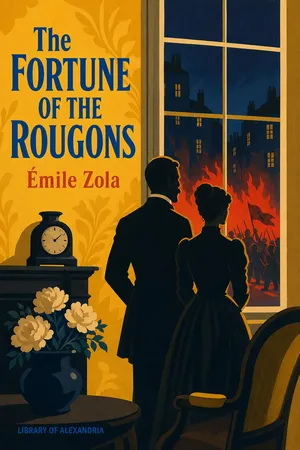
When a republic falls, some people risk their lives for their beliefs. Others see a chance to rise.
Set in the fictional Provençal town of Plassans during Louis-Napoleon Bonaparte's coup of December 1851, The Fortune of the Rougons opens Émile Zola's twenty-novel Rougon-Macquart cycle. Pierre Rougon and his calculating wife, Félicité, recognize an opportunity to turn political turmoil into social advancement. Their young relative Silvère, meanwhile, joins the Republican insurgents alongside Miette, the girl he loves. Their hopes stand in stark contrast to the ambitions taking shape behind respectable doors.
Zola brings the tensions of provincial France into sharp focus: wealth and poverty, inherited privilege, public respectability, and private self-interest. As rebellion spreads and repression approaches, the struggle over the town's future becomes a struggle over who will control its story. Intimate family history meets national upheaval in a novel that asks what success means when its foundations are betrayal and suffering. Its unsparing portrait of opportunism still speaks to readers concerned with power, inequality, and the distance between political ideals and political rewards.
What readers find inside:
- A dynasty's beginnings - The divided Rougon-Macquart family establishes the human groundwork for Zola's wider cycle.
- Political intrigue - Pierre and Félicité maneuver to secure status amid the uncertainty of the coup.
- Young love - Silvère and Miette bring tenderness and idealism to a story shaped by ruthless ambition.
- Provincial France - Plassans reveals a society marked by class divisions, competing loyalties, and carefully guarded appearances.
- Naturalist themes - Family inheritance and social surroundings help shape lives whose possibilities are far from equal.
For readers of French classics, politically charged historical fiction, and family sagas, this is a compelling encounter with the origins of Zola's fictional world.
Enter Plassans and discover the human price of a family's rise.