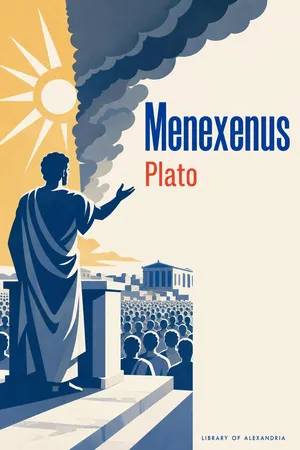
When a city praises its fallen soldiers, what does it teach the living to believe? Plato turns a ceremonial speech into a searching encounter with the power of patriotic language.
In Menexenus, Socrates meets a young man returning from the Council, where a speaker is being chosen to honor the war dead. With characteristic irony, Socrates suggests that praising Athenians before an Athenian audience is hardly a difficult task. He then recites an oration he attributes to Aspasia, the woman he presents as his teacher in rhetoric.
The speech celebrates Athens through its origins, military achievements, and sacrifices, invoking Marathon and Salamis as part of a grand account of civic virtue. Yet the conversation surrounding it makes that grandeur difficult to accept without question. Is this an act of commemoration, a parody of public eloquence, or both? The tension between the speech's emotional appeal and Socrates' skeptical framing gives this brief dialogue its lasting force. It asks readers to consider how collective memory is shaped, how praise becomes persuasion, and why audiences so readily welcome flattering accounts of themselves.
What readers find inside:
- Socratic irony - A playful opening conversation unsettles the authority of the solemn speech that follows.
- Aspasia and eloquence - The attribution of the oration to Aspasia complicates assumptions about who speaks for Athens.
- Athenian civic memory - The funeral speech draws on the city's past to construct an image of shared courage and virtue.
- The politics of praise - Ceremonial language reveals how honoring the dead can influence the living.
- Rhetoric under scrutiny - The work invites readers to weigh the beauty of persuasive speech against its selective telling of history.
A rewarding choice for readers of classical philosophy, students of rhetoric and public speaking, and anyone interested in the stories nations tell about themselves.
Enter this compact dialogue and listen for the questions beneath the praise.