How does language or culture come to be standardized to the degree that it is considered 'homogeneous'? How does teaching language relate to such standardization processes? How can teaching be mindful of the standardization processes that potentially involve power relations? Focusing on the case of Japanese, which is often viewed as homogenous in terms of language and culture, this volume explores these questions in a wide range of contexts: the notions of translation and modernity, the ideologies of the standardization of regional dialects in Japan, current practices in college Japanese-as-a- Foreign-Language classrooms in the United States, discourses in journals of Japanese language education, and classroom practices in nursery and primary schools in Japan. This volume's investigation of standardization processes of Japanese language and culture addresses the intersections of theoretical and practical concerns of researchers and educators that are often overlooked.
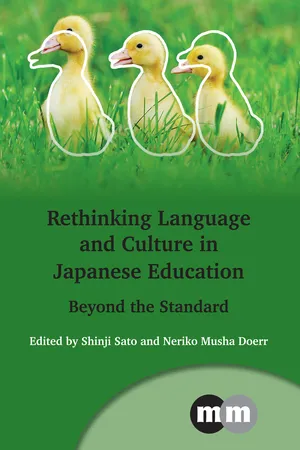
eBook - ePub
Rethinking Language and Culture in Japanese Education
Beyond the Standard
- 256 pages
- English
- ePUB (mobile friendly)
- Available on iOS & Android
eBook - ePub
Rethinking Language and Culture in Japanese Education
Beyond the Standard
About this book
Information
Part 1
Theoretical Framework
1 Standardization of Language and Culture
Ryuko Kubota
Introduction
The standardization of language and culture in Japanese language education is reflected in textbooks in which culture is portrayed in an essentialist way. It also used to be part of the process of the standardization of Japanese as seen in a history of Japanese language education in the pre-WWII era (Yasuda, 1999). As our society is becoming increasingly globalized and diverse, the significance and impact of standardization pose many challenges. As an introduction to the chapter, I shall present an intriguing news article as an analogy, although it is not directly related to Japanese language education.
On 2 November 2006, the Asahi Shimbun published an article entitled ‘Authentic Japanese food for overseas countries: Restaurant certification system by the Ministry of Agriculture, Forestry and Fisheries (MAFF)’. According to this article, the recent Japanese food boom had increased the number of Japanese restaurants abroad. However, MAFF was concerned that these restaurants were using ingredients and cooking methods that were far from authentic Japanese cuisine.1 In order to disseminate correct information about Japanese food, the article reported that MAFF would establish a Japanese restaurant certification system in 2007. Japanese food is popular even in the small college town where I live,2 and packed sushi began to be sold in corners of supermarkets several years ago. Such varieties of sushi as California roll (avocado and nori in sushi rice), vegetarian sushi (julienne carrots inside) and brown rice sushi are not common in Japan, so they would probably not be certified as ‘authentic Japanese food’. However, reflecting on the situation in Japan, the following question is raised: ‘Are ethnic cuisines served in Japan authentic?’. The answer is clearly ‘No’. Take pasta for example, the most popular Italian food. The familiar tomato ketchup-flavored ‘Napolitan’ was invented in Japan and so-called ‘Japanese-style spaghettis’ that use ingredients that are far from Italian, such as shiso (the herb perilla), ume (pickled plum) and tarako (salted cod roe), are certainly not ‘authentic’ cuisine.
Food travels beyond the borders of cultures and nation states, spreading out and transforming itself as it makes contact with other cultures. We can call such spreading out a food diaspora as hybrid forms of cuisine create new cultures. Such spreading out and the resulting hybridity indicate that judging what is right and what is wrong is not a matter of confirming a scientific, objective or absolute truth, but rather it is an arbitrary and political activity that prevents a natural transformation of culture. What are the criteria for determining the ‘right’ food, if the food culture is diverse regionally and individually? Who, with what authority, can make that judgment? These questions pose a risk to criteria setting. If this certification system were indeed implemented, the expected outcome would be an emergence of a clear distinction between ‘authentic’ and ‘fake’ Japanese food, serving its purpose of shaping people’s awareness. Moreover, a clear distinction would be created between restaurants that serve authentic Japanese food and those that do not. However, restaurant food is a commodity with monetary value and the value is decided by the consumer’s preference. Therefore, if the food, even if it is authentic, is unpalatable to the consumers, its commodity value would become lower than that of the ‘fake’ hybrid food.
Of course, food standardization in this food certification system does not overlap completely with language standardization. Dining out is a pastime and is not indispensable for life, whereas language use is a social activity that occurs in both private and public scenes with a gate-keeping function. Therefore, certifying a restaurant that serves the right Japanese food and regulating the correct language use through Japanese language teaching are rather different in terms of their impact on society and individuals. However, they share many similarities with regard to the purpose of standardization, their political and arbitrary nature, and the ways in which they function as hegemony through forming individuals’ consciousness despite the impossibility of regulating individuals’ behavior.
Drawing on critical scholarships in applied linguistics and English language education, this chapter raises questions about the standardization of language and culture.
Standardization of Language
What are the implications of linguistic standardization on language education? Reflecting on various components of language, we can see some examples. Using a language involves different elements, such as pronunciation, vocabulary, grammar and pragmatics. Linguistic variations are observed according to the individual difference, age group, geographical region, social class and occupation. However, an examination of Japanese textbooks and other teaching materials quickly reveals the fact that these linguistic elements are all in standardized Japanese that is based on the Tokyo dialect. Also, linguistic styles differ even within the Tokyo dialect according to the individual differences or situational differences in which the language is used. Therefore, standardized expressions as seen in textbooks are fictional standardized expressions in a sense. In fact, setting a rule undermines the diversity of language mentioned above, constructing an imaginary normalized Japanese language and thus creating an ‘imagined language community’ (Anderson, 1983).
Once certain language use becomes normalized as correct, values and hierarchies emerge, attaching superiority to certain language use on the one hand while excluding non-standard language use on the other. This is clearly demonstrated in the anti-dialect campaign in the language standardization movement during Japan’s modernization. As Sato’s chapter (Chapter 5) in this book shows, strong contempt for non-standard forms of language exists to date. In Japanese language education during the Imperial era, many Japanese teachers who taught overseas were from rural Japan and their use of dialects was criticized as undesirable for instruction (Yasuda, 1999). Even today, in my professional experience, some teachers think that speaking with accents other than the Tokyo dialect is not suitable for teaching Japanese. However, with the recent dialect boom, some young people in the Tokyo metropolitan area use dialects like wearing a playful accessory, and they envy those who can speak dialects (Jinnouchi, 2006; see the discussion on language creativity in section 4).
Furthermore, language standardization not only indicates what is right or wrong, but it also constructs linguistic norms for certain social categories. For example, a description of the difference between the ‘feminine style’ and ‘masculine style’ of language use without taking into account regional and individual differences constructs gendered language use that is far from the reality and constructs a fixed binary gender image (see Chapter 4 of this book; Kinsui, 2003; Okamoto & Shibamoto-Smith, 2004). This parallels the social norm which determines that women are (should be) polite, kind and reserved and which regulates social practices. In other words, although we tend to think that an objective description of language use reflects the language used in real life, it is, in fact, fictional, contributing to social control.
Furthermore, not only does standardization construct the norms of linguistic forms and social behaviors, but it also constructs discourses of the uniqueness of the language itself. In other words, it functions as the ‘standardization of the linguistic view’, defining the uniqueness of a particular language. For example, a widely supported idea, as seen in the discourse of Japanese honorifics, is that honorifics originate from a delicate and respectful mindset toward others, which is unique to the Japanese national characteristics, and that they reflect the uniqueness and beauty of the Japanese language (Yamashita, 2001). Here, the national character is used to explain the existence of honorifics and it constructs an image about a language. Furthermore, in contrastive rhetoric or research on written discourse structures, cultural thought patterns behind language use emerged in the 1960s (Kaplan, 1966). The theory was proposed to explain international students’ lack of competency in academic writing in the USA in the 1960s, when the number of international students dramatically increased. According to this theory, English writing reflects a linear logic whereas Eastern languages are based on a circular logic. In the 1980s, this research emphasized the uniqueness of the logic reflected in Japanese written discourse vis-à-vis English writing, and the uniqueness of Japanese was explained in terms of ki-shô-ten-ketsu (introduction, development, turn, conclusion) and an inductive reasoning (Hinds, 1983, 1987). However, as in the studies on honorifics and women’s language use, the discourse that emphasizes the uniqueness of the Japanese language in terms of its ambiguity, non-logicalness and indirectness constitutes nihonjinron (theory of the Japanese), and is linked to the essentialist understanding of the thinking style of the Japanese as argued by Segawa in Chapter 8 of this book. In recent years, such a fixed and essentialist view of language in general has been critiqued within the field of teaching English as a second language (see Casanave, 2004; Kubota & Lehner, 2004). Moreover, in recent instruction of written composition in kokugo (Japanese language arts), the emphasis has been on clearly stating one’s position and opinion in the introduction as well as organizing the text in a logical manner, which indicates a rhetorical standard opposite to indirect expressions (Kubota & Shi, 2005). This is an example that indicates the shifting nature of language and culture.
As argued so far, linguistic standardization and descriptions of standard language use assign a superior status to a particular language variation and create a hierarchy among diverse linguistic forms, while constructing a fixed image about a particular language as well as a social category such as gender. Through a process of language standardization, language is constructed as an essentialized and fictional entity. I shall now turn to cultural standardization.
Standardization of Cultural View
In applying the discussion of linguistic standardization to culture, it is first necessary to examine the meaning of culture. Language is a concrete phenomenon that exists as sounds, vocabulary, grammar, letters and texts. But what is culture? As argued in Chapter 10, the US National Standards in Foreign Language Education conceptualize culture in three components: ‘practices’, ‘products’ and ‘perspectives.’ One of the learning goals is to understand how ‘perspectives’ such as cultural values are related to the other two components. Conceptualizing culture in this way and applying the concept of standardization, we can imagine how the knowledge and skills about cultural practices and products lead to concrete definitions and become a target of standardization in Japanese language teaching. For example, taking your shoes off in the hallway of private homes, giving midyear ochûgen gifts and end-of-the-year oseibo gifts to the people you owe, saying ‘itadakimasu’ before a meal and ‘gochisô sama deshita’ after a meal, customs such as not washing yourself in bathwater with soap, or authentic food culture like the ingredients inside sukiyaki and Japanese-style breakfast are all conceptually standardized as normative knowledge. In contrast, cultural perspectives do not indicate any concrete matter; they are understood as abstract concepts that explain the background of cultural customs and products. For example, it is explained that the custom of taking one’s shoes off in a hallway is based on the concept of uchi-soto (inside-outside), ochûgen and oseibo derive from the concept of giri (obligation), and each of these concepts is unique to Japan. Just like language standardization produces the language system itself (e.g. pronunciation and grammar) and normalizes the view about various aspects of language, cultural perspectives normalize the way of talking about certain cultural characteristics and construct people’s knowledge about culture.
Thus, the standardization of Japanese culture in Japanese language teaching contributes to an essentialist cultural understanding through the emphasis on the uniqueness of Japanese culture. As in the case of authentic Japanese food mentioned in the introduction, this standardized view ignores diversity, fluidity and creativity and instead considers essentialized cultural values and...
Table of contents
- Cover-Page
- Half-Title
- Series
- Title
- Copyright
- Contents
- Contributors
- Introduction
- Part 1: Theoretical Framework
- Part 2: Kokugo Education: Japanese Education Designed for ‘Native Speakers’
- Part 3: Nihongo Education: Japanese Education Designed for ‘Non-Native Speakers’
- Conclusion and Departure
- Index
Trusted by 375,005 students
Access to over 1.5 million titles for a fair monthly price.
Study more efficiently using our study tools.
Frequently asked questions
Yes, you can cancel anytime from the Subscription tab in your account settings on the Perlego website. Your subscription will stay active until the end of your current billing period. Learn how to cancel your subscription
No, books cannot be downloaded as external files, such as PDFs, for use outside of Perlego. However, you can download books within the Perlego app for offline reading on mobile or tablet. Learn how to download books offline
Perlego offers two plans: Essential and Complete
- Essential is ideal for learners and professionals who enjoy exploring a wide range of subjects. Access the Essential Library with 800,000+ trusted titles and best-sellers across business, personal growth, and the humanities. Includes unlimited reading time and Standard Read Aloud voice.
- Complete: Perfect for advanced learners and researchers needing full, unrestricted access. Unlock 1.5M+ books across hundreds of subjects, including academic and specialized titles. The Complete Plan also includes advanced features like Premium Read Aloud and Research Assistant.
We are an online textbook subscription service, where you can get access to an entire online library for less than the price of a single book per month. With over 1.5 million books across 990+ topics, we’ve got you covered! Learn about our mission
Look out for the read-aloud symbol on your next book to see if you can listen to it. The read-aloud tool reads text aloud for you, highlighting the text as it is being read. You can pause it, speed it up and slow it down. Learn more about Read Aloud
Yes! You can use the Perlego app on both iOS and Android devices to read anytime, anywhere — even offline. Perfect for commutes or when you’re on the go.
Please note we cannot support devices running on iOS 13 and Android 7 or earlier. Learn more about using the app
Please note we cannot support devices running on iOS 13 and Android 7 or earlier. Learn more about using the app
Yes, you can access Rethinking Language and Culture in Japanese Education by Shinji Sato,Neriko Musha Doerr in PDF and/or ePUB format, as well as other popular books in Languages & Linguistics & Teaching Language Arts. We have over 1.5 million books available in our catalogue for you to explore.