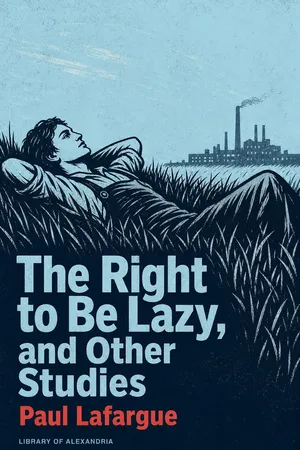
What if working harder is not the answer? Paul Lafargue challenges the belief that endless labor is a virtue-and asks who profits when workers accept it.
In The Right to Be Lazy, and Other Studies, Lafargue turns the moral language of industrial capitalism against itself. His provocative title essay attacks the glorification of work, arguing that excessive toil sustains exploitation rather than human well-being. Drawing on ancient societies and nineteenth-century industrial conditions, he makes a pointed case for leisure as a serious social aim, not a personal failing.
The accompanying studies extend that challenge to intellectual authority, economic crisis, women's equality, and the possibilities of socialism. Socialism and the Intellectuals questions the educated classes' relationship with power, while The Bankruptcy of Capitalism examines a system capable of producing abundance and poverty together. Throughout, Lafargue combines historical examples, polemical energy, and biting humor. These essays remain compelling not because readers must accept every argument, but because they make familiar assumptions about productivity, dignity, and progress newly debatable.
What readers find inside:
- The work ethic - The title essay disputes the idea that more labor necessarily means a better life.
- Knowledge and power - Lafargue asks whose interests writers, scientists, and other intellectuals serve.
- Capitalism's contradictions - Overproduction and deprivation appear as connected features of the industrial economy.
- Women's equality - The Woman Question challenges arguments used to justify women's domestic subordination.
- Socialist possibilities - The Socialist Ideal traces socialist thought and argues for a different organization of society.
- Political satire - The Rights of the Horse and the Rights of Man exposes the distance between declared rights and working-class experience.
For readers of political philosophy, students of labor history, and anyone reconsidering the place of work in daily life, this collection offers a forceful encounter with nineteenth-century socialist criticism.
Begin with Lafargue's challenge to overwork and discover how unsettling a defense of leisure can be.