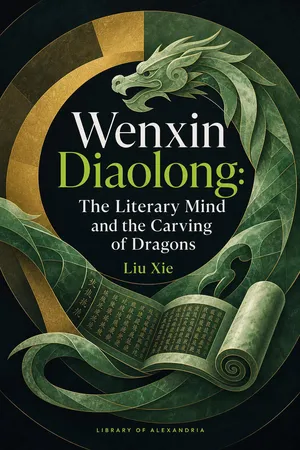
What gives writing its life-and what makes it worth returning to? This foundational work of Chinese criticism brings questions of creative craft into conversation with nature, tradition, and moral purpose.
Written around the turn of the sixth century, Liu Xie's Wenxin Diaolong: The Literary Mind and the Carving of Dragons examines literature in fifty chapters. It begins with a vision of pattern and expression as principles of the natural world, then considers how human writing participates in that larger order. Literature is not simply ornament: it gives form to feeling, thought, and the values of a culture.
From this philosophical starting point, Liu Xie turns to particular genres and the decisions writers make. Hymns, elegies, historical narratives, edicts, and philosophical discourse each have their own origins and demands. Chapters on craft explore imagination, personality, sound, word choice, proportion, and revision. Throughout, he asks how inherited forms can remain alive, and how substance and elegance can strengthen rather than diminish each other.
What readers find inside:
- Writing and cosmic order - The opening argument connects human expression with patterns in heaven and earth.
- Classical genres - Liu Xie traces literary forms to their sources and considers the qualities that distinguish them.
- Wind and bone - His celebrated account of vital force and structural strength asks what separates powerful writing from decoration.
- Imagination and style - The work explores the relationship between a writer's inner life and the character of the writing.
- Craft and judgment - Discussions of rhythm, diction, revision, and understanding address both making literature and reading it well.
For readers of Chinese philosophy and aesthetics, students of literary criticism, and writers curious about another tradition of craft, this work offers an enduring perspective on the responsibilities and possibilities of expression.
Begin with Liu Xie's vision of a patterned universe, and discover the searching attention he brings to the written word.