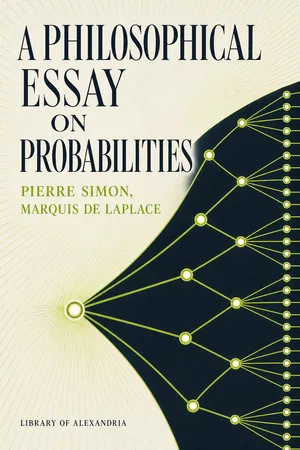
A Philosophical Essay on Probabilities
eBook - ePub

A Philosophical Essay on Probabilities

Probability Theory and the Art of Reasoning Under Uncertainty

  1. English
  2. ePUB (mobile friendly)
  3. Available on iOS & Android
eBook - ePub

A Philosophical Essay on Probabilities

Probability Theory and the Art of Reasoning Under Uncertainty

About this book

How should we reason when certainty is out of reach? Laplace shows why the mathematics of chance belongs at the heart of sound judgment.

In A Philosophical Essay on Probabilities, Pierre-Simon Laplace presents probability as more than a tool for games and calculations. It is a way to assess evidence and make sense of an imperfectly known world. Beginning with the ratio of favorable cases to equally possible cases, he develops principles for combining probabilities and reasoning from observed events to possible causes.

The essay carries these ideas into questions with unmistakably human stakes: whether testimony deserves belief, how juries arrive at verdicts, what mortality records reveal, and how small effects can emerge from large collections of observations. Laplace also examines the habits that lead judgment astray, from superstition to mistaken expectations about chance. His account of the subject's development places these arguments within a mathematical tradition shaped by Pascal, Fermat, Bernoulli, and Bayes. The result is both a landmark in the history of science and a searching argument for disciplined thought.

What readers find inside:

  • Foundations of chance - Ten principles establish how probabilities are defined, combined, and applied.
  • Evidence and testimony - Historical reports and chains of witnesses become tests of how belief should be weighed.
  • Justice and judgment - Jury decisions illustrate the relationship between collective choices and the likelihood of error.
  • Patterns in observations - Mortality records and atmospheric measurements show how numerical evidence can reveal otherwise elusive effects.
  • Illusions of reasoning - Misread coincidences and expectations about luck expose the distance between intuition and sound inference.

This work will reward readers interested in probability theory, the history of statistics, and the philosophy of scientific evidence. It also offers thoughtful material for anyone curious about why confident predictions fail and how claims should be assessed.

Begin with chance, and discover a lasting argument for thinking more carefully about what we know.

Table of contents

  1. Introduction
  2. Part 1 · A Philosophical Essay on Probabilities
  3. Chapter 1 · Introduction
  4. Chapter 2 · On Probability
  5. Chapter 3 · The General Principles of the Calculus of Probabilities
  6. Chapter 4 · Concerning Hope
  7. Chapter 5 · Concerning the Analytical Methods of the Calculus of Probabilities
  8. Part 2 · Applications of the Calculus of Probabilities
  9. Chapter 6 · Games of Chance
  10. Chapter 7 · Concerning Unknown Inequalities That May Exist Among Chances Supposed to Be Equal
  11. Chapter 8 · The Laws of Probability Arising from the Indefinite Multiplication of Events
  12. Chapter 9 · The Application of the Calculus of Probabilities to Natural Philosophy
  13. Chapter 10 · Application of Probability Calculus to the Moral Sciences
  14. Chapter 11 · On the Probabilities of Testimony
  15. Chapter 12 · On the Selections and Decisions of Assemblies
  16. Chapter 13 · On the Probability of the Decisions of Courts
  17. Chapter 14 · Concerning Tables of Mortality and Mean Durations of Life, Marriages, and Associations
  18. Chapter 15 · On the Benefits of Institutions That Depend on the Probability of Events
  19. Chapter 16 · On Illusions in Estimating Probabilities
  20. Chapter 17 · On the Various Ways of Approaching Certainty
  21. Chapter 18 · Historical Account of the Calculus of Probabilities

Trusted by 375,005 students

Access to over 1.5 million titles for a fair monthly price.

Study more efficiently using our study tools.

Information

Edition
1
Year
2026
eBook ISBN
9781808313615

Frequently asked questions

Yes, you can cancel anytime from the Subscription tab in your account settings on the Perlego website. Your subscription will stay active until the end of your current billing period. Learn how to cancel your subscription
No, books cannot be downloaded as external files, such as PDFs, for use outside of Perlego. However, you can download books within the Perlego app for offline reading on mobile or tablet. Learn how to download books offline
Perlego offers two plans: Essential and Complete
  • Essential is ideal for learners and professionals who enjoy exploring a wide range of subjects. Access the Essential Library with 800,000+ trusted titles and best-sellers across business, personal growth, and the humanities. Includes unlimited reading time and Standard Read Aloud voice.
  • Complete: Perfect for advanced learners and researchers needing full, unrestricted access. Unlock 1.5M+ books across hundreds of subjects, including academic and specialized titles. The Complete Plan also includes advanced features like Premium Read Aloud and Research Assistant.
Both plans are available with monthly, semester, or annual billing cycles.
We are an online textbook subscription service, where you can get access to an entire online library for less than the price of a single book per month. With over 1.5 million books across 990+ topics, we’ve got you covered! Learn about our mission
Look out for the read-aloud symbol on your next book to see if you can listen to it. The read-aloud tool reads text aloud for you, highlighting the text as it is being read. You can pause it, speed it up and slow it down. Learn more about Read Aloud
Yes! You can use the Perlego app on both iOS and Android devices to read anytime, anywhere — even offline. Perfect for commutes or when you’re on the go.
Please note we cannot support devices running on iOS 13 and Android 7 or earlier. Learn more about using the app
Yes, you can access A Philosophical Essay on Probabilities by Pierre-Simon Laplace in PDF and/or ePUB format, as well as other popular books in Mathematics & History & Philosophy of Mathematics. We have over 1.5 million books available in our catalogue for you to explore.