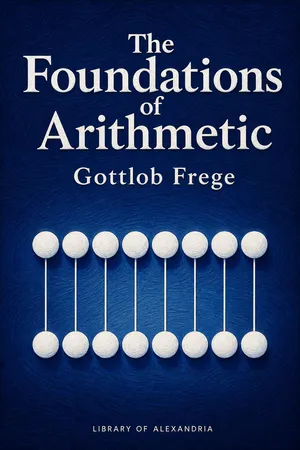
We know how to count. But what, exactly, are we counting with?
In The Foundations of Arithmetic, first published in 1884, Gottlob Frege asks what numbers are and what justifies our knowledge of them. This is not a manual of calculation, but a searching philosophical argument about truths so familiar that their foundations can seem invisible. Frege challenges accounts that treat numbers as properties of physical things, private mental images, or products of intuition.
His alternative begins with a striking shift: a statement of number makes an assertion about a concept. From there, he explores one-to-one correspondence, numerical equality, and the logical basis of zero and the natural numbers. Engaging critically with thinkers including Kant and Mill, Frege argues for logicism-the view that arithmetic rests on logic rather than experience. His context principle and distinction between concepts and objects also helped shape analytic philosophy, giving this compact work an importance far beyond mathematics.
What readers find inside:
- The nature of number - Frege examines why ordinary confidence in counting does not settle what numbers actually are.
- Rival explanations - Arguments against empirical and psychological accounts expose difficult questions about mathematical certainty.
- One-to-one correspondence - Matching the objects falling under concepts provides a route to understanding numerical equality.
- Zero and the number sequence - Frege develops his account of numbers through logical definitions rather than physical examples alone.
- Meaning in context - The context principle connects the investigation of number with enduring questions about language and thought.
For philosophy students, mathematically curious readers, and anyone interested in the origins of analytic philosophy, this work offers a demanding and rewarding encounter with first principles. Its central questions remain alive: what makes mathematical knowledge possible, and how much can logic establish?
Begin with the simplest question-what is a number?-and follow Frege into the reasoning beneath everyday calculation.