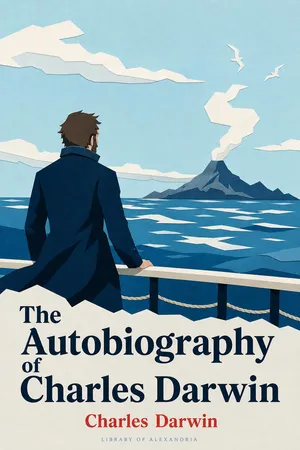
How does an ordinary, curious boy become a thinker who changes our understanding of life? Darwin looks back on that journey with warmth, modesty, and a scientist's eye for evidence.
Written for his children, The Autobiography of Charles Darwin follows the development of a mind rather than the making of a public legend. Darwin recalls his boyhood in Shrewsbury, his disappointing medical studies at Edinburgh, and his years at Cambridge, where his interest in natural history found encouragement through the botanist John Stevens Henslow. The voyage of the Beagle opened a wider world of collecting and observation; the years at Down House gave him the time to pursue the questions it raised.
Darwin describes the patient work behind his theory of evolution, the influence of reading Malthus on population, and the arrival of Alfred Russel Wallace's independently developed ideas. He reflects on On the Origin of Species, the friendships that sustained his research, and the personal costs of sustained intellectual concentration. His regret at losing some of his pleasure in poetry and music gives this account a human depth beyond its importance to the history of science.
What readers find inside:
- An uncertain beginning - Early studies and youthful enthusiasms reveal a scientific vocation taking shape gradually.
- The Beagle voyage - Darwin recalls the years of travel, collecting, and observation that transformed his direction.
- A theory taking shape - Long reflection and accumulated evidence lead toward a new explanation of species.
- Scientific friendships - Henslow, Lyell, Hooker, and Wallace appear in the story of an interconnected intellectual life.
- Habits of inquiry - Attention to facts that challenge a theory shows why intellectual honesty matters to discovery.
- The inward life - Reflections on character and changing tastes reveal the rewards and limits of devotion to science.
This memoir will appeal to readers of scientific biography, anyone curious about the origins of evolutionary thought, and those who enjoy candid accounts of how a working mind develops.
Begin a personal journey into the curiosity, patience, and self-questioning behind a scientific revolution.