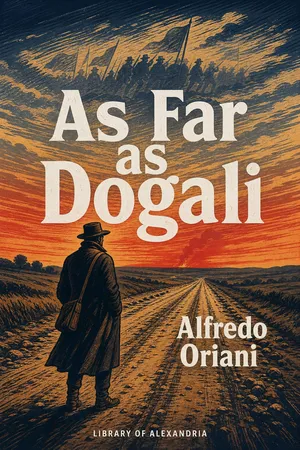
What happens when independence fails to deliver the nation people imagined? A village's act of remembrance becomes a searching inquiry into Italy's promises, divisions, and ambitions.
Published in 1889, Alfredo Oriani's As Far as Dogali begins when its narrator, a writer and reluctant public figure, is asked to represent his village at the funeral of Don Giovanni Verità, the revolutionary priest who once saved Garibaldi's life. From this local obligation, the narrative expands into a wide-ranging reckoning with the Risorgimento and the troubled life of a newly unified country.
Personal experience, political essay, and historical panorama meet in a work that moves from the crowded energy of a Garibaldian memorial rally to the long cultural memory of the Via Emilia. Oriani considers Machiavelli and Guicciardini as competing interpreters of power and the Italian character, while Garibaldi embodies the painful distance between patriotic faith and public disillusionment. The Italian defeat at Dogali in East Africa in 1887 brings colonial ambition into this argument, pressing the question of what national greatness means-and what its pursuit can cost.
What readers find inside:
- Revolutionary memory - Don Giovanni Verità's funeral prompts reflection on the ideals and legacies of Italian unification.
- Garibaldi's legacy - The revolutionary leader emerges as a figure of enduring conviction and tragic disappointment.
- A road through history - The Via Emilia becomes a setting for meditations on centuries of Italian civilization and conflict.
- Power and character - Machiavelli and Guicciardini provide contrasting ways to examine Italy's political habits and failures.
- Colonial ambition - Dogali exposes the tension between dreams of national prestige and the realities of a divided state.
For readers of European novels of ideas, literature of the Risorgimento, and politically engaged fiction, this is an encounter with patriotism that neither dismisses its hopes nor excuses its illusions.
Enter Oriani's Italy and follow a local remembrance into the unsettled heart of a nation.