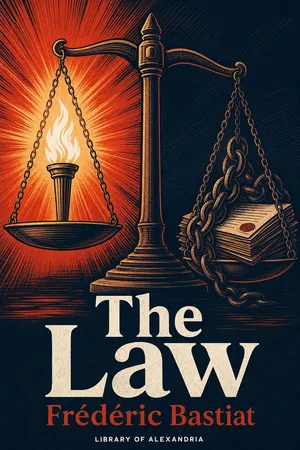
When does the power meant to protect your rights become the power that violates them? Frédéric Bastiat makes that question the starting point of a forceful argument for individual liberty.
Published in 1850, The Law is a sustained essay on justice, natural rights, and the proper limits of government. Bastiat argues that life, liberty, and property exist before legislation, and that the legitimate purpose of collective force is to defend them. When legislation instead authorizes taking from some people for the benefit of others, he calls the result legal plunder.
Bastiat traces this corruption to greed and misguided philanthropy, challenging the belief that legislators should shape society according to their own designs. He examines ideas associated with Rousseau, Montesquieu, Fénelon, and French socialism, and applies his reasoning to tariffs, subsidies, taxation, and state-directed education. Whether readers accept his conclusions or dispute them, his central distinction between protecting rights and directing lives gives enduring debates about government a precise and provocative focus.
What readers find inside:
- Natural rights - Bastiat builds his argument around life, liberty, and property as rights that legislation should protect rather than create.
- Legal plunder - He proposes a test for recognizing when an act forbidden to individuals gains the sanction of government.
- Political conflict - He explains why competing groups seek control of legislation when it becomes a means of distributing benefits.
- The legislator's ambition - His critique challenges thinkers who treat people as material to be organized by political authority.
- Limited government - He presents the prevention of force and fraud as an alternative to directing society through compulsory schemes.
This essay will appeal to readers of classical liberalism, students of political philosophy, and anyone examining the relationship between justice and government power. Its direct questions invite both conviction and thoughtful disagreement.
Begin The Law and consider where the defense of rights ends and the abuse of power begins.