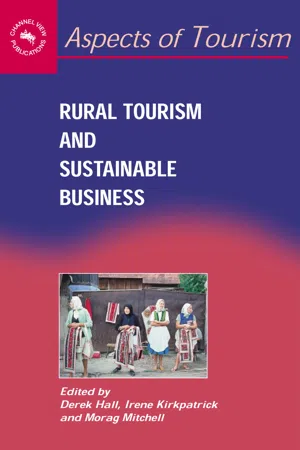
This book provides the latest conceptual thinking on, and case study exemplification of, rural tourism and sustainable business development from Europe, North America, Australasia, the Middle East and Japan in 19 concise, manageable chapters. The book is organised into distinct yet interrelated sections, and benefits from strong editorial input in terms of context setting and summary chapters. Rural Tourism and Sustainable Business represents a high quality text integrating the latest thinking on the evolving strategic roles of rural tourism and its role in sustainable business development. It provides readily accessible material drawn from a range of environmental and cultural contexts and draws attention to the nature and interrelationships between local and global issues in rural tourism and development.
eBook - ePub
Rural Tourism and Sustainable Business
- English
- ePUB (mobile friendly)
- Available on iOS & Android
eBook - ePub
Rural Tourism and Sustainable Business
About this book
Information
Part 1
Introduction
Chapter 1
Rural Tourism as Sustainable Business: Key Themes and Issues
MORAG MITCHELL and DEREK HALL
Introduction
For this volume, the editors approached specialist contributors who could add to the debate on rural tourism within the context of sustainable business development. For many countries around the world, this is the crucial next step for the rural tourism industries. The industry has been populated with thousands of small- and medium-sized enterprises (SMEs). It is estimated that more than two-and-a-half million SMEs are involved in the tourism industry in Europe (e.g. Middleton, 2001) with 81.5% of these actually falling into the micro category. The EU tourism industry is dominated by SMEs employing on average six people. Elsewhere in the world we find that:
• 99% of all tourism-related establishments in rural areas in the USA qualify as small businesses (Galston & Baehler, 1995);
• in New Zealand, the tourism industry is estimated to consist of between 13,500 and 18,000 SMEs (TIA, 2001); and
• in Israel, almost all rural tourism businesses are classified as small and family based, with 95% of those in the accommodation sector employing less than three people (Fleischer et al., 1993).
A positive aspect of this industry structure is that tourism is one of the most labour-intensive industries, so it has the potential to contribute towards job creation and economic development in rural areas, and indeed, is often seen as the linchpin in many rural development strategies (Briedenhann & Wickens, 2004; Fleischer & Felsenstien, 2000; Roberts & Hall, 2001). Negatively, however, there has been a tendency for businesses to develop in an ad hoc manner, with little or no meaningful strategy addressing the issue of sustainability, either from an environmental or marketing perspective. This has resulted in the emergence of rural tourism products that have not taken due consideration of environmental impact, demand conditions, competition, or supply side considerations.
Some of the examples presented in this book illustrate these issues and they address many of the structural and product problems facing rural tourism providers. Such problems include:
• lack of concern with and knowledge of demand factors;
• lack of skills with regard to product presentation;
• limited knowledge of the markets they work within; and
• limited development of cooperation and marketing networks (Jenkins & Parrott, 1997).
Key Themes and Issues
If rural tourism is to continue fulfilling expectations that it can contribute to the rural development process and emerge as an industry of sustainable, growing businesses, it must identify and meet the challenges facing it. Four are particularly critical, as given in the following.
Competition
There are signals that the competitive success of some destinations is declining and they are losing what previously had been assumed to be a sustainable market advantage (EC, 2002; Petrić, 2003). ‘Some regional environments seem to be more stimulating to economic progress and success than others’ (Jenkins & Parrott, 1997: 7) and the continuous emergence of new competitors means that these destinations must monitor their competitive strategies. This needs to be done at a regional planning level as well as by individual providers taking notice of product differentiation, quality, and knowledge of changing markets. It also requires a process of continual restructuring if tourism providers are to maintain any competitive advantage (Vera Rebollo & Ivars Baidal, 2004).
Marketing
Marketing is especially required in a climate where average tourist expenditure is declining and tourism is facing some negative publicity issues including images of environmental degradation and the physical deterioration of some heritage and cultural sites (EC, 2002). Marketing is often viewed as a weak link in rural diversification and development processes, but it can be used to counteract these images, especially in the context of rural tourism.
Many tourism providers seek to develop niche markets for their products, hoping that product differentiation will give them an advantage over their competitors, allowing them to increase their market share (OECD, 1995). However, to be successful, a product differentiation strategy must reach the consumers, and this is where successful marketing is crucial. Market segmentation is another strategy whereby tourism operators may seek to meet particular demands, for example, dance festivals. Several studies have used different forms of conjoint analysis (Green & Srinivasan, 1978; Hong et al., 2003; Wittink et al., 1994) or cluster analysis (Arimond et al., 2003) to identify market segment characteristics, which can then be used to refine a marketing strategy.
Few mainstream marketing texts mention sustainability per se, but they do provide insights into such issues as:
• an awareness of customer expectations;
• knowledge of the competition;
• exploitation of any market advantage or opportunity to develop niche/local products;
• market segmentation; and
• advertising and promotion strategies, including the use of internet and communication technologies (ICT),
all of which, if tackled properly, contribute to business sustainability (Middleton, 1989; Middleton & Clarke, 2001; Witt & Moutinho, 1995). Part 2 of this book looks at these issues, and Chapter 5 offers some practical advice on how to capitalise on the marketing process.
Cooperation and networking
The very essence of rural tourism is local cooperation and community involvement through appropriate forms of networking, arguably one of the most important requirements for the sustainability of rural tourism (Caalders, 2002; Petrić, 2003; Tinsley & Lynch, 2001). Community participation and the formation of partnerships that contribute to, and participate in, the development process, are the basic building blocks of this process (Goodwin, 2003; Oliver & Jenkins, 2003). Heritage or cultural aspects of an area may well contribute to its uniqueness and provide the opportunity to attract segmented markets. However, to gain best advantage, local providers, including those supplying accommodation, food and attractions, must work together to gain synergies from complementarity. Part 3 of the book looks at the benefits and problems of creating successful networks, and Chapter 17 includes a discussion of the ‘soft factors’ that can contribute to this process.
This issue is clearly linked to marketing strategies, and highlights the need for dialogue and training among those involved. Cooperation and building business networks also allows for the organic growth of tourism products in an area, increasing the chances of long-term sustainability and the attraction of investment into the area. Networking can also help to avoid conflicts arising between producers, institutions and local residents. Briedenhann and Wickens (2004) argue that the clustering of activities and attractions and the development of rural tourism routes stimulates cooperation and partnerships between local areas. Meaningful participation, together with public sector support, presents opportunities for the development of small-scale indigenous tourism products.
Globalisation
The impacts and significance of globalisation for rural tourism businesses can be considered from different perspectives (e.g. Teo, 2002). First, there is the increase in global travel and the number of tourists looking for individually tailored products. This growth has suffered some recent setbacks, affected by factors outside the control of the industry, such as wars, epidemics, climatic and political instability, and exchange rate fluctuations (Gonzalez, 2002). Some tourists are turning away from package holidays, and with the increased demand for à la carte holidays, opportunities open up for rural tourism products that may be seen – rightly or wrongly – as a more natural, sustainable option, protected to some extent from global contamination (EC, 2002). However, ironically, the tourists looking for and organising these individual packages will mainly expect to be able to do so through linked sites on the Internet, especially for reserving travel and accommodation and gathering information. Responding to this customer demand requires even the smallest provider to enter the global market if it is to continue to maintain its market share, let alone grow. This leaves tourism operators with several dilemmas regarding the best strategy for product development, such as:
• whether to respond to the global consumer, if such an animal exists (Seaton & Alford, 2001);
• how far globalisation is allowed to erode cultural and ethnic diversity (Blench, 2001); and
• whether rural tourism can provide nations with a competitive advantage (Wahab & Cooper, 2001).
This discussion touches on some of the factors facing rural businesses and the need to address seriously such issues as competition, horizontal and vertical linkages, and the need to adopt technological innovations. In addressing these, rural tourism businesses also need to move away from the perception that tourism provides mostly low-waged, lowskilled employment, into an arena where there is recognition of the benefits of attracting skilled entrepreneurs and staff, who can contribute towards the sustainable growth and profitability of the sector and the businesses within it.
Developing a Business Strategy
It may be difficult for SMEs to have access to the resources needed to respond to some of the trends and developments outlined above. They may start from the position that they can offer niche products and specialisms that large producers cannot, but SMEs face the problem of lacking the resources to engage in training, marketing and ICT, all of which are required to compete and maintain customers. Networking and cooperation, linking into promoting local packages and services, and playing a part in the overall development process can help this.
In terms of managing sustainable businesses, managers do not have to reinvent the wheel. Small- and medium-sized enterprises in all sectors have been in existence for a great number of years and have gained valuable experience that can be passed on. Innovation requires investment and a willingness to move on from traditional business practices. The European Commission has recognised that SMEs contribute significantly to the achievement of community objectives in terms of competitiveness, research, innovation, skills, and employment, while facing particular problems (e.g. EC, 2000).
In response to this, the EU has adopted a strategy of integrating sustainable development into its enterprise policy. Similar actions have also been launched within the policy framework of the Organisation for Economic Co-operation and Development (OECD), aimed at improving the financial situation of innovative companies by redirecting finance towards support for new business start-ups, high-tech firms and microenterprises (EC, 2002). Clearly, from a policy perspective there is a commitment to helping small enterprises be part of the sustainable development process, and tourism businesses must take advantage of these opportunities.
The Book that Follows
Part 2 of this book gives examples of how the policy contexts within which tourism businesses operate affect the strategic decisions they make. Chapter 2 provides a useful policy context within which the following chapters based on European research may be placed. It brings out the fragmented nature of EU rural tourism policy, which may be as a result of confusion about the role rural tourism plays within the wider issue of rural development. Mirja Nylander and Derek Hall draw comparisons between what a comprehensive rural policy could include and what is in place in different countries. They argue that, given EU enlargement and the important role it plays in economic development, rural tourism should be more at the forefront of the policy agenda and support mechanisms, so that it is ready to meet the challenges it faces.
In Chapter 3, Dallen Timothy identifies some interesting trends in rural tourism operations in North America. Being forced to diversify because of rising levels of unemployment, rural businesses have turned to tourism and to the service industries, including gambling, festivals, tourist shopping villages, and outdoor and nature-based activities. These developments have management and policy implications, and the challenges faced by operators in achieving sustainable enterprises are identified. These include environmental pressures such as coping with a large influx of numbers; the problems of identifying finance and investment, especially in poorer areas; overcoming a lack of experience and training; and working through a system of fragmented policies at all levels.
Chapter 4 examines the particular strategic decisions accommodation providers in the communities of Navarra in Spain have to make within a legislative process which reflects the immense heterogeneity of types of accommodation available and the cultural and linguistic variations within the region. Rural tourism in the area is growing rapidly and the accommodation sector needs to offer a clearly defined, well-structured, quality product if it is to attract custom, but not at the expense of jeopardising the landscape upon which it relies.
Effective marketing is the subject tackled by Jackie Clarke in Chapter 5. It draws upon her considerable experience in this field to identify the issues influencing marketing in rural tourism, and culminates in a useful checklist of propositions and questions for rural tourism providers. Questions are asked about the context within which rural tourism is marketed, a context hampered by a lack of good information on the rural tourism market. She argues that information and communications technology (ICT) can reduce the effects of remoteness, but stresses that attention must be paid to the depth and quality of linkages among providers and policy makers, a theme pursued later in Part 3 of the volume. To be successful, areas must develop portfolios of attractions, promoting an identifiable brand with which they can generate higher profit margins.
Chapter 6 follows on with a discussion related particularly to ICT and what it offers rural businesses combating the domination of global operators. Rural tourism is seen as a prime sector for economic development in the Aragon region of Spain, but a below average use of ICT, particularly in less developed areas, may limit marketing opportunities. Small- and medium-sized enterprises and micro-enterprises must build up strong interfirm relations before they can realise the full benefits of marketing, and failure to do so may result in widening inequalities between core and peripheral areas in terms of economic development. However, there are encouraging signs of increasing uptake, which can be encouraged by investment, a degree of clustering, and the provision of training.
The specific themes of networks, partnerships and community support beginning to emerge in the first part form the basis of Part 3. In Chapter 7, Catherine Gorman assesses whether cooperation can solve the problems faced by the Irish rural accommodation sector. The Small and Medium Sized Accommodation Marketing Initiative was launched to improve the marketing and competitive capabilities of the smaller accommodation enterprises that operate in a market whose fragmentation is characterised by i...
Table of contents
- Coverpage
- Titlepage
- Copyright
- Contents
- Preface
- The Contributors
- Abbreviations
- Part 1: Introduction
- Part 2: Strategic Considerations
- Part 3: Networks, Partnerships and Community Support
- Part 4: Quality Sustainable Business
- Part 5: Conclusion
- Index
Trusted by 375,005 students
Access to over 1.5 million titles for a fair monthly price.
Study more efficiently using our study tools.
Frequently asked questions
Yes, you can cancel anytime from the Subscription tab in your account settings on the Perlego website. Your subscription will stay active until the end of your current billing period. Learn how to cancel your subscription
No, books cannot be downloaded as external files, such as PDFs, for use outside of Perlego. However, you can download books within the Perlego app for offline reading on mobile or tablet. Learn how to download books offline
Perlego offers two plans: Essential and Complete
- Essential is ideal for learners and professionals who enjoy exploring a wide range of subjects. Access the Essential Library with 800,000+ trusted titles and best-sellers across business, personal growth, and the humanities. Includes unlimited reading time and Standard Read Aloud voice.
- Complete: Perfect for advanced learners and researchers needing full, unrestricted access. Unlock 1.5M+ books across hundreds of subjects, including academic and specialized titles. The Complete Plan also includes advanced features like Premium Read Aloud and Research Assistant.
We are an online textbook subscription service, where you can get access to an entire online library for less than the price of a single book per month. With over 1.5 million books across 990+ topics, we’ve got you covered! Learn about our mission
Look out for the read-aloud symbol on your next book to see if you can listen to it. The read-aloud tool reads text aloud for you, highlighting the text as it is being read. You can pause it, speed it up and slow it down. Learn more about Read Aloud
Yes! You can use the Perlego app on both iOS and Android devices to read anytime, anywhere — even offline. Perfect for commutes or when you’re on the go.
Please note we cannot support devices running on iOS 13 and Android 7 or earlier. Learn more about using the app
Please note we cannot support devices running on iOS 13 and Android 7 or earlier. Learn more about using the app
Yes, you can access Rural Tourism and Sustainable Business by Derek Hall, Irene Kirkpatrick, Morag Mitchell, Derek Hall,Irene Kirkpatrick,Morag Mitchell, Derek R Hall, Irene Kirkpatrick, Morag Mitchell in PDF and/or ePUB format, as well as other popular books in Business & Hospitality, Travel & Tourism Industry. We have over 1.5 million books available in our catalogue for you to explore.