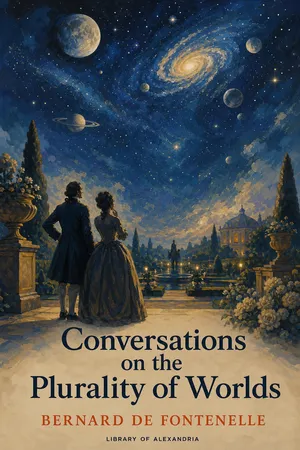
What if Earth were only one inhabited world among countless others? A philosopher and a curious Marchioness turn an evening beneath the stars into an adventure in thinking.
First published in 1686, Bernard de Fontenelle's Conversations on the Plurality of Worlds brings astronomy into the setting of a garden conversation. Through lively exchanges, the philosopher explains Earth's motion, the arrangement of the solar system, and the possibility that distant stars are suns with worlds of their own. The Marchioness questions, challenges, and follows the argument, giving the reader a companion in discovery rather than a silent audience.
Written in French for readers beyond the scholarly world, this landmark of science communication joins Copernican astronomy to imaginative speculation about life elsewhere. Its conjectures belong to the science of its time, not to present-day planetary knowledge; that historical distance is part of its fascination. Fontenelle shows how reason and imagination can work together, while raising enduring questions about evidence, belief, and humanity's place in a vast creation.
What readers find inside:
- Earth in Motion - Familiar appearances give way to the Copernican picture of a moving Earth among the planets.
- Inhabited Planets - Speculation about life on the Moon and other worlds tests the boundaries between reasoning and imagination.
- Distant Suns - The fixed stars become the starting point for a vision of many possible planetary systems.
- Curiosity in Dialogue - The Marchioness's questions turn abstract ideas into an engaging exchange of doubts and discoveries.
- Science and Belief - The scale of the cosmos prompts reflection on creation and the limits of human knowledge.
For readers of astronomy history, lovers of philosophical dialogue, and anyone intrigued by the long search for life beyond Earth, this is an inviting encounter with an earlier age of cosmic discovery.
Step into the garden and follow a conversation that makes the night sky a place of possibility.