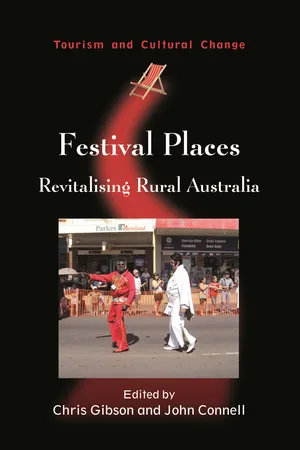
Festivals have burgeoned in rural areas, revitalising old traditions and inventing new reasons to celebrate. How do festivals contribute to tourism, community and a rural sense of belonging? What are their cultural, environmental and economic dimensions? This book answers such questions - featuring contributions from leading geographers, historians, anthropologists, tourism scholars and cultural researchers. It draws on a range of case studies: from the rustic charm of agricultural shows and family circuses to the effervescent festival of Elvis Presley impersonators in Parkes; from wildflower collecting to the cosmopolitan beats of ChillOut, Australia's largest non-metropolitan gay and lesbian festival. Festivals as diverse as youth surfing carnivals, country music musters, Aboriginal gatherings in the remote Australian outback, Scottish highland gatherings and German Christmas celebrations are united in their emphasis on community, conviviality and fun.
- 328 pages
- English
- ePUB (mobile friendly)
- Available on iOS & Android
eBook - ePub
About this book
Information
Part 1
Exploring Rural Festivals
Chapter 1
The Extent and Significance of Rural Festivals
Festivals are enjoyable, special and exceptional, sometimes the only time of celebration in small towns. Festivals are full of rituals of entertainment, spectacle and remembrance, and they bring people together. Most people participate for enjoyment, something different and the pleasure of coming together. Festivals offer much more than just dollars and cents, or place-marketing and branding, although both are implicated. Festivals create culture, engaging some but excluding others. The narratives of participants may articulate a strong sense of being part of a community, however transient, or a reframing of a personal understanding of a specific issue, perhaps sustainability, multiculturalism or reconciliation. More often festivals simply enhance already existing pleasures, from beer drinking to line dancing. Festivals take multiple forms and play multiple roles.
This chapter summarises the findings from a three-year Australian Research Council (ARC) funded project, which sought to document the extent and significance of festivals for rural communities and economies. Hitherto, no studies have sought to measure the geographical extent of festivals, despite numerous case studies done usually from a single disciplinary perspective. What was missing was a sense of the diversity of economic and socio-cultural impacts of festivals in rural localities – understood cumulatively as well as individually. Hence, we sought to develop a different approach, based on accumulating information about festivals across a large area, and building a stock of basic information on their operation and how they nestled within rural communities. We were interested in a range of questions: the role of festivals in rural and regional restructuring; on post-agricultural or ‘post-productivist’ transitions in rural places; and the changing nature of rural cultural identities. Eventually, we constructed the largest ever database of rural festivals in Australia, with more than 2850 festivals in just three eastern Australian states – Tasmania, Victoria and New South Wales – and through wide-ranging qualitative research with a small, selected number of rural festivals, as well as completed questionnaires from 480 festival organisers (Gibson et al., 2010), gleaned insights on the ability of festivals to catalyse social and community networks, to inform regional development and to challenge or sustain rural cultural identities.
Festivals were located mainly by using internet search engines, and running detailed queries by keyword for every local government area (LGA) in the three states, and for particular niches (e.g. for particular styles of music), for common festival types (e.g. food and wine festivals) and for more specific activities associated with demographic groups, subcultures and other leisure activities (e.g. ‘hot rod’ car shows, seniors festivals, gay and lesbian festivals, goth festivals, and diverse sports). Festivals were also located via print media (including regular scanning of metropolitan broadsheets), regional tourism brochures and flyers. Under-represented were festivals without a formal organising committee, postal or email address, and festivals such as those organised by neo-Pagans, Radical Faeries or similar-minded ‘New Age Travellers’ who were seeking to operate in social networks outside mainstream society (see Begg; Gibson & Wong; Slater, this volume). The database and survey eventually became a baseline for various studies that have become chapters in this book. Subsequent detailed studies included analysis of economic dimensions via visitor and business surveys at the Elvis Revival Festival in Parkes, in inland NSW (see Chapter 11), at ChillOut, Australia’s largest rural gay and lesbian festival, held in Daylesford, Victoria (see Chapter 13) and at Gromfest, a youth surfing festival (see Chapter 5). Additional case studies were pursued elsewhere based on related themes, including cultural identity (see Chapter 16), and environmental sustainability (see Chapter 6). In this chapter, we review the overall results of the project and in doing so introduce key themes and issues that resonate throughout the remainder of this book, and that have drawn in contributors with quite different perceptions of the role of festivals in diverse contexts.
Much debate surrounds what constitutes a ‘festival’. A demarcation was made between infrequent, usually annual events, which were included (pending other criteria), and regular, recurrent events (such as sporting fixtures and regular musical nights) held throughout the year that were excluded. Conferences, conventions and trade exhibitions were also excluded. Generally festivals had to meet at least one (and preferably more than one) of the following criteria: use of the word ‘festival’ in the event name; being an irregular, one-off, annual or biannual event; emphasis on celebrating, promoting or exploring some aspect of local culture, or being an unusual point of convergence for people with a given cultural activity, or of a specific subcultural identification. Festivals then were understood following Getz (2007: 31) as ‘themed, public celebrations’. Occasional festivals were spectacular, evoking an older notion of carnival, where ‘people do something they normally do not; they abstain from something they normally do; they carry to the extreme behaviours that are usually regulated by measure; they invert patterns of daily social life’ (Falassi, 1987: 3). This was rare, but evident at the Daylesford ChillOut Festival (see Chapter 13). At most rural festivals people focused on very specific activities (as enthusiasts of a certain sport, music style, collector’s habit or pastime such as gardening), and simply did more of what they did at other times, sometimes flamboyantly – eating, drinking, dancing, singing, spending. What makes festivals different from other events is that they were usually held annually and generally have social aims: getting people together for fun, entertainment and a shared sense of camaraderie. Most festivals created a time and space of celebration, a site of convergence outside of everyday routines, experiences and meanings – ephemeral communities in place and time.
The Diversity of Rural Festivals
Festivals are increasingly numerous, and kaleidoscopically diverse; rural and regional Australia has never hosted as many festivals, an indication of evolving creativity and ingenuity (Gibson et al., 2009; Gibson, 2010). This diversity of festivals reveals the cultural diversity of non- metropolitan Australia – a cultural diversity not so much about ethnic polyphony in the conventional sense (as measured by international migration) but about diversity of cultural pursuits and ideas. The most common festivals were sporting, community, agricultural and music festivals – which together made up three-quarters of the festivals (Table 1.1). Within these categories there was further diversity. ‘Community’ festivals covered everything from Grafton’s historic Jacaranda Festival (named after the town’s signature tree) to Kurrajong’s Scarecrow Festival, Nimbin’s Mardi Grass (a marijuana pro-legalisation festival), Ballarat’s Stuffest Youth Festival, Ettalong’s Psychic Festival, Tumut’s elegant Festival of the Falling Leaf, Queanbeyan’s Festival of Ability, and Myrtleford’s Tobacco, Hops and Timber Festival. Similarly varied were sports festivals, covering everything from fishing to billy carts, cycling, pigeon-racing, hang gliding, track and field events, horse racing, basketball carnivals, ski races, dragon boat racing and campdrafting.
Table 1.1 Numbers of festivals, by type, Tasmania, Victoria and NSW, 2007
| Type of festival | TAS | VIC | NSW | TOTAL** | % of total |
| Sport | 86 | 485 | 488 | 1059 | 36.5 |
| Community | 45 | 216 | 175 | 436 | 15.0 |
| Agriculture | 19 | 146 | 215 | 380 | 13.1 |
| Music | 13 | 116 | 159 | 288 | 9.9 |
| Arts | 12 | 73 | 82 | 167 | 5.8 |
| Other* | 7 | 87 | 71 | 165 | 5.7 |
| Food | 10 | 53 | 67 | 130 | 4.5 |
| Wine | 7 | 49 | 32 | 88 | 3.0 |
| Gardening | 20 | 43 | 14 | 77 | 2.7 |
| Culture | 2 | 21 | 11 | 34 | 1.2 |
| Environment | 1 | 8 | 12 | 21 | 0.7 |
| Heritage/historic | 4 | 8 | 7 | 19 | 0.7 |
| Children/Youth | 0 | 10 | 5 | 15 | 0.5 |
| Christmas/New Year | 0 | 10 | 2 | 12 | 0.4 |
| Total | 226 | 1325 | 1340 | 2891 | 100 |
Source: ARC Festivals database, 2007
*The other category includes small numbers of the following festival types: Lifestyle, Outdoor, Science, Religious, Seniors, Innovation, Education, Animals and Pets, Beer, Cars, Collectables, Craft, Air Shows, Dance, Theatre, Gay and Lesbian, Indigenous and New Age.
**The total for this table is slightly more than the total number of festivals in the database, due to counting of some festivals in more than one category. This occurred when separating categories proved impossible (e.g. for ‘food and wine festivals’).
*The other category includes small numbers of the following festival types: Lifestyle, Outdoor, Science, Religious, Seniors, Innovation, Education, Animals and Pets, Beer, Cars, Collectables, Craft, Air Shows, Dance, Theatre, Gay and Lesbian, Indigenous and New Age.
**The total for this table is slightly more than the total number of festivals in the database, due to counting of some festivals in more than one category. This occurred when separating categories proved impossible (e.g. for ‘food and wine festivals’).
Places with the most festivals tended to be large regional towns outside capital cities (such as Newcastle, Wollongong and Wagga Wagga), regions reliant upon tourism industries (Snowy River and Coffs Harbour) or coastal ‘lifestyle’ regions with mixes of tourism and retiree in-migration (Lake Macquarie, Bass Coast, Great Lakes). Such places have large enough populations to justify a sequence of festivals with minimal risk of failure. Moreover, several are within ‘day tripper’ driving distance of Sydney and Melbourne, and most have dedicated regional tourism offices, major tourist information centres and expertise in place marketing (Gibson et al., 2010). Some ‘festival capitals’ emerge – like Ballarat, with 73 festivals across the calendar year – where there is a clearly identifiable, professional festival and event management industry, with rare parallels in smaller towns (such as Daylesford and Byron Bay).
Few festivals were organised as subversive protests, despite the rapid social and economic transformations beyond metropolitan centres. Exceptions included the counter-spaces of folk festivals (Chapter 15) and ‘free-festivals’, such as the Homeland Festival of Sacred Song and Dance (Dorrigo) and Woodford Festival (where music combines with poetry, politics, Koori (Aboriginal) ceremonies, open-mike sessions and workshops on sustainability and activism). While satire may be an integral part of many street parades – such as the Daylesford New Year Festival (which typically, and unusually for a regional festival, features floats that comment on local controversies and parody big corporations) – rarely were festivals opposed to political systems, or offered different political agendas or to win new loyalties. Nor did festivals resonate with Bakhtin’s (1984) concept of the ‘carnivalesque’, where festivals are sanctioned by the political elite as a mechanism to help the masses forget social injustices and inequalities: bread and circuses. Where rural communities have engaged in political action, on issues as diverse as the closure of regional services and infrastructure, timber cutting, climate change and industry deregulation, they have usually resorted to more formal protests, petitions and lobbying (Gibson et al., 2008). Instead, where politics featured at rural festivals in our research, this was usually a somewhat reserved integration of political issues with more simple pleasures: a stall from the local branch of the Green Party or the National Farmer’s Federation amongst those selling bags, t-shirts, hot-dogs and beer, or charities promoting ‘good causes’ such as ecology, sustainability or breast cancer research as part of a festival’s aims and activities (see Chapters 6 and 10).
Country, jazz, folk and blues festivals counted for over half the music festivals – far outweighing styles such as rock or hip-hop that are more commercial or lucrative in the wider retail market for recorded music (Gibson, 2007). Music and arts festivals were more vernacular than elite: sewing and quilting festivals were as common as opera festivals; country music was more prevalent than jazz, and ‘roots’, bluegrass and folk were more popular than commercial sales of recorded music might suggest. Music festivals were amongst the largest of the festivals, including Tamworth’s annual country music festival, Tweed Heads’ ‘Wintersun’ Rock and Roll/1950s nostalgia festival, and Byron Bay’s East Coast Blues and Roots Festival and Splendour in the Grass, where audiences ranged from 15,000 to 100,000 people.
The vast bulk of regional festivals were otherwise comparatively small. The average attendance at festivals was 7000, but the actual sizes varied enormously. The Victorian Seniors Festival, actually held in many locations at different times throughout the state, claimed an attendance of 400,000. By contrast, the tiny Summit to the Sea endurance cycling festival had a mere 15 participants. Some 138 festivals (29%) had audiences of fewer than 1,000 people and two-thirds had fewer than 5000, while just 11 festivals (barely 2%) had audiences of more than 50,000; four of these were agricultural shows and another four were music festivals.
Generally small numbers indicate both that country towns themselves are small and that many festivals refl ect the proliferation of specialist niches for people with shared passions – whether pigeon-racing or model train collecting. At such events, subcultural or even ‘neo-tribal’ relationships are formed between people with shared enthusiasms who speak the same (often arcane) language (Chapter 15). More frequently small numbers refl ected small places and thinly spread populations – demographic reality making it difficult to generate large crowds. In these small festival settings, the range of sometimes socially diverse people who live nearby are brought together into what are often quite intimate social settings. Anonymity is near impossible, with participants personally encountering entertainers and activities, friends and neighbours, and even sworn enemies. More than anything else this sense of totally embracing community distinguishes rural and urban festivals.
Festivals thus provide unique opportunities to bring unrelated people together in novel ways (see Chapter 3), but also reinforce pre-existing relationships and social ties. Because rural festivals are on the whole small and geared towards local communities, rather than tourists or other outsiders, they provide venues for individuals, families and friendship-circles to sustain and re-invigorate emotional ties. In the unusual case of the ChillOut Festival in Daylesford, the event built an alternative understanding of community by providing a context for local residents to challenge their assumptions about sexuality, and dispel the anxieties of some local people over homosexuality in rural Australia, however tentatively (see Chapter 13). Few alternative instances exist and are as successful as community festivals in bringing together, however fleetingly, otherwise disparate social groups. Through their capacity to evoke emotions, festivals thus have the capacity to reconsider and re-imagine what constitutes the local community.
While newcomers like the ChillOut Festival have been in place for just 14 years, 67 festivals who returned a survey had been running since before 1900. These were mostly gardening and flower festivals (a mainstay of Australian country life), and rodeos agricultural shows, an archety...
Table of contents
- Coverpage
- Series Editor
- Titlepage
- Copyright
- Contents
- List of Figures and Tables
- Contributors
- Dedication
- Preface
- Part 1: Exploring Rural Festivals
- Part 2: Nuts and Bolts: Making Festivals Happen
- Part 3: Politics and Place: Culture, Nature and Colonialism
- Part 4: Reinventing Rurality
- Part 5: Festival People
- Index
Trusted by 375,005 students
Access to over 1.5 million titles for a fair monthly price.
Study more efficiently using our study tools.
Frequently asked questions
Yes, you can cancel anytime from the Subscription tab in your account settings on the Perlego website. Your subscription will stay active until the end of your current billing period. Learn how to cancel your subscription
No, books cannot be downloaded as external files, such as PDFs, for use outside of Perlego. However, you can download books within the Perlego app for offline reading on mobile or tablet. Learn how to download books offline
Perlego offers two plans: Essential and Complete
- Essential is ideal for learners and professionals who enjoy exploring a wide range of subjects. Access the Essential Library with 800,000+ trusted titles and best-sellers across business, personal growth, and the humanities. Includes unlimited reading time and Standard Read Aloud voice.
- Complete: Perfect for advanced learners and researchers needing full, unrestricted access. Unlock 1.5M+ books across hundreds of subjects, including academic and specialized titles. The Complete Plan also includes advanced features like Premium Read Aloud and Research Assistant.
We are an online textbook subscription service, where you can get access to an entire online library for less than the price of a single book per month. With over 1.5 million books across 990+ topics, we’ve got you covered! Learn about our mission
Look out for the read-aloud symbol on your next book to see if you can listen to it. The read-aloud tool reads text aloud for you, highlighting the text as it is being read. You can pause it, speed it up and slow it down. Learn more about Read Aloud
Yes! You can use the Perlego app on both iOS and Android devices to read anytime, anywhere — even offline. Perfect for commutes or when you’re on the go.
Please note we cannot support devices running on iOS 13 and Android 7 or earlier. Learn more about using the app
Please note we cannot support devices running on iOS 13 and Android 7 or earlier. Learn more about using the app
Yes, you can access Festival Places by Chris Gibson,John Connell in PDF and/or ePUB format, as well as other popular books in Business & Hospitality, Travel & Tourism Industry. We have over 1.5 million books available in our catalogue for you to explore.