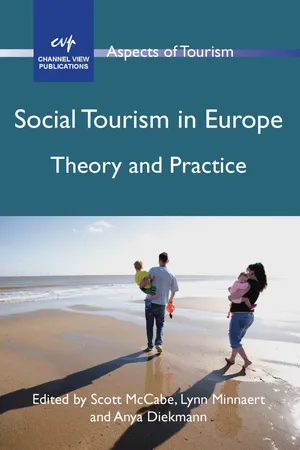
This book, the first on social tourism in English, provides a comprehensive analysis of the various systems and practices in support of disadvantaged people's enjoyment of tourism. Combining theory and practice and a truly European perspective, this book provides an interdisciplinary approach to examine the concepts and contexts underpinning social tourism that will be a key reference point for students, practitioners and researchers. Theoretical perspectives on social tourism are assessed in the context of social inequality, sustainability, family diversity, mobility and the welfare society. The case studies cover public initiatives, charities and voluntary organisations, from a range of different countries including the UK, Ireland, Belgium, Denmark and Poland, covering the diversity of systems and practices in Europe.
- 216 pages
- English
- ePUB (mobile friendly)
- Available on iOS & Android
eBook - ePub
About this book
Information
Topic
Negocios y empresaSubtopic
Hostelería, viajes y turismo1 Introduction
Social tourism is an established part of the tourism sector in many European countries. Early manifestations date back to the 19th century, and in the 20th century social tourism played a large part in the democratisation of travel for the masses. Today, there is a wealth of organisations involved in the supply of social tourism to a diverse range of groups. Social tourism schemes across Europe involve billions of euros of spending and help to provide access to tourism for millions of citizens. Social tourism is diverse, innovative and collaborative, and often at the cutting edge of sustainable practice in the tourism sector. Social tourism provides opportunities for social inclusion in European society; it not only delivers important benefits for individuals but also helps to create stronger families, improves wellbeing and delivers a fairer Europe for all.
Considering its importance and rich history, its linkages across sectors of the industry and government policies, its orientation to social goals, and its implementation across Europe in many different ways, it is surprising that social tourism as a concept has been largely neglected in the tourism literature, at least in the English language, until fairly recently. Somewhat less surprisingly, but no less of an issue, social tourism is not represented at all in the English language literature on social policy. The tourism industry is often described as a hidden industry because of its intangible characteristics, but within the sector social tourism is very often totally invisible. Moreover, because great variations exist across Europe in the scale, emphasis and direction of social tourism practice (as well as the lack of translated research or policy across European languages), it is difficult to generalise about social tourism as a phenomenon. What is certain, though, is that social tourism has not received the attention which it deserves in terms of either conceptual debate or an understanding of practices, systems and contexts.
This book aims to address the peripheral position that social tourism has been afforded by the literature. It offers a multidisciplinary perspective that seeks:
• to develop our understanding of what social is and how it is structured and organised in Europe;
• to set out the role that tourism plays in society generally, problematising the conception of tourism as ‘just an industry’ and social tourism's role in the emerging restructuring of a ‘social economy’;
• to establish the links between tourism as a feature of social and welfare policies (incorporating social inclusion agendas) and the sustainability agenda;
• to highlight the ways in which tourism is affected by social policies that relate to changing family structures and disability issues.
The book also aims to connect academic discussions with practical examples of how social tourism operates in Europe today, identifying best practices across a broad range of European contexts. The purpose is to set a context for future debate and research, to outline the range of challenges and opportunities for social tourism in the future and to assess the contribution that social tourism can make to an inclusive Europe.
The timing of this book is particularly apt, as social tourism is presently being discussed with renewed interest. Over the past 15 years, there has been a seismic shift in consumer practices in the developed world. The consumer society, heralded by the great social theorists in the late 1960s, has truly come to pass. European economies have witnessed a massive transformation from production to consumption; they are now dominated by the service and public sectors, and are driven by huge leaps in technological advances. The most recent economic crisis and global recession, triggered by the collapse in global investment banking businesses in late 2007, demonstrates both the interconnectedness of global economies and also the fragility of European capitalism's dependence on the financial and other service sectors. The impacts of the crisis in the financial services sector and the high levels of public debt in many European countries may have a lasting and profound effect on consumer practices, even well established norms in areas such as holidays and leisure travel.
Tourism is one area of consumption that has come to epitomise the processes of development and economic growth of the past decades: European travel has been democratised as a consequence of a deregulated market which has aligned cheaply available accommodation, combined with mass transport infrastructure, to an exploding market demand. This has positioned Europe as the leading generating and receiving region for global tourism over the last 30 years. Europeans have become addicted to travel and holidays have become an increasingly essential aspect of social life. In terms of academic position, the new mobilities paradigm, ‘enabling “the social world” to be theorised as a wide array of economic, social and political practices, infrastructures, and ideologies that all involve, entail or curtail various kinds of movement of people, or ideas or information or objects’ (Urry, 2007: 18) appears most apt in highlighting the centrality of travel as an organising construct.
The growing importance of the concept of the ‘visitor economy’ has heralded a hegemonic shift in thinking about travel and tourism, from a crude sectoral perspective to being considered a central force driving economic and social regeneration in many regions of Europe. For these economies, the tourism sector represents an important component of the service sector, which is threatened by the fiscal tightening caused by the economic crisis, important enough for many key players in the industry to call for stimulus actions on the part of governments because of its resilience and potential to help drive recovery (see UNWTO, 2010). The extent to which European national governments and the European Commission (EC) take up this opportunity remains to be seen. In fact, the level of government focus on, and willingness to develop policy for, the travel and tourism sector are uneven, partially depending on whether international travel is a negative or positive factor in balance of payments, and the relative contribution of tourism in each country's gross domestic product (GDP) among a range of other factors. But the growth of mass tourism (and its growing importance as an economic driver) masks great inequalities across Europe in access to its products, as well as differences in cultural practices. Despite increases in the opportunities for and take-up of leisure travel over the last 40 years, many people across Europe cannot access or participate in travel at all, whether holidays, short breaks or even day trips.
It is at this point that debates about the purposes and outcomes of tourism need to be addressed. Some people argue that tourism is just one aspect of discretionary consumer practice, not a fundamental human need, and therefore not a priority for social policy. This view is epitomised by the press coverage which accompanied the launch of the European Union's Calypso programme in 2010. In many examples available on the blogosphere, the announcement was interpreted as a move by Brussels to spend taxpayers’ money on subsidies for holidays for the poor. The argument is that holidays are luxury consumer goods that are ‘earned’ as a reward for work. This rather one-dimensional position appears to have been driven more by an anti-interventionist approach to European politics per se rather than a critical assessment of the role and purpose of holidays in people's lives.
However, others believe travel and tourism to be a social right. The United Nations (1948) Universal Declaration of Human Rights enshrines in its article 24, ‘Everyone has the right to rest and leisure, including reasonable limitation of working hours and periodic holidays with pay’. And although this article is about the right for leisure time and does not mention the right to travel or to tourism activities, article 13(2) of the Declaration insists on the right that ‘Everyone has to leave any country, including his own, and to return to his country’. While this article clearly is about free mobility and goes far beyond ‘tourism’ issues, it still is part of a general conception of a new perceived right to mobility among large proportions of European society. The article is not expressly concerned with social equality of access to travel, however. It is indeed only in the Global Code of Ethics for Tourism of the United Nations World Tourism Organization (UNWTO, 1999: article 7) that tourism is considered to be a right, accessible to all. The semantic backdrop to this debate originates in the European Council Treaty of Nice in 2000, where the right to holidays formally for all people was linked in title IV:31 to work (see Chauvin, 2002). While these two views represent opposing perspectives, it is certainly true that over the last 10–20 years a lack of an ability to take a holiday once per year has become embedded in social indicators of relative poverty, and demonstrates the increasing social importance attached to holidays.
There has also been renewed recent interest in the potential for tourism beyond its economic value as a discretionary consumer activity served by a group of connected service industries. Higgins-Desbiolles (2006; and Chapter 4 in this volume) has argued powerfully that tourism can and should be seen as a social force capable of assisting with development goals as well as providing intrinsic benefits to users. Recent research has reflected on: the potential for tourism to contribute to development goals, particularly as a tool to alleviate poverty through what has become known as pro-poor tourism (Briedenhann & Wickens, 2004; Meyer, 2007); the welfare of people in destina tion com muni ties (Hall & Brown, 1996, 2006); the links between holiday participation and subjective wellbeing (Gilbert & Abdullah, 2004; McCabe et al., 2010); and the potential for tourism to increase social and human capital (Minnaert et al., 2009), especially in the context of disadvantaged families facing difficult personal, social and environmental circumstances.
Research on the benefits of tourism for tourists, however, is limited and lacks comprehensive analysis. Much more focus has been placed on developing the research case for tourism in terms of the development and widespread application of consistent and universal metrics to measure tourism activity and to understand its impacts upon host (destination) communities than on trying to develop a more systematic understanding of the effects of participation on tourists. There is no denying that these effects are not always positive. People on holiday have, for example, been reported to drink more alcohol, take less care with diet and engage in risky sexual behaviour (Hughes et al., 2009; Josiam et al., 1998; Uriely & Belhassen, 2006), but also, at perhaps the more mundane level of family life, the stress of organising family travel coupled with the financial investment in a short, concentrated time can produce severe tensions. Nevertheless, tourism participation is also reported to have a range of positive effects on tourists, which can be seen as responses to a range of psychological, social and physical needs.
Holidays, for example, offer an escape from routine, commitments and social norms and roles. They can represent important opportunities for rest and recuperation from work. Leisure travel (which, in addition to holidays, may take the form of visiting friends and relatives, or religious pilgrimage) provides new experiences, leading to a broadening of horizons and the opportunity for learning and intercultural communication, thereby promoting of peace and understanding, as well as personal and social development and health (McConkey & Adams, 2000; UNWTO, 1980). Relatively little is known about these potential benefits, or indeed the challenges presented by leisure travel. We intuitively accept that holidays are ‘good for you’ and yet we have very little idea how, or to what extent. Because of this lack of research there is hardly any general understanding of how tourism could be used to improve the lives of those people who are currently disadvantaged and unable to participate in tourism, or indeed how to recognise and maximise benefits and minimise the negatives among wider society.
The quest to understand the transformative role of tourism is not new, however. Many scholars across the social sciences and within the tourism academy have noted the potential of tourism to have a lasting impact in terms of identity, personal development, career shifts and worldview. And while there has been much useful recent research focusing specifically on evaluating the impact of government and third-sector support, particularly for disadvantaged groups and people living with disability, this research is atomised, resulting in piecemeal findings that are not connected or which coalesce around an overarching conceptual area. A useful framework does exist, however, in the form of social tourism, especially in relation to its benefits to people, economies and society. But although social tourism is well established in some parts of the world, it is hardly known in others. Even across Europe there are myriad interpretations and understandings given to this term, with multiple definitions and a varying range of applications across national boundaries, despite the existence of the International Social Tourism Organisation (ISTO, formerly BITS – see Case Study 1), based in Brussels, and an increasing importance attached to social tourism through the European Union's Tourism Unit (Diekmann & McCabe, 2011). Also, there is a lack of academic focus on social tourism in the European university curricula, to the extent that no specific high-level programmes are currently available. There are few academic study materials available in English: the current book aims to address this, to put social tourism on the educational agenda in tourism studies.
The rationale for attempting to provide a comprehensive analysis of social tourism stems partially from the lack of attention given to the subject by the various stakeholders, but also from a recognition that tourism has come full circle from its origins as an activity which was acknowledged to bring important social and personal benefits for individuals in the early days of the development of mass tourism in the 19th century. After a long period in which tourism was seen solely as an aspect of conspicuous consumption, it is being considered once again for its merits for individual and social growth, partially through recognition of tourism's role in modernisation and development in the poorest countries of the world, but also through social tourism.
European societies have undergone dramatic structural changes: increas ing inequalities between the poor and the better-off (see for example Organisation for Economic Co-operation and Development, 2008); restrictions on mobility placed by soaring fuel prices; the ‘ghetto-isation’ of disadvantaged people in high-density, urban, deprived neighbourhoods; and greater differences in health, education and work opportunities between communities. Coupled to these problems is a recognition that government interventions are perceived to have been unable to achieve a real difference in the quality of people's lives. This has left governments across Europe to reassess their policies to tackle material deprivation, health, education and wellbeing. Our impetus with this book is to make the case that social tourism does have the potential to make a real difference to people's lives, that there is a need for social tourism in Europe and that the adoption of a pan-European social tourism policy can be a realistic goal. The need for further research and policy is also highlighted, as this book aims to provide a theoretical overview of the scope for social tourism, to outline the issues and to place them in the context of a broad range of case studies that illuminate a wide range of practices across Europe.
Structure of the Book
This book combines an exploration of the theoretical underpinnings of social tourism with examples of practical implementations. The more conceptual chapters draw upon different fields in the social sciences, such as economics, mobilities studies, politics and sociology. The key issues raised in each chapter (apart from the concluding one) are highlighted in the case study that follows it.
In contrast to recent interest in research on social tourism, many governmental organisations, federations, unions, health insurance companies, ecclesiastic movements as well as private enterprises have been important key actors since the introduction of paid holidays back in the 1930s. These actors have shaped the development of social tourism in Europe and have contributed to its diverse evolution. Chapter 2 discusses the various definitions of social tourism and places it in its historical context. The chapter examines the development of social tourism since the 19th century and explores how this history informs current practices and systems. We highlight how conceptions of social tourism are still evolving today, in response to a rapidly changing socio-ec...
Table of contents
- Coverpage
- Titlepage
- Copyright
- Contents
- Figures
- Tables
- Acknowledgements
- Contributors
- 1 Introduction
- Case Study 1: International Social Tourism Organisation (ISTO, formerly BITS)
- 2 Defining Social Tourism and its Historical Context
- Case Study 2: Holiday Participation Centre (Steunpunt Vakantieparticipatie), Flanders, Belgium
- 3 Social Tourism Today: Stakeholders, and Supply and Demand Factors
- Case Study 3: Family Holiday Association, UK
- 4 Resisting the Hegemony of the Market: Reclaiming the Social Capacities of Tourism
- Case Study 4: Labour Market Holiday Fund (Arbejdsmarkedets Feriefond), Denmark
- 5 Social Tourism and the Social Economy
- Case Study 5: Floreal (Joie et Vacances), Belgium
- 6 Mobilities and Social Exclusion: Towards a Research Agenda
- Case Study 6: The Sunshine Fund, Ireland
- 7 The Welfare Society and Tourism: European Perspectives
- Case Study 7: Polish Tourist Country-Lovers’ Society (Polskie Towarzystwo Turystyczno-Krajoznawcze, PTTK)
- 8 The Family Factor in Social Tourism
- Case Study 8: The Family Fund, UK
- 9 Disability, Representation and Access to Tourism
- Case Study 9: Cooperative Social Society (Consorzio Sociale, COIN), Italy
- 10 Social Tourism and Sustainability
- Case Study 10: European Union Federation of Youth Hostel Associations (EUFED)
- 11 Conclusions and Future Research Issues
- Index
Trusted by 375,005 students
Access to over 1.5 million titles for a fair monthly price.
Study more efficiently using our study tools.
Frequently asked questions
Yes, you can cancel anytime from the Subscription tab in your account settings on the Perlego website. Your subscription will stay active until the end of your current billing period. Learn how to cancel your subscription
No, books cannot be downloaded as external files, such as PDFs, for use outside of Perlego. However, you can download books within the Perlego app for offline reading on mobile or tablet. Learn how to download books offline
Perlego offers two plans: Essential and Complete
- Essential is ideal for learners and professionals who enjoy exploring a wide range of subjects. Access the Essential Library with 800,000+ trusted titles and best-sellers across business, personal growth, and the humanities. Includes unlimited reading time and Standard Read Aloud voice.
- Complete: Perfect for advanced learners and researchers needing full, unrestricted access. Unlock 1.5M+ books across hundreds of subjects, including academic and specialized titles. The Complete Plan also includes advanced features like Premium Read Aloud and Research Assistant.
We are an online textbook subscription service, where you can get access to an entire online library for less than the price of a single book per month. With over 1.5 million books across 990+ topics, we’ve got you covered! Learn about our mission
Look out for the read-aloud symbol on your next book to see if you can listen to it. The read-aloud tool reads text aloud for you, highlighting the text as it is being read. You can pause it, speed it up and slow it down. Learn more about Read Aloud
Yes! You can use the Perlego app on both iOS and Android devices to read anytime, anywhere — even offline. Perfect for commutes or when you’re on the go.
Please note we cannot support devices running on iOS 13 and Android 7 or earlier. Learn more about using the app
Please note we cannot support devices running on iOS 13 and Android 7 or earlier. Learn more about using the app
Yes, you can access Social Tourism in Europe by Scott McCabe,Lynn Minnaert,Anya Diekmann in PDF and/or ePUB format, as well as other popular books in Negocios y empresa & Hostelería, viajes y turismo. We have over 1.5 million books available in our catalogue for you to explore.