Shopping Tourism, Retailing and Leisure provides a comprehensive examination of the relationships between tourism, leisure, shopping, and retailing. Critical issues are examined within the framework of the dichotomous relationship between utilitarian and hedonic forms of shopping, shopping as a primary and secondary attraction in tourist destinations, the development of various tourist-retail venues, the role of souvenirs in tourism, and management issues (e.g. merchandising, venue design, and customer service).
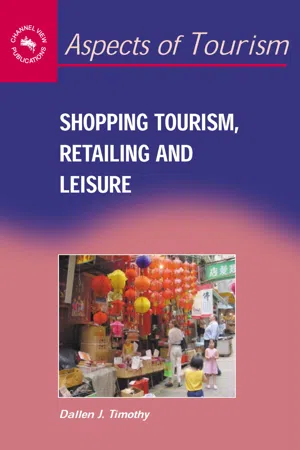
- 200 pages
- English
- ePUB (mobile friendly)
- Available on iOS & Android
eBook - ePub
Shopping Tourism, Retailing and Leisure
About this book
Information
Chapter 1
Leisure Consumption, Shopping, and
Tourism
Get me out of this irritating natural stuff and back to the mall!
This 1999 comment by a female tourist in Volcano National Park, Hawaii, overheard by Lori Otterstrom, an acquaintance of the author, is very enlightening. It emphasizes the depth and breadth of relationships between tourism, mass consumption, and shopping. For this tourist, an essential trip to the mall while on holiday in Hawaii was interrupted briefly by an undesirable side-trip to a natural site. The following question seems to be posed: Why would anyone want to experience nature in Hawaii, when there is shopping to be done? There is little doubt that, once back in ‘civilization’, this tourist's shopping activities resumed. Thus, in the midst of the grandeur of a natural wonder, the desire for a transition from symbolic consumption (of nature) to a more concrete form of consumption (of goods) was pronounced. While visiting the natural attraction was indeed a form of symbolic consumption, it was not the most important form for this woman.
All types of tourism and tourist activities are, in one way or another, a form of consumption but it is the consumptive activity of shopping that is of most concern in this book. This introductory chapter sets the stage for understanding the relationships between shopping, consumption, and leisure/tourism from a conceptual viewpoint. It reviews the notion of consumption as the foundation of the relationships between tourism, leisure, and shopping and outlines the book's content. It also provides an overview model of the treatment of the subject of shopping tourism, retailing, and leisure.
Consumption
In medieval times, the notion of consumption differed considerably from to what it is today. For the majority of the earth's population, consumption was based on need and everyday survival, while for a small handful of landlords and nobility, it centered on excess, spectacle, and status. The 18th century, however, brought about the initial stages of industrialization, and consumer capitalism soon followed. An increased domestic consumer market was thus created, and in response, new merchandise and wider product choices were introduced (Friedman, 1994). This early consumer revolution allowed an increasing number of people to purchase wider varieties of household goods, clothing, and body adornments in an increasingly broad array of retail venues (Coles, 1999b). Heavier industrialization during the 19th century spread greater wealth to more people and sectors of society, as industrial capitalism began to pervade the social economics of Western Europe and North America. With affluence came changes in patterns of consumption. It began to play a more central role in people's lives, providing opportunities to set themselves apart from other social status groups. Owing to their new-found wealth, the emerging middle and upper classes of North America began to imitate the lifestyles of European and British elites (Bocock, 1993: 14–15). In the economic works of Keynes, the propensity to consume was seen as a product of increased income, although not necessarily at the same rate, thus allowing the middle and upper classes to accumulate wealth (Friedman, 1994). Veblen (1934) studied this social class in the 1890s in the United States and it was from these observations he developed his theory of ‘the leisure class’. Patterning their lives after how they thought the European aristocracy lived, the richer classes of the late 19th century practiced methods of consumption that typically precluded the involvement of the working and lower middle classes. Eating expensive food, drinking costly wines, wearing fine clothing and jewelry, and purchasing fine furniture for their stately homes became central to the lives of the leisure class of the 1800s (Bocock, 1993; Campbell, 1994; Davis, 1966a, 1966b; Satterthwaite, 2001), ushering in the age of mass consumption (Miller, 1987, 2001). In this way, according to Satterthwaite (2001: 8), rarities became commonplace.
In the late 19th century, caught up in the rush of this burgeoning class of consumers, cities like Paris, London, Berlin, Chicago, and New York expanded their transportation networks, enhanced their urban infrastructures, and built large department stores in their booming centers (Bocock, 1993; Coles, 1999a; Edwards, 2000; Miller, 1987). By the middle of the 20th century, mass consumption had spread throughout Europe and North America among all but the very poorest groups in society. As products became more diverse and variations in size and quality expanded, consumption was no longer the exclusive province of the upper class: even the working class, employed in menial jobs, joined the throngs of mass consumers, although patterns of consumption were still underscored by class distinctions (Bocock, 1993).
Consumption has been a key force in the development and sustainability of modern capitalism (Appleby, 1993; Preteceille & Terrail, 1985). ‘Consumerism, that is the active ideology that the meaning of life is to be found in buying things and pre-packaged experiences, pervades modern capitalism’ (Bocock, 1993: 50). As utility theory of demand suggests, people purchase what they want and producers manufacture what is demanded (Friedman, 1994). Modern mass consumption is based almost entirely on desires rather than needs and thus, at its very core, consumption is as much social and cultural as it is economic.
Miller et al. (1998: 3–7) summarize the history of the study of consumption, breaking it down into five stages of development. The first stage was characterized by a recognition of the new landscape of consumption, marked most notably by the development of supermarkets, retail warehouses, and shopping malls. Researchers also became interested in consumption because it was in opposition to traditional views of production (e.g. Marxism), which were seen as inadequate in explaining the decline of production-based working classes and the emergence of consumption-oriented middle classes. Likewise, consumption was seen as a way of bringing cultural studies and humanities further along in the social sciences.
Stage 2 is notable because, at this time, the study of consumption became independent and a recognized subject worthy of scholarly attention in several disciplines. It rose in popularity also because of its now-accepted role as a medium for the subjective construction of self and social identity. Additional activities, such as festivals, collecting, and catalogue shopping, became legitimized as new forms of consumption. Consumption was recognized as a vital attribute of modernity and its study became increasingly tied to place and space.
Research on the subject grew considerably in the third stage, with attention being paid more closely to production and distribution, rather than just consumption. This new trend began to examine the important roles of store salespeople, merchants, and other members of the workforce in the process of consumption. This period was also concerned with the meaning of subjectivity in that most works had previously too easily assigned consumer objects to specific groups of subjects owing to the overuse of social categories like class and status. Thus, the subjective meanings and values assigned to objects and subjects were seen as being inaccurate and too conforming.
The fourth stage addressed primarily the history of consumption and how the mass consumer societies developed and the retail growth that accompanied it from the late 1800s. Finally, the issue of place and space characterizes much of the research during the latest phase. In particular, place and space are seen as important elements in the formation of consumer identities. Researchers are now beginning to deconstruct the notions that space creates consumption and consumption creates place.
Based on the recognition of these important elements of consumption, several academic disciplines (i.e. sociology, anthropology, economics, politics, psychology, and geography) grasped the subject as a worthwhile and serious topic of study – each bringing its own unique perspective into the realm of consumption research.
Social and anthropological perspectives
Challenging the traditional economic views of consumption, with the recognition that it is, in fact, not merely an economic activity but also a social and cultural one, sociologists and anthropologists became interested early on (in the 1800s) in the ways in which consumption manifests in society and in various cultural contexts. Most of the sociological literature indicates that the consumption of commodities is based more on their socially conditioned meaning than on their functional use (Brown, 1992; Friedman, 1994; Newby, 1993). Veblen (1934) recognized this (originally in 1899) in his discourse on the symbolic meanings behind consumption. This line of thinking stems from history as described earlier, wherein levels and degrees of consumption were a sign of social status and class distinction. Thus, consumerism became connected to social identity and self-image with considerable implications for social inequality and individualism (Edwards, 2000; Miller, 1987; Starkey, 1989). Consumption does not just benefit from objects or services but, rather, it is the act of consuming objects itself that is a sign of personal and social identity; the image projected by the object is usually more important than its usefulness (Baudrillard, 1988). In the contemporary context,
This certainly is the basis on which many cars are marketed and purchased, and certainly for many, it is a prime consideration when buying clothes. It is the need to identify and acquire these images that shifts some shopping activity into the leisure domain. (Newby, 1993: 212)
According to Solomon (1992), this is because consumers base their social reality on product symbolism and what it portrays to others.
Also of concern has been the effect of social relations on consumption patterns or influences of the social reference group (e.g. class, gender, age, friends, ethnicity, family) (McCracken, 1987; Miller, 1998). Shields (1992: 110) notes the importance of this and suggests that shopping and consumption have ‘become a communal activity, even a form of social solidarity’.
Anthropological perspectives have tended to focus on material culture and its various uses (Campbell, 1991), as well as the cultural significance of consumable commodities. Cultural artifacts and celebrations as commodities to be promoted and consumed by various groups and the resultant changes in their forms and functions are of considerable interest to cultural theorists (e.g. Cohen, 1988a; Graburn, 1976, 1984).
Spatial and ecological perspectives
The spatial dynamics of consumption were recognized in the 1930s by German geographer Walter Christaller, who developed Central Place Theory to describe the retail hierarchy of cities and towns. He theorized that the size and spacing of towns and villages were a result of people's consumptive behavior. In studying settlements in southern Germany, Christaller found that there were many small communities, which offered limited services and were located relatively short distances from each other. Larger towns, however, were fewer in number and located further apart. In today's terms, basic services (e.g. grocery store or petrol station) are said to be of a lower order, while specialized services (e.g. electronics shops, universities, etc.) are said to be of a higher order. Christaller concluded that a town with higher-order services implies that there are lower-order services around it but not necessarily vice versa. Settlements that provide lower-order services, he called ‘low-order settlements’. These, he argued, were more plentiful and closer together than high-order towns, which are fewer and farther between (Christaller, 1966). While many of the basic elements of his theory still hold true today, variables such as population size, cost of travel, physical geography, and technology necessarily have created disparities in his model from place to place in intervening years. Following Christaller's early work, geographers became engrossed in retail location analysis and physical planning, which had important practical implications for the retail business community when it came to issues of scale, hinterland or service area, and size and layout.
The processes of suburbanization and counter-urbanization were instigated in part at least and extended through various forms of consumption (e.g. car ownership and highway development). Naturally, these movement patterns were of interest to retail geographers, as they sought to understand the role that consumption played in those movements and the ways in which these modern changes transformed consumption patterns (Bromley & Thomas, 1993; Lowe & Rigley, 1996). As Sack (1992: 2) noted, retail establishments, such as malls and department stores, are not only places where goods and services are consumed, they are also places that are spatially arranged to promote consumption.
In more recent times, spatial scientists have become interested in the social spatialization of retail places, consumers’ use of retail space, and the implications of retail scale (Coles, 1999a; Guy, 1998; Shields, 1989; 1992; Snepenger et al., 2003). Correspondingly, geographers have started deconstructing the processes involved in the creation of landscapes of consumption (Goss, 1992; Sack, 1998), for consumption is not only about products: it is also about consuming places, spaces and time – not just at the point of purchase but also in the production and distribution of goods and services. Consumption ‘creates spaces and transforms places’ (Sack, 1992: 25) with social meanings and collective identities. Sack (1992: 1) argues that ‘places created by and for mass consumption are fundamental to our making sense of the modern world… and to our power as agents in the world’.
One thread of geographical inquiry is the relationship(s) between humans and the earth. The ecological viewpoint concerns the impacts that occur as a result of mass consumption. Cars, the must-have embodiment of mass consumption in most western societies, for instance, have acknowledgeable impacts on air and water quality. They are seen as expending natural resources (e.g. oil) too rapidly and indiscriminately. The negative effects of consumption on the environment and its subcomponents (e.g. forests, oceans, etc.) are a major ecological concern. Modern mass consumption is also notorious for the production of billions of tons of waste and pollution every year, which has to be disposed of or dissipated somewhere (Princen et al., 2002; Sack, 1992).
Psychological interests
Consumer psychology is a well-developed and respected area of study. Its main emphasis has been on understanding the consumer experience and relationships with various products and retail venues. This approach to the study of consumption has probably been most utilized by the retail sector in an effort to understand consumer behaviors, expectations, and desires. Traditional studies have sought to reveal the influence of store design, atmosphere, and environment on customer satisfaction and choice (Donovan et al., 1994; Downs, 1970; Jones & Simmons, 1987a, 1987b; O'Neill & Jasper, 1992; Sherman et al., 1997; Solomon, 1992). Many other works have attempted to identify the motivations and decision-making processes behind different forms of consumption (Bellenger et al., 1977; Hirschman, 1984; Westbrook & Black, 1985), as well as the emotions, moods, and subjective experiences that affect consumptive performances (Hirschman, 1980; 1986; Hirschman & Solomon, 1984; Sherman et al., 1997).
More recent research on the psychology of consumption has tended toward the symbolic significance of material objects and concepts about self (Campbell, 1991; McKracken, 1987). Issues such as lifestyle and life cycle, sexuality, the body, fashion, and materialism have recently been spotlighted in psychological research on mass and individual consumption (McCracken, 1987; Solomon, 1992).
Historical and political views
Historians have long looked to pre-industrial societies for an understanding of (post) modern mass consumption before, during, and after industrialization (Campbell, 1991). Because consumption has been viewed with various political undertones, political historians have an interest in class issues of consumption as well, specifically in terms of power, empowerment, and choice. The ways consumption was/is used as a political instrument and how it assists various groups in legitimizing claims to power is a genuine concern among political theorists (McCracken, 1987). Perhaps the most notable is its uses as a tool for maintaining status and class position and, more recently, a justification for economic exploitation through production (Edwards, 2000).
While these short synopses cannot underscore the depth and range of thinking about consumption from each disciplinary perspective, they do highlight some of the major issues of concern that have a conceptual bearing on this book. All of these disciplinary perspectives contribute to our understanding of tourism and leisure as forms of consumption.
Consumption, Leisure, and Tourism
The antecedents (e.g. Marxism) to contemporary thought on capitalism focused on production and the role it played in a modernizing free-market society. Much thinking in the 18th and 19th centuries was geared toward production and work as being fundamental to people's lives and to their very sense of identity, and it was from this perspective that class distinctions were viewed (Bocock, 1993). Today's notion of leisure hardly existed at that time: work was the essence of life and was done as a means of survival. However, toward the end of the 19th century, with the spread of wealth among the burgeoning middle and upper classes, the spotlight moved from production to consumption. Class distinctions were recognized by consumption patterns rather than production, and consumption became defined as leisure – the conceptual opposite of the notion of production or work (Edwards, 2000: 3). According to Bocock (1993), this transformation marked the change from modernity into postmodernity because it entailed a social parad...
Table of contents
- Coverpage
- Titlepage
- Dedication
- Copyright
- Contents
- Preface
- Acknowledgements
- 1 Leisure Consumption, Shopping, and Tourism
- 2 Recreational Shopping, Leisure and Labor
- 3 Shopping Tourism
- 4 Tourist Shopping
- 5 What Tourists Buy: The Ubiquitous Souvenir
- 6 Shopping Venues and Contexts
- 7 Management Issues for Place and People
- 8 Conclusion
- References
- Index
Trusted by 375,005 students
Access to over 1.5 million titles for a fair monthly price.
Study more efficiently using our study tools.
Frequently asked questions
Yes, you can cancel anytime from the Subscription tab in your account settings on the Perlego website. Your subscription will stay active until the end of your current billing period. Learn how to cancel your subscription
No, books cannot be downloaded as external files, such as PDFs, for use outside of Perlego. However, you can download books within the Perlego app for offline reading on mobile or tablet. Learn how to download books offline
Perlego offers two plans: Essential and Complete
- Essential is ideal for learners and professionals who enjoy exploring a wide range of subjects. Access the Essential Library with 800,000+ trusted titles and best-sellers across business, personal growth, and the humanities. Includes unlimited reading time and Standard Read Aloud voice.
- Complete: Perfect for advanced learners and researchers needing full, unrestricted access. Unlock 1.5M+ books across hundreds of subjects, including academic and specialized titles. The Complete Plan also includes advanced features like Premium Read Aloud and Research Assistant.
We are an online textbook subscription service, where you can get access to an entire online library for less than the price of a single book per month. With over 1.5 million books across 990+ topics, we’ve got you covered! Learn about our mission
Look out for the read-aloud symbol on your next book to see if you can listen to it. The read-aloud tool reads text aloud for you, highlighting the text as it is being read. You can pause it, speed it up and slow it down. Learn more about Read Aloud
Yes! You can use the Perlego app on both iOS and Android devices to read anytime, anywhere — even offline. Perfect for commutes or when you’re on the go.
Please note we cannot support devices running on iOS 13 and Android 7 or earlier. Learn more about using the app
Please note we cannot support devices running on iOS 13 and Android 7 or earlier. Learn more about using the app
Yes, you can access Shopping Tourism, Retailing and Leisure by Dallen J. Timothy in PDF and/or ePUB format, as well as other popular books in Business & Hospitality, Travel & Tourism Industry. We have over 1.5 million books available in our catalogue for you to explore.