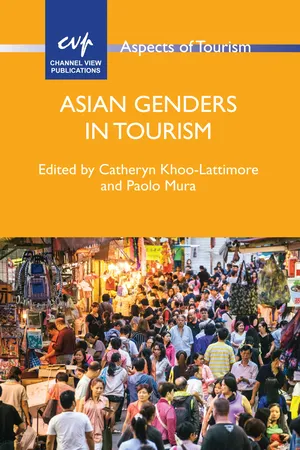
While gender research in tourism has become increasingly important within Western academic circles, little has been written from an Asian perspective. This book is the first to address this knowledge gap and to fully explore Asian gendered identities and tourism. The chapters reflect upon the role of tourism in producing, reiterating and resisting existing gendered structures of power in Asia. The authors attempt to reconcile both Asian and Western perspectives on gender using their own personal experiences of understanding and negotiating Western and Asian identities and practices. The book paves the way for important reflections about the ontological and epistemological meanings of 'Asia', 'gender' and 'tourism'. It is an important resource for researchers from a range of disciplines including tourism, leisure studies, Asian studies and feminist and gender studies, as well as for professionals working in the tourism industry.
- English
- ePUB (mobile friendly)
- Available on iOS & Android
eBook - ePub
Asian Genders in Tourism
About this book
Information
| 1 | The Embodiment of Gender and ‘Asianness’ in Tourism |
| Catheryn Khoo-Lattimore and Paolo Mura |
For some contemporary commentators, academic and activist discussions about
‘gender’ are ‘so last century’, a debate out of place in today’s postmodern world….
(Pritchard et al., 2007: 1)
‘gender’ are ‘so last century’, a debate out of place in today’s postmodern world….
(Pritchard et al., 2007: 1)
… structural inequalities carry little weight, and concerns about the existence and
consequences of social differences based on genders are seen to be ‘politically old fashioned’.
(Oakley, 2006: 19)
consequences of social differences based on genders are seen to be ‘politically old fashioned’.
(Oakley, 2006: 19)
Introduction
Despite the above sentiments, Pritchard et al. (2007) have emphasised the crucial need to continue gender-focused work in tourism. This work is even more pressing in Asia, and from an Asian perspective. As one of the largest tourist-receiving regions, with many emerging markets such as India and Southeast Asia (World Tourism Organization, 2015), Asia is increasingly become a promising market for tourism (Winter et al., 2008). Considering the massive economic potential of tourism in the region, it is not surprising that tourism research in Asia has gained increasing scholarly attention. This new interest in tourism in Asia, however, is predominantly focused on business and marketing, and gender research on Asians as travellers and providers of tourism experiences has not caught up. Moreover, the landscape of the tourism academy is changing, as is the number of Asian researchers (Henderson & Gibson, 2013). A book addressing Asian gendered identities and tourism from a reflexive Asian-centric approach is very therefore timely, especially one with contributors with diverse Asian academic profiles (Mura & Pahlevan Sharif, 2015).
In this regard, we believe that the composition of the team of researchers who produced this book represents the uniqueness of this book, as the authors’ work and leisure routines over time have been unconsciously (and maybe more consciously for some) based on understanding and negotiating both Western and Asian identities and practices. More specifically, the authors’ academic and their equally important non-academic backgrounds and experiences will provide a balanced array of emic and etic perspectives necessary to understand in detail the complexities of gender in Asia. As the reflexivity of researchers as participants is increasingly encouraged, we feel that each author’s ‘situation’ within their own chapters and topics discussed in the book adds a methodological dimension not discussed in any other books on gender. Given that this is the introductory chapter, we also introduce ourselves and the chapter authors to the reader as both researchers and ‘bodies’ located within the tourism topics discussed in this book. To this effect, we first introduce ourselves as editors of the book, and then the authors in the subsequent paragraphs.
Catheryn Khoo-Lattimore is a Malaysian female who has lived in Malaysia for most of her adult life and then pursued an academic career in New Zealand, Malaysia, the USA and Australia. Being married to a white New Zealander, her research often takes a cultural and gendered approach, comparing similarities and differences between Asians and their Western counterparts. Paolo Mura is an Italian male who has studied in Western countries (Italy, Germany, the USA and New Zealand) and has been working as a lecturer and researcher in Malaysia since 2010. In the last 10 years, Paolo’s work has focused on gendered identities on holiday. His PhD studies explored young tourists’ perceptions of fear from a gender perspective. At the moment, his research interests are centred on Asian gendered identities.
Asian Identities in Tourism
While it is easy to define Asia in terms of its geographical boundaries, characterising the diverse Asian identities and their cultural values is a much more difficult task. In Chapter 2, Elaine Chiao Ling Yang and Paolo Mura take on this task and discuss the socio-cultural construction of genders in Asia and what it is to be an Asian woman, man or ‘other’. They examine Asian identities with reference to the dominant cultural ideologies practised in the region – Confucianism, Islam and Hinduism – and how these ideologies have affected the construction of not only gender norms but also socially accepted travel behaviour for contemporary Asian male and female travellers. These ideologies also form the three major religions embraced by Malaysians (Butler et al., 2014), and Elaine, as a Malaysian Chinese, is well placed to provide an emic perspective on the topic in this chapter. As an avid female traveller, Elaine has first-hand experience of linking her doctoral work on Asian female solo travellers to her own experience as an objectified body in tourism. Paolo, an Italian living in Malaysia, contributes a somewhat etic view to this chapter.
Eight out of the 19 books we found in our initial research for competing titles (see below) take a more encompassing male–female approach in the discussion of gender in Asia. However, these books also adopt a very minimalist approach to gender, as they refer to gender using monolithic categories such as ‘men’ and ‘women’. In doing so, existing work on gender in Asia reduces the complexity of gendered relationships to minimalist studies on women’s experiences. In contrast, our book provides a different and complex analysis of gender-based relations in Asia. ‘Gender’, as it is used throughout this book, is not intended to refer only to one’s biological sex (e.g. man or woman). Our aim from the beginnings of this book was to treat the term ‘gender’ as encompassing a more complex meaning, and as a sociocultural construct which regulates how men and women interact with each other in a wider social and tourism setting. We therefore introduce these Asian male–female interactions in a tourism setting in Chapter 4, where Tau Sian Lim and Paolo Mura discuss the concepts of ‘performance’ and ‘performativity’ from theatrical studies, cultural studies and anthropology. In doing so, Tau Sian reflects on his researcher identity as an Asian male exploring the embodiment and enactment of Asian femininity, through the performance of Asian women as tourists on a beach holiday. His reflexivity allows for an understanding of how different masculinities and femininities are performed in different contexts and how they interact to shape gender-based political and socio-cultural structures of power in Asia.
Who’s Who in Asian Genders and Tourism Research?
When researching competing titles for this book, we entered keywords such as ‘Asian + gender’, ‘Asia + gender’ into major publishers’ websites, Google Scholar and Google Books. Although not tourism focused, we did find 19 books on Asian gender and identities, but 11 of these focused on women. Cursory explorations into books that relate gender to tourism revealed interesting work by Kinnaird and Hall in 1994, Sinclair in 1997, Swain and Momsen in 2002, and Pritchard, Morgan, Ateljevic and Harris in 2007, but very few chapters in these books focus on Asian gendered identities in tourism, partly because many of the books’ contributors are Western academics. In Chapter 3, Elaine Chiao Ling Yang and Rokhshad Tavakoli provide an analysis of how past studies have approached Asian genders and tourism. The chapter introduces the reader to the paradigms and methods used by past scholars in their work on tourism research in Asia. It presents both quantitative and qualitative methodologies before revealing the dearth of research on Asia, Asians and Asianness that embraces the crisis of representation. Both Elaine and Rokhshad are young Asian scholars, so their reflections on the issues of power relations in knowledge creation challenge us as a tourism academy to be more accessible to scholars who may not be proficient in the universal language of publications – that is, English – and to consider how the freedom of research is limited in some Asian countries. Their voices echo that of Khoo-Lattimore (2017), who laments the barriers placed in the way of Asian academics in their quest for academic excellence. As a result of their analysis, the authors of Chapter 3 recommend that tourism researchers adopt more critical and reflexive approaches, and find alternative, localised methods for producing knowledge.
As a response to Elaine and Rokhshad’s chapter, Karun Rawat and Catheryn Khoo-Lattimore in Chapter 5 reflect on the dynamics of the Asian researcher–Asian respondent relationship, and in particular how the performance of masculinities among indigenous people in Asia might affect the quality of in-depth data collection. As Karun Rawat is a young Nepali male who has spent most of his life immersed in patriarchal societies with traditional stereotyped definitions of the roles of men and women, it is interesting to see the notion of masculinity in this chapter not only conceptualised within the male researcher’s identity but also emerging among the female indigenous participants in the study presented in the chapter. This emergence, and the acknowledgement of it, reiterate the intersectionality of femininity and masculinity within genders, and in gender studies. At the end of the chapter, the authors come to the realisation that when analysed from a socio-historical point of view, the acquired researcher identity is closer to the socio-cultural identity of his participants than was originally assumed, and that this relationship plays a role in the data collection and analysis stages of any research.
In Chapter 6, Eunice Tan and Barkathunnisha Abu Bakar provide an insight into the Asian female tourist gaze. As Singaporean female tourism scholars, Eunice and Nisha challenge the universalism of the tourism gaze and highlight the cultural and gendered nature of the Asian female gaze. Importantly, by reiterating the idea that the tourist gaze has tended to privilege white males and ignore Asian tourists, their work reminds us of the academic structures of power underpinning tourism scholarly production.
In Chapter 7, Roksana Badruddoja explores the gendered identities of South Asian American women in negotiating their consumption and experiences of Western holidays in America. As a second-generation South Asian American herself, Roksana has had to battle her own different identities, so her own experiences were instrumental in writing this chapter. Likewise, in identifying herself with the 25 female participants of her year-long ethnographic study, she benefited from the acquisition of a calm confidence, understanding and acceptance that it is not possible for an immigrant to choose ‘an’ identity, because identities are fluid and need to be negotiated at all times. Roksana emphasises this point through Western holiday celebrations such as Christmas, which do not immediately and naturally align with the women’s identity as South Asians, even when they do feel connected to such holidays as second-generation Americans. In her analysis, she discusses the intersections among women and their gendered identity, taking into account their skin colour, immigration status and diasporic movement, as well as national belonging and the nation-state, and the relationships among and between these variables.
In Chapter 8, Rokhshad Tavakoli provides a reflective account of her virtual journeys and how virtual tourism has represented an avenue to overcome Iranian women’s barriers to travel. By embracing an ‘auto-netnographic’ approach, Rokhshad’s work also paves the way for new ways of conducting and representing research on Asian genders in tourism.
Overall, with this book we hope to provide an overview of Asian gendered identities on holiday, as we believe that ‘Asia’ has been neglected by tourism scholars. While we appreciate that this collection is only a partial representation of the complexities of Asian genders travelling, we believe that the book will be of interest to tourism scholars focusing on gender, as it provides insights into this unknown universe.
References
Butler, G., Khoo-Lattimore, C. and Mura, P. (2014) Heritage tourism in Malaysia: Fostering a collective national identity in an ethnically diverse country. Asia Pacific Journal of Tourism Research 19 (2), 199–218. doi: 10.1080/10941665.2012.735682.
Henderson, K.A. and Gibson, H.J. (2013) An integrative review of women, gender, and leisure: Increasing complexities. Journal of Leisure Research 45 (2), 115–135.
Khoo-Lattimore, C. (2017) The ethics of excellence in tourism research: A reflexive analysis and implications for early career researchers. Tourism Analysis (forthcoming).
Kinnaird, V. and Hall, D. (1994) Tourism: A Gender Analysis. Chichester: Wiley.
Mura, P. and Pahlevan Sharif, S. (2015) The crisis of the ‘crisis of representation’ – Mapping qualitative tourism research in Southeast Asia. Current Issues in Tourism 18 (9), 828–844. doi: 10.1080/13683500.2015.1045459.
Oakley, A. (2006) Feminism isn’t ready to be swept under the carpet. Times Higher Education Supplement, 3 March, pp. 18–19.
Pritchard, A., Morgan, N., Ateljevic, I. and Harris, C. (2007) Tourism and Gender: Embodiment, Sensuality and Experience. Wallingford: CABI.
Sinclair, M.T. (1997) Gender, Work and Tourism. London: Routledge.
Swain, M.M. and Momsen, J.H. (eds) (2002) Gender/Tourism/Fun? New York: Cognizant Communication.
Winter, T., Teo, P. and Chang, T.C. (2008) Asia on Tour: Exploring the Rise of Asian Tourism. Abington: Routledge.
World Tourism Organization (2015) Over 1.1 billion tourists travelled abroad in 2014. Press release online at http://media.unwto.org/press-release/2015-01-27/over-11-billion-tourists-travelled-abroad-2014 (accessed 27 April 2015).
| 2 | Asian Gendered Identities in Tourism |
| Elaine Chiao Ling Yang and Paolo Mura |
From culture to culture, the male–female distinction has been assigned
meanings and significance that have implications for work, family,
leisure, and ritual – virtually all aspects of social life.
(Lips, 2005: xiii)
meanings and significance that have implications for work, family,
leisure, and ritual – virtually all aspects of social life.
(Lips, 2005: xiii)
Introduction
As a ‘highly politically charged concept’ (Bradley, 2007: 1), gender shapes many aspects of our lives (Burr, 1998), including our experiences as tourists (Swain, 1995). Kinnaird et al. (1994) point out that tourism is a phenomenon constructed within a gendered society, namely a space where gendered identities are formed, reproduced and contested. Likewise, Aitchison (2001: 134) argues that tourism should be conceived as ‘a powerful cultural arena and process that both shapes and is shaped by gendered (re)presentations of places, people, nations and cultures’. Tourism scholars have acknowledged the importance of the gendered structures of power in shaping holiday experiences and tourists’ patterns of behaviour. Indeed, the interest in the gendered nature of tourism has led to a proliferation of studies on gender in the last 30 years. While gender was rarely discussed within tourism academic circles until the mid-1970s, a plethora of studies on gender in tourism have been conducted since the 1980s (see Enloe, 1989; Garcia-Ramon et al., 1995; Kariel & Kariel, 1982; Laver, 1987; Pritchard & Morgan, 2000; Wilson & Little, 2008). The emergence of gender research in tourism reflects many other social science disciplines, especially those focusing on human behaviour and social experience, where gender issues began to receive scholarly attention only after the second wave of the Western feminist movement, in the 1970s (Burgess-Proctor, 2006; Caterall & Maclaran, 2001).
Despite this, the limitations to essentialist and structuralist conceptualisations of gender, mainly based on the assumption that men and women are different due to biological factors (Grewal & Kaplan, 2006), have only recently been acknowledged. In this rega...
Table of contents
- Cover
- Title Page
- Copyright
- Contents
- Acknowledgements
- Contributors
- 1 The Embodiment of Gender and ‘Asianness’ in Tourism
- 2 Asian Gendered Identities in Tourism
- 3 ‘Doing’ Tourism Gender Research in Asia: An Analysis of Authorship, Research Topic and Methodology
- 4 Asian Gendered Performance in Tourism
- 5 The Impact of Masculinities in the Researcher–Respondent Relationship: A Socio-Historical Perspective
- 6 The Asian Female Tourist Gaze: A Conceptual Framework
- 7 ‘Home’ as a Mobile Cultural Diaspora: South Asian American Women and the Conceptualisation of Holidays in America
- 8 My Journeys in Second Life: An Autonetnography
- 9 Conclusion
- Index
Trusted by 375,005 students
Access to over 1.5 million titles for a fair monthly price.
Study more efficiently using our study tools.
Frequently asked questions
Yes, you can cancel anytime from the Subscription tab in your account settings on the Perlego website. Your subscription will stay active until the end of your current billing period. Learn how to cancel your subscription
No, books cannot be downloaded as external files, such as PDFs, for use outside of Perlego. However, you can download books within the Perlego app for offline reading on mobile or tablet. Learn how to download books offline
Perlego offers two plans: Essential and Complete
- Essential is ideal for learners and professionals who enjoy exploring a wide range of subjects. Access the Essential Library with 800,000+ trusted titles and best-sellers across business, personal growth, and the humanities. Includes unlimited reading time and Standard Read Aloud voice.
- Complete: Perfect for advanced learners and researchers needing full, unrestricted access. Unlock 1.5M+ books across hundreds of subjects, including academic and specialized titles. The Complete Plan also includes advanced features like Premium Read Aloud and Research Assistant.
We are an online textbook subscription service, where you can get access to an entire online library for less than the price of a single book per month. With over 1.5 million books across 990+ topics, we’ve got you covered! Learn about our mission
Look out for the read-aloud symbol on your next book to see if you can listen to it. The read-aloud tool reads text aloud for you, highlighting the text as it is being read. You can pause it, speed it up and slow it down. Learn more about Read Aloud
Yes! You can use the Perlego app on both iOS and Android devices to read anytime, anywhere — even offline. Perfect for commutes or when you’re on the go.
Please note we cannot support devices running on iOS 13 and Android 7 or earlier. Learn more about using the app
Please note we cannot support devices running on iOS 13 and Android 7 or earlier. Learn more about using the app
Yes, you can access Asian Genders in Tourism by Catheryn Khoo-Lattimore,Paolo Mura in PDF and/or ePUB format, as well as other popular books in Business & Hospitality, Travel & Tourism Industry. We have over 1.5 million books available in our catalogue for you to explore.