The rapid global spread of the English language has serious linguistic, ideological, socio-cultural, political, and pedagogical implications as it creates both positive interactions and negative tensions between global and local forces. Accordingly, debate about issues such as the native/non-native divide, the politics of an international language, communication in a Lingua Franca, the choice of a model for ELT, and the link between English and identity(ies) has stimulated scholarly inquiry in an unprecedented way. The chapters in this volume revisit, challenge, and expand upon established arguments and positions regarding the politics, policies, pedagogies, and practices of English as an international language, as well as its sociolinguistic and socio-psychological complexities.
eBook - ePub
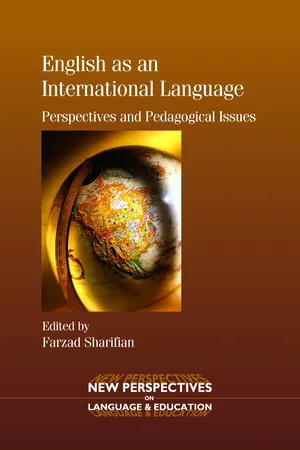
English as an International Language
Perspectives and Pedagogical Issues
- 240 pages
- English
- ePUB (mobile friendly)
- Available on iOS & Android
eBook - ePub
About this book
Information
Topic
EducationSubtopic
Multicultural EducationChapter 1
English as an International Language: An Overview
FARZAD SHARIFIAN
Background Studies
For better or worse, by choice or force, English has ‘traveled’ to many parts of the world and has been used to serve various purposes. This phenomenon has created positive interactions as well as tensions between global and local forces and has had serious linguistic, ideological, sociocultural, political and pedagogical implications. Many publications have been devoted to the study of the worldwide spread of English. Processes, implications and consequences have been explored (e.g. Abbott & Wingard, 1981; Bailey & Görlach, 1982; Brutt-Griffler, 2002; Crystal, 1997; Graddol, 1997; Hardin, 1979; Hassall, 2002; Holliday, 2005; Jenkins, 2000, 2006a; Kachru, 1986; Kirkpatrick, 2007; McKay, 2002, 2003; Nakamura, 2002; Smith, 1983; Strevens, 1980). The roles that English has played in the lives of individuals as well as communities range from marginalization and hegemony on the one side to empowerment and upward mobility on the other. As Kachru (1996: 135) puts it, ‘the universalization of English and the power of this language have come at a price; for some, the implications are agonizing, while for others they are a matter for ecstasy’. Recent decades have witnessed scholarly inquiry and unprecedented lively debate about these issues (e.g. Burns & Coffin, 2001; Canagarajah, 1999; Pennycook, 1994; Phillipson, 1992; Phillipson & Skutnabb-Kangas, 1996; Rubdy & Saraceni, 2006).
As English rapidly develops more complex relationships within and between communities of speakers around the world, the dialogue addressing its role as a global language needs to continue to expand. Established arguments and positions regarding politics, policies, pedagogies and practices of English as an international language, as well as its socio-linguistic and sociopsychological complexities need to be revisited, raising new sets of questions. Also, in order to explore these issues from a truly global perspective, it is necessary to open the forum further to scholars from underrepresented regions in the world, who would be able to explore yet untouched issues. This volume is a step towards achieving these aims.
But first, there seems to be a need to clarify what EIL refers to. A good number of discussions in the context of the globalization of English have centered around the use of umbrella terminology. While this overview chapter does not intend to engage in a terminological debate within the field, it aims at clarifying what EIL, as a unifying theme for this volume, stands for.
What is EIL?
In general, we can say that English as an International Language refers to a paradigm for thinking, research and practice. It marks a paradigm shift in TESOL, SLA and the applied linguistics of English, partly in response to the complexities that are associated with the tremendously rapid spread of English around the globe in recent decades. My mention of ‘thinking’, ‘research’ and ‘practice’ above is not meant to suggest that research does not include thinking or that practice excludes thinking. In fact, to engage in practice, informed by the perspective of EIL, is to engage in critical thinking and research.
It is important to emphasize that EIL does not refer to a particular variety of English. Some scholars confuse the term ‘International English’ with EIL. The use of an adjective plus ‘English’ often suggests a particular variety, such as American English, Singaporean English or Chinese English. Thus ‘International English’ can suggest a particular variety of English, which is not at all what EIL intends to capture. EIL in fact rejects the idea of any particular variety being selected as a lingua franca for international communication. EIL emphasizes that English, with its many varieties, is a language of international, and therefore intercultural, communication.
As a paradigm, EIL calls for a critical revisiting of the notions, analytical tools, approaches and methodologies within the established disciplines such as the sociolinguistics of English and TESOL, which explored various aspects of the English language. One of the central themes of EIL as a paradigm is its recognition of World Englishes, regardless of which ‘ circles’ they belong to (Bolton, 2004; Kachru, 1986, 1992). Kachru (e.g. 1986, 1992) described the role and use of English around the world using a model that has three concentric circles: Inner-Circle, Outer-Circle and Expanding-Circle countries. In Inner-Circle countries, English is used as the primary language, such as in the United Kingdom, the United States, Australia and Canada. Countries located in the Outer Circle are multilingual and use English as a second language, such as India and Singapore. In Expanding-Circle countries, the largest circle, English is learned as a foreign language, such as in China, Japan, Korea and Egypt. Some scholars use the term ‘World Englishes’ in a limited way to refer only to Englishes in the Outer-Circle countries. However, my usage of the term covers all Englishes from all circles.
The EIL paradigm also emphasizes the relevance of World Englishes to ELT (Matsuda, 2002, this volume). EIL contexts are ones in which English is used between speakers coming from different cultural and national backgrounds. In response to the rapid development of new Englishes, in particular in what was termed ‘Expanding-Circle’ countries, it has become safe to replace terms like ‘English speakers coming from different cultural and national backgrounds’ with ‘speakers of World Englishes’. Again, it should be stressed, this terminology is not restricted to any narrow sense of English used only in Outer-Circle countries.
As Canagarajah (2006) observes, World Englishes can no longer be viewed through the ‘three Circles’ metaphor for various reasons. These include the spread of Outer-Circle Englishes and Expanding-Circle English into the so-called ‘Inner-Circle’ countries. As a large number of speakers from the Outer-Circle and Expanding-Circle countries now live in the Inner-Circle countries, even native speakers of English are increasingly exposed to World Englishes. This means revising the notion of ‘proficiency’ even for the English of native speakers. Canagarajah (2006: 233) maintains that, ‘in a context where we have to constantly shuttle between different varieties [of English] and communities, proficiency becomes complex … one needs the capacity to negotiate diverse varieties to facilitate communication.’
I can provide an example of the complexity of World Englishes from Australia, a country that has generally been viewed as an Inner-Circle country. Here, English has developed into a codified variety which has its own dictionary and a recognized ‘standard’ Australian dialect. However, Aboriginal people in Australia have indigenized English to Aboriginal English, which acts as a lingua franca between Aboriginal and non-Aboriginal people as well as among Aboriginal people who speak mutually unintelligible Aboriginal languages. But Aboriginal English has not been viewed as an Inner-Circle variety, even though it was developed in an Inner-Circle country. Also it should be noted that a large number of Australians speak other World Englishes such as Indian English, Chinese English, Malay English, and so on. In a sense Australia, and countries like Australia, encompass all three circles, hosting many World Englishes. Thus, successful communication for many Australians requires what Canaragajah (2006: 233) refers to as ‘multidialectal competence’, part of which is ‘passive competence to understand new varieties [of English]’. This observation is not just true of Australia. It is gaining global validity.
EIL does not only have implications for mapping the scope of the World Englishes paradigm but it also engages with it at the level of theory. World Englishes can, and have started to, make a significant contribution to the EIL paradigm through the new approaches employed over the last few decades in the study of that field. These include established sociolinguistic approaches as well as more recent approaches such as those from cultural linguistics and cognitive linguistics (Polzenhagen & Wolf, 2007; Sharifian, 2006, this volume). These approaches can provide deeper insights not only into the nature of world Englishes but also about communication across Englishes, an issue which lies at the heart of EIL. This area, however, is still in its infancy (see e.g. Wolf & Polzenhagen, 2006).
EIL has also started to develop a close affinity with research in the area of intercultural communication. As said before, EIL recognizes that English is widely used for intercultural communication at the global level today. It is becoming increasingly recognized that ‘intercultural competence’ needs to be viewed as a core element of ‘proficiency’ in English when it is used for international communication (see also Sharifian, this volume, for the notion of meta-cultural competence).
Given the fact that the bulk of research in the area of intercultural communication has focused on English as a medium of communication, the results can readily be applied in EIL training and teaching. In fact some scholars of EIL have also written in the area of intercultural communication (e.g. Holliday et al., 2004) and many, if not all, have referred to intercultural communication in their discussions of EIL. It should of course be added here that most studies of intercultural communication in English have, up until now, focused on NS-NNS inter-cultural communication. Henceforth, what is needed in the EIL paradigm is an expansion of the scope of speech communities and interlocutors engaged in intercultural communication, especially as most instances of intercultural communication in English today takes place between its non-native speakers.
It should be mentioned here that while the EIL paradigm does problematize the polarization of the English speaking world into native speaker/non-native speaker, it does include so-called ‘native speakers’ of English. There is after all no word in the phrase ‘English as an International Language’ that would automatically exclude the native speakers of the language. However, in the context of the globalization, or what I have termed glocalization (Sharifian, forthcoming) of English, EIL recognizes the fact that the distinction between who is and who is not a native speaker is not always clear-cut. The focus in the EIL paradigm is on communication rather than on the speakers’ nationality, skin color, and so on, those factors which in the metaphor of ‘Circles’ acted as symbolic markers of the politicized construct of ‘native speaker’ (e.g. Brutt-Griffler & Samimy 2002). However, while it lasts, this construct can serve as a springboard for ELT scholars to criticize fundamental notions that are often assumed to capture realities.
From a methodological perspective, the EIL paradigm draws on the established research approaches within the areas of sociolinguistics and applied linguistics but also welcomes the newer qualitative approaches that have emerged in the social sciences. These include narrative inquiry (e.g. Clandinin & Connelly, 2000) and ethnomethodologically-oriented interviews (e.g. Seidman, 2006). As English has played a multitude of roles in people’s lives, and many speakers of English have developed complex relationships with the language, such that it has touched their identities, cultures, emotions, personalities, and so on, so the stories they tell about their relationship with it reveal significant links between language, culture and identity. These stories may best be captured through methods such as narrative inquiry and autoethnography (e.g. Ellis, 2004). English has also come to be used by communities of speakers on the internet, a phenomenon which may best be captured by cyberethnography (e.g. Hine, 2000). Such methods are currently under-utilized in the field, but we are witnessing more and more scholars using methodologies which tap into speakers’/learners’/teachers’ lived experiences and the meanings that they make out of these in relation to English. Some chapters in this volume reflect this trend.
This Volume
The topics covered in the volume represent the variety of arguments and research questions that characterize EIL as a paradigm for thinking, research and practice. The volume also represents the diversity of the research approaches and methodologies that have been adopted to address these questions. These include dialogue, discourse analysis, narrative and conversation analysis. In general, the contributions to this volume fall within the scope of the following subthemes, which are used as a basis for structuring the book. It should, however, be noted that most chapters engage with issues that may relate to two or more of these subthemes:
(1) Native/non-native divide: politics, policies and practices.
(2) EIL, attitudes and identity(ies).
(3) EIL, teacher education and language testing: gaps and challenges.
(4) The scope of EIL: widening, tightening and emerging themes.
Native/Non-native Divide: Politics, Policies and Practices
One of the themes that can broadly be associated with the EIL paradigm is research on English as a Lingua Franca (ELF) (e.g. Jenkins, 2006a, 2007; Seidlhofer, 2004). This line of research aims at characterizing communication in English between people from different linguistic backgrounds. For example, it explores the communication strategies employed by non-native speakers of English when they communicate with each other. Holliday’s chapter considers the criticism that has arisen in some quarters that the ELF movement has only focused on the linguistic code and has failed to engage with the political ideological dimensions of native/non-native distinction. This involves taking it to task for seemingly ignoring issues of self-image and identity in users of English. He observes that in many cases, the categorization of speakers into native/non-native has a nonlinguistic basis; for example, it may be based on the colour of skin and the racial background of one’s parents.
Holliday also explores the ideological and political consequences of labeling speakers using the Centre and Periphery metaphor, which is again closely linked with the native/non-native dichotomy. He reminds us that such classifications are more ideological than geographic or linguistic. Throughout his chapter, Holliday reveals how a native-speaker ideology and, the Centre/Periphery categorization underlie a great deal of discrimination, for example discrimination in hiring practices in the ELT profession.
The issue of native speaker/non-native speaker (NS-NNS) is also explored in the chapter by Ali, but in the context of Gulf Corporation Council Countries (Saudi Arabia, Kuwait, Bahrain, Qatar, the United Arab Emirates and the Sultanate of Oman). She observes that in these countries English is increasingly being used as an international language between the local residents and expatriates who come from many other countries. One of the main themes of Ali’s chapter is the prevalence of discrimination against non-native speakers, particularly those from the Outer-Circle countries, in hiring practices in ELT businesses in these countries. She observes that ELT institutions still largely prefer Western teachers of English, mainly due to the learners’ assumed preference for native-speaking teachers. Ali explores the experiences of five English teachers from Outer-Circle counties who are currently working in GCC countries. She reports their frustration with the extent to which the native/non-native divide has disadvantaged them career-wise.
Ali also explores the perceptions of a group of students in relation to native/non-native teachers. She observes that the students’ perceptions range from unawareness of the native/non-native divide to the attribution of certain linguistic features and teaching approaches, not necessarily positive ones, to native teachers. For example, some students view native teachers as having incomprehensible accents, being less strict or having less experience. Ali observes that when asked about the desirable qualities of an English teacher, none of the student participants in her study proposed a Western/English background. Interestingly, many students in her study expressed a willingness to be involved in the selection of English teachers at their institutions. The findings of Ali’s seem to confirm the conte...
Table of contents
- Coverpage
- Titlepage
- Copyright
- Contents
- Acknowledgements
- Contributors
- Abbreviations
- 1 English as an International Language: An Overview
- Part 1: Native/Non-native Divide: Politics, Policies and Practices
- Part 2: EIL, Attitudes and Identity(ies)
- Part 3: EIL, Teacher Education and Language Testing: Gaps and Challenges
- Part 4: The Scope of EIL: Widening, Tightening and Emerging Themes
- Index
Trusted by 375,005 students
Access to over 1.5 million titles for a fair monthly price.
Study more efficiently using our study tools.
Frequently asked questions
Yes, you can cancel anytime from the Subscription tab in your account settings on the Perlego website. Your subscription will stay active until the end of your current billing period. Learn how to cancel your subscription
No, books cannot be downloaded as external files, such as PDFs, for use outside of Perlego. However, you can download books within the Perlego app for offline reading on mobile or tablet. Learn how to download books offline
Perlego offers two plans: Essential and Complete
- Essential is ideal for learners and professionals who enjoy exploring a wide range of subjects. Access the Essential Library with 800,000+ trusted titles and best-sellers across business, personal growth, and the humanities. Includes unlimited reading time and Standard Read Aloud voice.
- Complete: Perfect for advanced learners and researchers needing full, unrestricted access. Unlock 1.5M+ books across hundreds of subjects, including academic and specialized titles. The Complete Plan also includes advanced features like Premium Read Aloud and Research Assistant.
We are an online textbook subscription service, where you can get access to an entire online library for less than the price of a single book per month. With over 1.5 million books across 990+ topics, we’ve got you covered! Learn about our mission
Look out for the read-aloud symbol on your next book to see if you can listen to it. The read-aloud tool reads text aloud for you, highlighting the text as it is being read. You can pause it, speed it up and slow it down. Learn more about Read Aloud
Yes! You can use the Perlego app on both iOS and Android devices to read anytime, anywhere — even offline. Perfect for commutes or when you’re on the go.
Please note we cannot support devices running on iOS 13 and Android 7 or earlier. Learn more about using the app
Please note we cannot support devices running on iOS 13 and Android 7 or earlier. Learn more about using the app
Yes, you can access English as an International Language by Farzad Sharifian in PDF and/or ePUB format, as well as other popular books in Education & Multicultural Education. We have over 1.5 million books available in our catalogue for you to explore.