This book joins two important fields, that of literacy and multimodality, with a focus on local and global literacies. Chapters include work on media, popular culture and literacy, weblogs, global and local crossings, in and out of educational settings in such locations as the US, the UK, South Africa, Australia and Canada.
eBook - ePub
Travel Notes from the New Literacy Studies
Instances of Practice
- 280 pages
- English
- ePUB (mobile friendly)
- Available on iOS & Android
eBook - ePub
Travel Notes from the New Literacy Studies
Instances of Practice
About this book
Information
Part 1
Identity in Multimodal Communicative Practices
Chapter 1
Global, Local/Public, Private: Young Children’s Engagement in Digital Literacy Practices in the Home
JACKIE MARSH
Since the early 1980s, numerous studies have offered valuable insights into the literacy practices undertaken by young children in the home (Heath, 1983; Cairney & Ruge, 1998; Taylor, 1983; Taylor & Dorsey-Gaines, 1988; Weinberger, 1996). These studies have raised awareness of the way in which children’s formative experiences in the family are central to a developing understanding of the role and nature of literacy. However, all of these studies were conducted in the last decades of the 20th century when technological advances were transforming the way in which societies communicated, but the effects on children’s communicative practices were less well understood. In this chapter, I focus on examining how popular culture, media and new technologies have impacted on the literacy experiences of young children in the home in the 21st century. I draw on data collected in three different studies which explored the media-related literacy practices of 83 young children, aged two-and-a-half to five years, in the UK. These studies were conducted over a period of four years (2000–2004) and the data from all three studies have been used to inform an analysis of the contemporary communicative practices of the children involved. The purpose of this task is two-fold. First, I intend to trace the continuities in family practices across the last three decades, despite rapid technological developments. Secondly, I hope to identify the innovative ways in which children’s communicative practices in the home are changing, the discontinuities in practice, due primarily to social change engendered by technology. Throughout the chapter, drawing from Street (1997), I use the phrase ‘communicative practices’ to refer to the range of multimodal meaning-making in which young children engage (Marsh, 2003). Using the term ‘literacy’ for these practices would be to confuse the issue, as Kress (2003) insists, as the word more accurately describes practices which relate to ‘lettered representation’ (Kress, 1997).
In this chapter, the classification of literacy practices within homes that was developed by Cairney and Ruge (1998) is revisited in the light of children’s changing practices in a digital world, and the categories they identified adapted accordingly. In addition, children’s engagement with popular culture, media and new technologies in the home is explored in relation to current debates concerning the polarization of global and local, and public and private. Space, place and time are central to consumption and production of media discourses and are thus embedded in the daily practices of many families who live in highly technologized societies (Pahl, in press). The focus in this chapter is on the way in which the complex web of space and time, within both a local/global, public/private context, frames children’s media-related literacy practices in home contexts.
Globalization/Localization and Children’s Media
Globalization takes place across economic, political, social and cultural planes (Giddens, 1990) and this multifaceted process is endemic in relation to media texts. Some investigations of the way in which media texts are globalized are predicated on notions of cultural imperialism, such as Ritzer’s (1998) concept of ‘McDonaldization’ or Bryman’s (2004) ‘Disneyization’ thesis. In this analysis, cultural heterogeneity is made problematic because of the way in which American media and cultural discourses saturate the international arena. Others suggest that globalization is not such a one-way process, but involves international exchanges of material resources and human capital (Hannerz, 1990). Hay and Marsh (2000), however, suggest that globalization as an international phenomenon has been misrepresented:
International flows of capital (such as foreign direct investment, FDI) tend to be extremely concentrated within the core ‘triad’ (of Europe, North America and Pacific Asia) providing evidence of regionalization, ‘triadization’ or internationalization but hardly of globalization. (Hay & Marsh, 2000: 5)
Certainly, in terms of young children’s media culture, the ‘triadization’ process can be seen in the worldwide take-up of British television programmes such as the Teletubbies, the American-Hollywood influence on children’s films and computer games and the appeal of Japanese anime, which has informed countless permutations of computer games and collecting cards. Indeed, a careful tracing of cultural trends would suggest that Japanese culture is currently highly fashionable across a range of artifacts. For example, Japanese cool is encapsulated for young children in the introduction of the Bratz doll, ‘Tokoyo a Go-Go’, which is packaged complete with mobile phone and digital video camera and comes with additional accessories such as a Sushi Bar, Karaoke Bar and a set of robot pets known as ‘Virtual Buddiez’.
Although the process of globalization has often been projected as one of cultural imperialism and the homogenization of societies through market-driven goals, a number of theorists have pointed to the way in which localizing practices ensure that cultural goods are never simply adopted, but are adapted to local contexts (MacDougall, 2003; Murphy & Kraidy, 2003). In addition, the synergy produced by the global–local nexus leads to hybridity, which is indicated in Juluri’s (2003) summary of the development of satellite broadcasting in India. Although early programming was dependent on American culture, this gave way to a far more complex culture which was:
… marked by foreign channels localizing furiously: films, music videos and advertisements celebrating a new form of Indian national identity in an explicitly global context; and the rise of curious hybrid cultural forms and products such as “Hinglish” (Hindi and English) and Kellogg’s Basmati flakes. (Juluri, 2003: 216)
It is this complex interchange of locally-inflected meanings with global discourses, leading to the production of new and hybrid texts, which informs much of young children’s interactions with the media in contemporary society.
However, the adaptation of media products by very young children needs further scrutiny. These often constitute not so much localized practices at a community level (which is often the unit of analysis for the localization process) as familial (micro-local) practices in which children adapt globalized discourses in ways which reinscribe family narratives and collective memories (Pahl, in press). Nevertheless, as Morley and Robins point out, there is a danger in over-emphasizing the extent to which an individual child can adapt global media practices, thus viewing them as ‘a kind of semiotic guerilla’ (Morley & Robins, 1995: 127) in their ability to transgress or transcend hegemonic discourses; readings are, of course, framed in some way by the texts themselves (Atkinson & Nixon, 2005). In the analysis of the way in which children and their families construct localized practices with regard to media texts, and the interplay of structure and agency within this, I draw on Appadurai’s notion of ‘mediascapes’ (1996). Appadurai (1996) identified a number of global flows, or -scapes, which described the disjunctures created as a result of the globalization process, disjunctures relating to differences in political, economic and social discourses. The -scapes he identified are: ethnoscapes, technoscapes, financescapes, ideoscapes and mediascapes. Of most interest to the analysis in this chapter is the concept of mediascapes. For Appadurai, ‘mediascapes’ refers both to the global distribution of media and the images/ideologies conveyed through media. These mediascapes are experienced by global audiences as a complex mix of modes through which commodification is linked to the social, cultural and political world. They provide sets of metaphors for daily lives:
Mediascapes, whether produced by private or state interests, tend to be image-centred, narrative-based accounts of strips of reality, and what they offer to those who experience and transform them is a series of elements (such as characters, plots and textual forms) out of which scripts can be formed of imagined lives, their own as well as those of others living in other places. (Appadurai, 1996: 35)
Although Appadurai moves on in this analysis to present the public in contemporary societies as lacking agency in a way which locates him within a Frankfurtian school of thought in relation to mass consumerism, his development of the concept of mediascapes is highly salient in forming an understanding of how young children incorporate media into their daily lives in the home. Before taking a closer look at this process, however, it is important to explore previous work which has sought to identify the communicative practices children undertake within a family context.
Young Children’s Literacy Practices Within the Home
In the last three or four decades, there have been a number of studies that have informed understanding of the range of literacy practices in which young children engage in the home (for a review of these, see Cairney, 2003). In relation to this chapter, I wish to foreground one of these studies, that of Cairney and Ruge (1998). In a study of 27 Australian families, Cairney and Ruge determined four distinct purposes for literacy in homes. The first purpose was literacy for establishing or maintaining relationships. Children, siblings and parents and carers reported a rich range of literacy practices which included reading and writing letters to relatives and friends, reading bedtime stories and making birthday cards. The second purpose was literacy for accessing or displaying information. Families engaged in reading a range of texts such as shopping lists, TV guides, newspaper articles. Literacy for pleasure and/or self-expression was the third purpose identified and this involved reading books, comics and magazines, writing stories and keeping personal diaries. Finally, Cairney and Ruge identified literacy for skills development as an important part of family life and this included activities such as writing the alphabet or ‘read aloud’ practice. Whilst this study was important in categorizing family literacy practices in this way, it was conducted during a period when children’s techno-literacy practices were not identified as being important in terms of their everyday lives. This, however, has been addressed by more recent research (Knobel, in press; Marsh, 2005a; Rideout et al., 2003). It is clear that many young children in the ‘developed’ world are engaged in a rich range of communicative practices from birth, many of which are deeply embedded within the discourses of popular culture, media and new technologies. In the next part of this chapter, I will review some of these multimodal practices in relation to the framework offered by Cairney and Ruge (1998) and, in the process, explore how they relate to issues of globalization and space.
The Studies
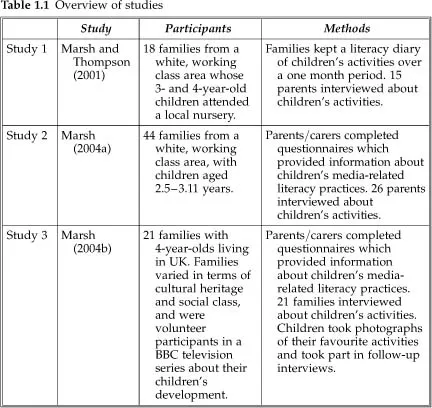
The analysis in this chapter draws on data collected in studies which explored young children’s media-related literacy practices in the home. Altogether, the data discussed in this chapter relate to 83 families in the UK. These families took part in three different studies I have conducted over the last five years. Each study focused on tracing the popular cultural, media-related and techno-literacy practices of young children in the home. These studies are outlined in Table 1.1. The data from these studies were compared and contrasted in order to address the following questions: What are the roles and functions of the media-related literacy practices engaged in by young children in the home and how do these relate to the categories determined by Cairney and Ruge (1998)? The following analysis is organized according to the four categories identified by Cairney and Ruge (1998), outlined previously, in addition to a further purpose which was identified in all of the studies: communicative practices in identity formation/performance.
Communicative practices for forming social relationships
The children in all three studies were engaged in a rich range of practices in which family relationships were reinforced and extended. As in the Cairney and Ruge study (1998), shared reading of print-based texts played a major part in family life. This reading related to popular culture and media in a number of ways, as it involved the sharing of texts related to popular cultural and media interests, such as picture books based on television and popular cultural narratives, TV guides, catalogues and magazines.
However, a wide range of other texts was shared, including television programmes and films. For example, for four-year-old Sameena, watching Hindi films and Indian television programmes on a satellite channel with her family was a way of participating in established family rituals, distinct from her time watching children’s programming, as indicated by Sameena’s mother:
… in the daytime she watch most of the CBeebies or programmes like that and after that ‘Spider-man’ and evening times she watches our Indian programmes with me and her family.
These daily acts of communal viewing are not simply routines, Steeg Larsen and Tufte (2003) argue, but ritualized acts in which watching television together ‘symbolically integrates each member into the family as a social institution, (re-)establishing each member’s place and position in it’ (Steeg Larsen & Tufte, 2003: 103). In Sameena’s case, these ritualized acts also served the purpose of acknowledging and celebrating the cultural heritage of the family, made possible in many homes by the use of satellite television (Kenner, 2005).
As discussed elsewhere (Marsh, 2004a, 2005a), children played out narratives they had encountered in films and television programmes and involved family members in this play, important for both development of narrative understanding and facilitation of intersubjective experiences with family members. This process was an important el...
Table of contents
- Coverpage
- Titlepage
- Copyright
- Contents
- Foreword
- Introduction
- Part 1: Identity in Multimodal Communicative Practices
- Part 2: Multimodal Literacy Practices in Local and Global Spaces
- Part 3: Crossings in Literacy Practices
- Part 4: Multimodal Communicative Practices in Pedagogical Settings
- Afterword
- Biographies
- Index
Trusted by 375,005 students
Access to over 1.5 million titles for a fair monthly price.
Study more efficiently using our study tools.
Frequently asked questions
Yes, you can cancel anytime from the Subscription tab in your account settings on the Perlego website. Your subscription will stay active until the end of your current billing period. Learn how to cancel your subscription
No, books cannot be downloaded as external files, such as PDFs, for use outside of Perlego. However, you can download books within the Perlego app for offline reading on mobile or tablet. Learn how to download books offline
Perlego offers two plans: Essential and Complete
- Essential is ideal for learners and professionals who enjoy exploring a wide range of subjects. Access the Essential Library with 800,000+ trusted titles and best-sellers across business, personal growth, and the humanities. Includes unlimited reading time and Standard Read Aloud voice.
- Complete: Perfect for advanced learners and researchers needing full, unrestricted access. Unlock 1.5M+ books across hundreds of subjects, including academic and specialized titles. The Complete Plan also includes advanced features like Premium Read Aloud and Research Assistant.
We are an online textbook subscription service, where you can get access to an entire online library for less than the price of a single book per month. With over 1.5 million books across 990+ topics, we’ve got you covered! Learn about our mission
Look out for the read-aloud symbol on your next book to see if you can listen to it. The read-aloud tool reads text aloud for you, highlighting the text as it is being read. You can pause it, speed it up and slow it down. Learn more about Read Aloud
Yes! You can use the Perlego app on both iOS and Android devices to read anytime, anywhere — even offline. Perfect for commutes or when you’re on the go.
Please note we cannot support devices running on iOS 13 and Android 7 or earlier. Learn more about using the app
Please note we cannot support devices running on iOS 13 and Android 7 or earlier. Learn more about using the app
Yes, you can access Travel Notes from the New Literacy Studies by Kate Pahl, Jennifer Rowsell, Kate Pahl,Jennifer Rowsell in PDF and/or ePUB format, as well as other popular books in Languages & Linguistics & Education General. We have over 1.5 million books available in our catalogue for you to explore.