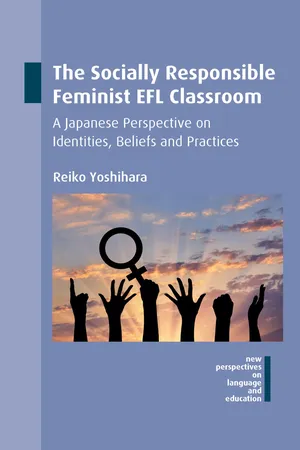
This book explores the realities of feminist EFL teachers' lives through interviews and classroom observations with eight EFL teachers at Japanese universities. The data contained in the book broaden our understanding of feminist teaching in the language classroom while also providing suggestions for practice. The book examines not only how the teachers' feminist identities influence their pedagogical beliefs and practices but also how the teachers actually practice feminist teaching in their classrooms. The tensions, dilemmas and pleasures of feminist teaching converge in this book, which attempts to shed light on a question that is often asked in either ESL or EFL teaching contexts: is teaching about gender-related topics (including controversial sociopolitical topics) in the language classroom education or indoctrination?
eBook - ePub
The Socially Responsible Feminist EFL Classroom
A Japanese Perspective on Identities, Beliefs and Practices
- English
- ePUB (mobile friendly)
- Available on iOS & Android
eBook - ePub
The Socially Responsible Feminist EFL Classroom
A Japanese Perspective on Identities, Beliefs and Practices
About this book
Trusted by 375,005 students
Access to over 1.5 million titles for a fair monthly price.
Study more efficiently using our study tools.
Information
1Introduction
Why Teach about Gender Topics?
Since becoming an English as a foreign language (EFL) teacher at the university level, I have been asking myself what my responsibility as a university EFL teacher is and how I can prepare my students for their future. I believe that our job is not just to teach grammar, vocabulary and linguistic information, but also to promote equality, peace, justice, freedom and human rights among all people. The importance of the social responsibility of English as a second language (ESL) and EFL teachers has been highlighted by Cates (2002, 2004), who pointed out that one of our responsibilities as language teachers in ESL/EFL classes is to address global issues of ethnic conflict, social inequality and injustice, environmental destruction and to educate our language students to become socially responsible world citizens. Gender issues are also discussed in language education to promote social equality and justice (for a detailed discussion on ESL, see Benesch, 1998; Frye, 1999; Nelson, 1999, 2004, 2009; Rivera, 1999; Vandrick, 1994, 1995b, 1997b, 1998, 2000; for EFL, see Casanave & Yamashiro, 1996; McMahill, 1997, 2001; O’Mochain, 2006; Saft & Ohara, 2004; Simon-Maeda, 2004b; Summerhawk, 1998; Yoshihara, 2010, 2011).
However, when I argue that we should teach, not only about gender equality on wages and laws, but also about topics on violence against women, sexual harassment and lesbian, gay, bisexual and transgender (LGBT) issues in the language classroom in articles and conferences, hesitation and resistance from ESL/EFL teachers sometimes surfaces. Even accusations of indoctrination or brainwashing are leveled against feminist language teachers, including me. Nevertheless, as Vandrick (1995b) noted, addressing these difficult gender issues is important, because girls and women often are not taught about these issues and possible means to fight sexism. She concluded that this kind of teaching should not be criticized as indoctrination and that one of language teachers’ responsibilities is to help students raise their consciousness about issues of justice in order to end sexism.
Vandrick (1995a, 1997a, 1998, 2000, 2011) also pointed out that teaching about feminist or gender issues is important for ESL male students from privileged class backgrounds, immigrant and international women students with various cultural backgrounds, women students from the working classes and sexual minority students. Feminist pedagogy would provide the opportunity to raise awareness and consciousness toward gender equality and justice among privileged male ESL students, because they often take for granted gender segregation in their culture and tolerate gender inequality (Vandrick, 1995a, 2000, 2011). It would also benefit marginalized students, including immigrant and international women students from various cultural and working class backgrounds, and ESL students with hidden identities to give them more voice and help to empower them (Vandrick, 1997a, 1998, 2000). All students, whatever their gender, sexual, racial and class identities, should be treated equally and respectfully.
These concerns can refer to not only ESL settings in the USA, but also EFL settings in Japan and around the world. Increasingly, women learn English as a foreign language and go on to higher education in EFL settings, and women from various cultural and social backgrounds are appearing in EFL university classes in Japan and worldwide. Feminist teaching would give these women a voice and empower them. In particular, in Japan and some Asian countries, EFL teachers might find female students have internalized typical gender roles and fear being labeled odd or unfeminine, or being criticized by parents and peers (Hardy, 1996). Feminist teaching would give these female students the opportunity to express their own opinions and analyze gender inequality in their society. In my teaching experience in Japan, I often see male students who agree with women’s equal rights, but feel no particular connection to them. Feminist teaching might provide an opportunity to change these male students’ perceptions.
We as educators should teach gender equality and justice for a better world, even in the language classroom. In any educational institutions, progressive teachers do not tolerate discriminatory language and attitudes toward women or minority groups. Avoiding teaching about gender issues deprives students of an opportunity to learn about important topics for social equality and justice. These points are applied to language classrooms more broadly as Vandrick’s work and that of others confirm.
Readers might wonder how I became a feminist EFL university teacher in Japan and why I have such a strong feminist teaching belief. Becoming a feminist language educator was not straightforward. It was a very complex journey. I was born in a Tokyo suburban middle-class family in which typical gender roles, such as believing that a man should work outside the home and a woman should stay home and take care of children, were endorsed (see Fujimura-Fanselow, 2011; Fujimura-Fanselow & Kameda, 1995; Inoue, 2011; Koyama, 1991; Mackie, 2003; Sabatini, 2012). My parents expected me to be a good wife and wise mother (ryosai kenbo), so they sent me to a private girls’ high school and a women’s university. However, like many daughters who want to lead a different life than their mother, I did not want to be like my mother who devoted herself to her husband and children. I had known that women in my generation would have more possibilities and choices beyond being a full-time housewife. Therefore, against my parents’ wishes, I went to the USA to study abroad and escape from my ‘overprotective’ mother. While I was enrolled in American universities, I took a few women’s studies courses at the undergraduate level and majored in women’s studies in graduate school, which opened the door of feminism to me. Women’s studies taught me what to name my experiences as a woman and how to place them in social, cultural and political contexts. Feminism became my philosophy and one perspective through which to see things in the world.
When I returned to Japan, I wanted to teach women’s studies in a Japanese university; however, there were very few opportunities to teach women’s studies courses in Japan. I was naive about the academic world in Japan. I had no job in Japan. One professor in my Japanese university introduced me to an English teaching job in the university, because I was able to speak English and had graduated from an American graduate school. I accidentally became a university EFL teacher. Although many people told me that I was lucky to have a teaching job in a university in my late 20s, I was not happy to teach only English, especially with assigned textbooks that focused on grammar, vocabulary, linguistic information and superficial topics. The assigned textbooks did not include gender-related topics and other sociopolitical topics at all.
However, even though I found that I had freedom to use any kinds of materials later, I did not teach about gender issues in my language classroom. Like many other ESL/EFL teachers, I worried about the inappropriateness of using gender and other sociopolitical issues in the language classroom. For a long time, I separated my feminist identity from my classroom practice in EFL classes. Yet, I have met several feminist and critical pedagogical language teachers and feminist activists in Japan. Through interactions with them, I changed my perspective toward teaching English and started to incorporate gender and other sociopolitical issues in my EFL classroom. Nevertheless, I was still worried about the appropriateness of teaching about these issues in EFL university classes. Such anxiety, as well as curiosity about teaching of English to speakers of other languages (TESOL) made me decide to go to a graduate school of an American university located in Japan and study TESOL officially. One course I took at the graduate school, on the topic of controversies in second language education, taught by Dr Christine Pearson Casanave, was eye-opening for me. I found and learned that there were controversial debates on teaching about sociopolitical issues in the TESOL field. I have been strongly attached to feminist and critical pedagogues in the TESOL field and assured myself that it is important to teach about gender and other sociopolitical issues even in language classrooms, though this view is not universal.
Thus, the process of becoming a feminist language teacher was a struggle and it took time to unite my feminist identity, teaching beliefs and teaching practices. Not only I, but also many language teachers, take different paths in becoming feminist EFL university teachers in Japan and elsewhere in the world. Each has different perceptions of feminism, teaching beliefs and teaching practices. Several studies showed that there were interconnections among identities, beliefs and practices even though they did not focus on feminist identities (Varghese et al., 2005; see also Ajayi, 2011; Duff & Uchida, 1997; Ellis, 2004; Morgan, 2004; Nagatomo, 2012; Tsui, 2007). In On Becoming a Language Educator, the editors, Casanave and Schecter (1997), collected stories told by well-known language educators and researchers and showed the complexity, diversity and transformation of authors’ professional identities, teaching beliefs and teaching practices. However, research on feminist ESL/EFL teachers’ identities, beliefs and practices in TESOL, or stories about the professional lives and development told by feminist ESL/EFL educators, particularly in Japanese higher education contexts, is not sufficiently widespread or scrutinized. Like other ESL/EFL teachers, feminist ESL/EFL teachers construct and reconstruct complex, diverse and shifting identities, beliefs and practices. They can bring the value of feminist teaching into the TESOL field.
Purposes of the Book
The main purpose of this book is to explore feminist pedagogy in TESOL through a study of several feminist EFL university teachers in Japan. I focus on feminist EFL educators’ teaching practices in Japanese universities, because I am particularly interested in EFL in my home country; however, many aspects of the study also relate to language teaching elsewhere. To understand feminist language teachers’ practices deeply, it is important to explore them in connection with teachers’ feminist identities and teaching beliefs. As Vandrick (2017) noted, one’s feminist language teacher identity affects one’s teaching beliefs, language teaching, research, career, the relationship with students, colleagues and administrators, and the academic world. Therefore, I first explore their feminist teacher identities; what feminism meant to participants in my study and how they became feminists and developed their feminist teacher identities. I then examine what teaching beliefs the teachers have in relation to their feminist identities and how they have reflected their teaching beliefs in their practices. My final analysis explores how they relate their feminist identities, teaching beliefs and teaching practices. The multiple in-depth interviews of eight feminist EFL university teachers in Japan have helped me answer these what- and how-questions about their feminist identities, teaching beliefs and teaching ...
Table of contents
- Cover-Page
- Half-Title
- Series
- Title
- Dedication
- Copyright
- Contents
- Acknowledgments
- 1. Introduction
- 2. Method, Data Collection and Participants
- 3. On Becoming a Feminist EFL Teacher
- 4. Teaching According to Feminist Principles
- 5. Incompatibility Between Feminist Identity and Classroom Practices
- 6. Conclusion
- Appendix A: Lists of Abbreviations
- Appendix B: Timetable of Data Collection
- Appendix C: Sarah’s Handout
- Appendix D: Tom’s Handout
- Appendix E: List of Feminist ESL/EFL Associations
- Epilogue
- References
- Index
Frequently asked questions
Yes, you can cancel anytime from the Subscription tab in your account settings on the Perlego website. Your subscription will stay active until the end of your current billing period. Learn how to cancel your subscription
No, books cannot be downloaded as external files, such as PDFs, for use outside of Perlego. However, you can download books within the Perlego app for offline reading on mobile or tablet. Learn how to download books offline
Perlego offers two plans: Essential and Complete
- Essential is ideal for learners and professionals who enjoy exploring a wide range of subjects. Access the Essential Library with 800,000+ trusted titles and best-sellers across business, personal growth, and the humanities. Includes unlimited reading time and Standard Read Aloud voice.
- Complete: Perfect for advanced learners and researchers needing full, unrestricted access. Unlock 1.5M+ books across hundreds of subjects, including academic and specialized titles. The Complete Plan also includes advanced features like Premium Read Aloud and Research Assistant.
We are an online textbook subscription service, where you can get access to an entire online library for less than the price of a single book per month. With over 1.5 million books across 990+ topics, we’ve got you covered! Learn about our mission
Look out for the read-aloud symbol on your next book to see if you can listen to it. The read-aloud tool reads text aloud for you, highlighting the text as it is being read. You can pause it, speed it up and slow it down. Learn more about Read Aloud
Yes! You can use the Perlego app on both iOS and Android devices to read anytime, anywhere — even offline. Perfect for commutes or when you’re on the go.
Please note we cannot support devices running on iOS 13 and Android 7 or earlier. Learn more about using the app
Please note we cannot support devices running on iOS 13 and Android 7 or earlier. Learn more about using the app
Yes, you can access The Socially Responsible Feminist EFL Classroom by Reiko Yoshihara in PDF and/or ePUB format, as well as other popular books in Languages & Linguistics & Teaching Language Arts. We have over 1.5 million books available in our catalogue for you to explore.