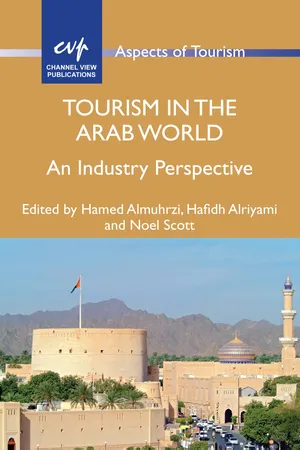
This book is the first to explore Arabic tourism from a business viewpoint, rather than taking a sociological, anthropological or political stance. It focuses on business planning, management and marketing destinations in the Arab World, which are topics crucial for industry stakeholders and which have previously been neglected in the tourism literature. The book examines similarities and differences in the emergence and development of the tourism industry in countries across the Arab world as well as its inbound and outbound travel flows. It analyses several different aspects of Arabic tourism including tourism policy, organisation and planning, tourism product development, destination marketing and consumer behaviour. This volume will be of interest to postgraduate students and researchers of tourism studies, business and Middle Eastern studies.
eBook - ePub
Tourism in the Arab World
An Industry Perspective
- English
- ePUB (mobile friendly)
- Available on iOS & Android
eBook - ePub
Tourism in the Arab World
An Industry Perspective
About this book
Information
Subtopic
Business GeneralIndex
Business1Introduction
Hamed Almuhrzi, Noel Scott and Hafidh Alriyami
Tourism in the Arab World: An Industry Perspective provides the first collection of papers that explore tourism in the Arab countries from a business viewpoint. Its focus is on different aspects of business such as planning, management and marketing destinations, which are crucial for the industry stakeholders and areas that have been neglected in the tourism literature in general (Ballantyne et al., 2009; Swarbrooke & Horner, 2001). These arguments appear even more relevant in relation to the context of the Arab world as past research has focused on sociological, geographical, religious and anthropological studies (Daher, 2007; Jafari & Scott, 2014). Given the limited tourism literature about tourism in the Arab region in general and about the business perspective of tourism in this region in particular, it is vital to understand the region’s tourism industry in terms of planning, management, marketing and visitors’ views (Jafari & Scott, 2014). Understanding these concepts will enhance our knowledge about the tourism industry in the Arab world and its inbound and outbound travel flows.
What is the Arab World?
Before discussing tourism industry in the Arab World, it is necessary to define what is meant by the Arab World and clarify the term ‘Arab’. ‘Arab’ is widely accepted as an ethno-national term (Darity, 2008) that labels Arabic-speaking nations. From a political and organisational perspective, it is associated with ‘The League of Arab States’, which was founded in Cairo in 1945 by six Arab states and which currently has 21 members. These countries are: Algeria, Bahrain, Comoros, Djibouti, Egypt, Iraq, Jordan, Kuwait, Lebanon, Libya, Mauritania, Morocco, Oman, Palestine, Qatar, Saudi Arabia, Somalia, Sudan, Tunisia, United Arab Emirates and Yemen. The League recently suspended the membership of Syria. As a regional organisation of Arab states, the League aims to promote and facilitate cooperation in relation to social, cultural, political and economic affairs between its members. However, there is no concise definition in the League’s membership articles on what an Arab state is or who is an Arab.
Geographically, Arab States stand on two continents: Asia and Africa. The geographical area of the Arab League stretches from the Indian Ocean and Somali Peninsula (Horn of Africa) in the South East to the Mediterranean Sea in the north; and from the Arabian (Persian) Sea in the east to the Atlantic Ocean in the west. Table 1.1 provides an overview on population in Arab countries and its growth from 2010 to 2013. There are two related geographical terms that create confusion alongside that of the Arab World: the Muslim World and the Middle East. Ben-Dor (1999: 1) borrowed two terms, ‘ethnoreligiousness’ and ‘ethnoregionalism’, to clarify this confusion between religious and other identity determinants. ‘Ethnoreligiousness’ describes the overlaps between religious identity and other identities determinates (i.e. ethnic, culture background, mother-tongue), whereas ‘ethnoregionalism’ describes the overlaps between national and others identity specifications. The confusion between Arab World, Muslim World and Middle East is an example of differences between ethnoreligiousness and enthnoregionalism descriptions. Such confusion can be regularly witnessed in the media as well as in academic discussions.
Table 1.1 Population indicator for Arab countries | ||||
Country name | Population | |||
2010 | 2011 | 2012 | 2013 | |
United Arab Emirates | 8,441,537 | 8,925,096 | 9,205,651 | 9,346,129 |
Bahrain | 1,251,513 | 1,292,764 | 1,317,827 | 1,332,171 |
Comoros | 683,081 | 700,216 | 717,503 | 734,917 |
Djibouti | 834,036 | 846,646 | 859,652 | 872,932 |
Algeria | 37,062,820 | 37,762,962 | 38,481,705 | 39,208,194 |
Egypt, Arab Rep. | 78,075,705 | 79,392,466 | 80,721,874 | 82,056,378 |
Iraq | 30,962,380 | 31,760,020 | 32,578,209 | 33,417,476 |
Jordan | 6,046,000 | 6,181,000 | 6,318,000 | 6,459,000 |
Kuwait | 2,991,580 | 3,124,705 | 3,250,496 | 3,368,572 |
Lebanon | 4,341,092 | 4,382,790 | 4,424,888 | 4,467,390 |
Libya | 6,040,612 | 6,103,233 | 6,154,623 | 6,201,521 |
Morocco | 31,642,360 | 32,059,424 | 32,521,143 | 33,008,150 |
Mauritania | 3,609,420 | 3,702,763 | 3,796,141 | 3,889,880 |
Oman | 2,802,768 | 3,024,774 | 3,314,001 | 3,632,444 |
Qatar | 1,749,713 | 1,910,902 | 2,050,514 | 2,168,673 |
Saudi Arabia | 27,258,387 | 27,761,728 | 28,287,855 | 28,828,870 |
Sudan | 35,652,002 | 36,430,923 | 37,195,349 | 37,964,306 |
Somalia | 9,636,173 | 9,907,903 | 10,195,134 | 10,495,583 |
Syrian Arab Republic | 21,532,647 | 21,961,676 | 22,399,254 | 22,845,550 |
Tunisia | 10,549,100 | 10,673,800 | 10,777,500 | 10,886,500 |
Yemen, Republic | 22,763,008 | 23,304,206 | 23,852,409 | 24,407,381 |
Plantain (mainly West Bank and Gaza) | 3,811,102 | 3,927,051 | 4,046,901 | 4,169,506 |
Source: The World Bank, 2015. | ||||
Past scholars have pointed to the confusion that a researcher may face to differentiate between Arab world, Islamic World (Jafari & Scott, 2014) and Middle East (Feghali, 1997). Whereas Islam is the main religion in many Arab and non-Arab societies (i.e. Persian, Turkish, and Kurdish society), it is not correct to consider these societies as having identical cultures (Hassan, 1991; Hourani, 1992). In fact, there are many cultural differences between Arab-Islamic and non-Arab-Islamic societies in their way of living and societal traditions (Hassan, 1991; Hourani, 1992). Jafari and Scott (2014: 2) emphasized that ‘within the global Muslim community there is diversity from the blending of religion, culture, politics and historical influences. The Muslim world embodies both a common set of religious beliefs as well as a complexity that rewards investigation and rejects any simple label or categorization’. Although Islam originated on the Arabian Peninsula, Arabs are a minority within the Islamic World today. Among the 1.6 billon people that recognized themselves as Muslims, only 20% are located within the Arab League States. In fact, the largest five Islamic countries today are non-Arab speaking states: Indonesia (209 million), India (176 million), Pakistan (167 million), Bangladesh (133 million) and Iran (74 million) (Jafari & Scott, 2014). This highlights the needs to differentiate between the Islamic World and Arab World when a tourism phenomenon is under investigation.
Beside the Muslim World, the Arab World is also often confused with the term Middle East. Unlike the Muslim World (religion) and the Arab World (ethnic), the Middle East has a more geopolitical connotation. Perhaps this is understandable if the historical root of the term to be known. Similar to other terms such as ‘The East’, ‘Far East’ and ‘Near East’, the Middle East was born in a European-centric world between the First and Second World Wars at the end of the colonisation era (Beaumont et al., 1988). There is some agreement that the Middle East term initiated from within the military-political discourse (Beaumont et al., 1988; Held, 2000; Ian, 1972), although the frontiers of the Middle East were unclear. Durin...
Table of contents
- Cover-Page
- Half-Title
- Series
- Title
- Copyright
- Contents
- Contributors
- 1. Introduction
- 2. Tourism Development and Governance: An Overview of Arab Countries
- 3. Developing Event Tourism in Saudi Arabia: Opportunities and Challenges
- 4. Women Empowerment in the Arab Tourism Sector: Case Study of the Sultanate of Oman
- 5. Tourism Sustainability Planning in the ‘Arab World’: Insights from Egypt
- 6. Planning for Tourism in Oman based on Lessons from Dubai: Overviewing Economic, Environmental and Sociocultural Impacts
- 7. The UAE: A Disneyland in the Desert
- 8. Halal Tourism: Definitions and Developments
- 9. Brand Expectation and Authentic Service Experiences in the Hotel Industry in Dubai
- 10. Tunisian Tourism: At the Eye of an Arab Spring Storm
- 11. Destination Brands Dubai and Abu Dhabi: Bitter Rivalry or Strategic Partnership?
- 12. Marketing the Middle East in Times of Political Instability – The Case of Jordan
- 13. Representation of Egyptian Bedouins in English-Language Tourist Brochures
- 14. The Business of Hajj
- 15. Understanding the Motivations and Expectations of Arab Visitors at the Gold Coast, Australia
- 16. The Role of Islam in Omani Tourists’ Travel Behaviour
- 17. Exploring the Experiences of International and Domestic Visitors at the Egyptian Museum in Cairo
- 18. Conclusion
- Index
Trusted by 375,005 students
Access to over 1.5 million titles for a fair monthly price.
Study more efficiently using our study tools.
Frequently asked questions
Yes, you can cancel anytime from the Subscription tab in your account settings on the Perlego website. Your subscription will stay active until the end of your current billing period. Learn how to cancel your subscription
No, books cannot be downloaded as external files, such as PDFs, for use outside of Perlego. However, you can download books within the Perlego app for offline reading on mobile or tablet. Learn how to download books offline
Perlego offers two plans: Essential and Complete
- Essential is ideal for learners and professionals who enjoy exploring a wide range of subjects. Access the Essential Library with 800,000+ trusted titles and best-sellers across business, personal growth, and the humanities. Includes unlimited reading time and Standard Read Aloud voice.
- Complete: Perfect for advanced learners and researchers needing full, unrestricted access. Unlock 1.5M+ books across hundreds of subjects, including academic and specialized titles. The Complete Plan also includes advanced features like Premium Read Aloud and Research Assistant.
We are an online textbook subscription service, where you can get access to an entire online library for less than the price of a single book per month. With over 1.5 million books across 990+ topics, we’ve got you covered! Learn about our mission
Look out for the read-aloud symbol on your next book to see if you can listen to it. The read-aloud tool reads text aloud for you, highlighting the text as it is being read. You can pause it, speed it up and slow it down. Learn more about Read Aloud
Yes! You can use the Perlego app on both iOS and Android devices to read anytime, anywhere — even offline. Perfect for commutes or when you’re on the go.
Please note we cannot support devices running on iOS 13 and Android 7 or earlier. Learn more about using the app
Please note we cannot support devices running on iOS 13 and Android 7 or earlier. Learn more about using the app
Yes, you can access Tourism in the Arab World by Hamed Almuhrzi, Hafidh Alriyami, Noel Scott, Hamed Almuhrzi,Hafidh Alriyami,Noel Scott in PDF and/or ePUB format, as well as other popular books in Business & Business General. We have over 1.5 million books available in our catalogue for you to explore.