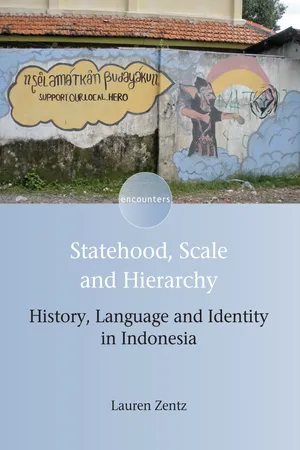
Against the background of language and nation formation in Indonesia, this book demonstrates how language planning is inseparable from the broader actions of the state, and how postcolonial nationalism and globalization have had profound implications for language use and state actions to control it. Using language planners' texts, national and regional policy statements and the discussions of university English majors, it explores the borders of what can be defined as Indonesian, Javanese and English languages, and how this is informed by ideologies of language and nationalism in contemporary Indonesia. The tensions played out in the book between the ideologically perceived languages around which policies are built and the realities of linguistic performance and the resources of the individual are echoed across the globe, making this book crucial reading for anyone interested in the interplay of language planning and language use.
- English
- ePUB (mobile friendly)
- Available on iOS & Android
eBook - ePub
About this book
Trusted by 375,005 students
Access to over 1.5 million titles for a fair monthly price.
Study more efficiently using our study tools.
Information
1States, Language(s) and Globalization
… [T]he model of official nationalism assumes its relevance above all at the moment when revolutionaries successfully take control of the state, and are for the first time in a position to use the power of the state in pursuit of their visions … ‘official nationalism’ was from the start a conscious, self-protective policy, intimately linked to the preservation of imperial-dynastic interests … The one persistent feature of this style of nationalisms was, and is, that it is official – i.e. something emanating from the state, and serving the interests of the state first and foremost.
Anderson, 2006: 159, emphasis in original
1.1 On Not Feeling Foreign in One’s Own Capital City
Officially in Indonesia, signs in public must be written in Indonesian ‘except where local or foreign languages are necessary’. This is written in the national law on language, Undang-Undang Republik Indonesia 24/2009, the slogan of which states that Indonesian people must ‘love’ their local languages, ‘use’ their national language, and ‘study’ foreign languages (with extra emphasis on English). This is not the first legislation that states such: the government has frequently threatened to impose fines on people or companies who have placed other languages – ‘domestic’ or ‘foreign’ – onto their public signs (Dardjowidjojo, 1998; Heryanto, 1995; Kitamura, 2012). Ariel Heryanto (1995) documented state assignment of fines for English on Jakarta signboards prior to 1995, and in 2010, some 15 years subsequent to Heryanto’s report, I asked an employee of the national Pusat Bahasa (Language Center, now called the Badan Bahasa), about the use of English on signboards in the nation’s capital city. He described to me that it was indeed prudent to discourage the use of English on signboards because rural people would not appreciate coming to Jakarta and subsequently feeling diasingkan [foreignized] in their own capital city.
I employ this brief anecdote, which took place in May 2010, as well as the quote above it, in reference to the policy- and penalty-driven state formation processes that Indonesia has undergone since it gained national independence. In my time studying Indonesia both in person and through texts, I have learned of its unique, yet exemplary, nationalization process. It is nearly the nation-state prototype, a primary inspiration for Imagined Communities. Benedict Anderson points out the importance of ‘the state’ in ‘the nation’; that is, the top-down policy-making activities in the state-driven, postcolonial creation of the Indonesian sentiment of nationally belonging – of being Indonesian and of speaking like or as one – are quite salient. In this book, we will explore the events that led to Indonesia’s past and current attempts at statification and nationalization, particularly from the perspective of language: its importance throughout historical shifts, in current state policies and in individuals’ navigations of their identities.
The theories on which this book is based consist of ongoing conversations in Linguistic Anthropology and Applied Linguistics concerning English in globalization, language policy, language ecologies in contemporary nation-states, and the ubiquitous postmodern tension between linguistic performativity and ‘languages’. These topics will set the scene for analysis throughout each chapter of language planners’ texts, national and regional policy statements, and university English majors’ discussions, in their Sociolinguistics class assignments and the research interviews they participated in, about the borders of what can be defined as the Indonesian, Javanese and English languages, and how they are informed by ideologies of language and nationalism in contemporary Indonesia. I first introduce the theoretical frameworks that are used throughout this book before moving on to an introduction of the methodology, context, and the primary individuals involved in this study.
1.2 The State and its Language(s)
‘The state’ has existed for centuries now, in many locations. Prior to the nation-state, states without nations – for example, central monarchies ruling over a land with little communication with residents, and residents having less of an idea of being connected to others in the same kingdom – were precursors to what we now call the nation-state. One essentially transitioned (rarely peacefully) into the form of the next, with a healthy dose of nationalist revolution aided by advances in technology: of primary importance, the printing press, and a good while later, trains and other forms of transportation (Anderson, 2006; Jha, 2006). An important difference between the pre-national state and our current nation-state structure is essentially a feeling of connection to and within an ‘imagined’ national community, but also important is the reach of state bureaucracy and infrastructure. The state now dictates education most importantly, but it also has its hands in media, roads and transportation, and most other technologies.
Within the modern nation-state there is a basic set of knowledge that is expected to be shared by all citizens, and it is distributed through newspapers, education and media. There is also a relatively uniform register of language that most of these media function within, and with the expansion of these institutions it becomes a register that almost everyone understands. In the ideal version of the nation-state, everyone is supposed to be able to produce this register to some extent, and preferably quite well; however, in the real version, this ideal register becomes a point of comparison or reference for the vast array of differences that exist under the state’s reach. That is, in Indonesia’s case, under the Indonesian ‘language regime’ (Sonntag & Cardinal, 2015), national distribution of a fixed and perpetually reiterated set of principles, morals and ideal behaviors, including speech, emanate from central points of media distribution as well as central geographic, class and ethnic locations. Almost everyone sees and hears the ideal model of a national citizen and, as the state’s reach expands, all come to know themselves in relation to it.
The state is of course most certainly not the only power and this is increasingly the case (Jha, 2006), but I take the point of view that, in general, other centers of orientation exist in relation to it, and it is therefore ‘often a determining force in the sociolinguistic landscape, in contrast to other centering institutions whose effect can best be described as dominant’ (Blommaert, 2005: 220; see also Ives, 2015; Ricento & Hornberger, 1996; Skocpol, 1985; Sonntag & Cardinal, 2015). As modern states have developed, we have thus seen a re-scaling, or active hierarchization, of perceived language forms and beliefs about them as states have distributed and regulated infrastructure and ‘power/knowledge’ complexes (Foucault, 1980) through education,1 communication technologies and mass media. In this re-scaling, prestige comes to be associated with qualities and language forms that are accessible through time spent in state-regulated institutions (more on this below). Gellner (1983) calls this generally school-based acquisition of nationally shared language and knowledge ‘exo-socialization’: with schooling, large portions of children’s socialization move outside the home and are in direct interaction with the goals of the state. The more one has access to these state-regulated goods and services, the more one performs according to the model distributed by the state, and the more generally publicly acceptable, ‘unmarked’ or ‘part of the common culture’ (Milroy, 2001) that person’s behavior is.
Scholars of language claim that the rise of the nation-state in fact coincides with the invention of ‘language’ as we currently know it (Heryanto, 1995, 2007; Makoni & Pennycook, 2007; Mazrui, 2002). The one state–one nation–one language ideology is regularly traced back to an early formal description in the 1648 Peace of Westphalia in Germany, and its legacy continues through today (Bauman & Briggs, 2003; Krasner, 1995; Sassen, 2006; Sonntag & Cardinal, 2015). After the Peace of Westphalia, 18th-century German scholar Johann Gottfried Herder’s writings are some of the earliest documentation2 that explicitly state the utility of and need for one nation–one language ideologies among then-forming nation-states in Europe (Herder & Forster, 2002). The ideology was repeated or reinforced unofficially throughout the French Revolution and through late 19th-century labor revolts, then officially expressed again in the 1919 Treaty of Versailles (Duchêne, 2008). Anderson (2006) has described how the one nation–one language ideology has been reinforced more recently, in decolonization: the nationalized ‘imagined communities’ that came to life in Europe, and eventually around the world nearing the end of official European colonization, are only stronger in post-colonial contexts. Although these ‘new states’ (Geertz, 1977) generally lacked the same historically integrated foundations that led to Western states’ formation (Anderson, 2006), as they formed they joined an international community already in place – based on the Western national model and state tradition, and already increasingly unified under the League of Nations and then the United Nations structure (Anderson, 2006; Duchêne, 2008; Geertz, 1977; Keane, 2003). The early politicians and language planners of these new states, additionally, were fully aware that they were trying to consolidate, in as few years as possible, the centuries of nation-state formation already achieved in the West (Alisjahbana, 1974; Moeliono, 1986; Simatupang, 1974). Safran (2015) points out, in fact, that in the case of most post-colonial nations it was more the case that their governments ended up forming ‘state-nations’ – that is, a state that forces its agenda of nation-formation on the nation that it is trying to create or consolidate (see also Blommaert, 2006).
Postcolonial nations, then, largely fought from the hands of colonial powers by indigenous elite classes who had been educated in European education systems, are frequently and purposefully quintessential top-down modelings of the nation-state structure and ideology complex (or ‘state tradition’; Cardinal & Sonntag, 2015) that came to life through centuries of European change. These newer states have imposed the more ‘organic’ processes that Bauman and Briggs (2003) so astutely described in their documentation of the Grimm brothers’ formation of a national German literature and lore and therefore a national imaginary, by actively generating and consolidating a singular national language, literature and history over their vastly diverse populations.3
For Heryanto, the creation and control of a linguistic good under nation-state or state-nation formation occurred alongside the establishment of an institutionalized national way of communicating. Such institutionalization, which necessarily entailed differentiated access to these new institutions, also created issues of rights, (non-)equity and a ‘… new privilege to consume what is scarce’ (Heryanto, 2007: 54; cf. Ruíz, 1984). Thus now, when someone uses a certain systematic way of performing language, this is not just their use of a language; it is a perfor...
Table of contents
- Cover-Page
- Half-Title
- Series
- Title
- Copyright
- Contents
- List of Abbreviations
- Acknowledgments
- Preface
- 1. States, Language(s) and Globalization
- 2. Engineering an Imagined Community
- 3. Locating Languages in Time and Space
- 4. Preserving the Nation: The Threat Beyond our Borders
- 5. The State Marches On
- Appendix
- References
- Index
Frequently asked questions
Yes, you can cancel anytime from the Subscription tab in your account settings on the Perlego website. Your subscription will stay active until the end of your current billing period. Learn how to cancel your subscription
No, books cannot be downloaded as external files, such as PDFs, for use outside of Perlego. However, you can download books within the Perlego app for offline reading on mobile or tablet. Learn how to download books offline
Perlego offers two plans: Essential and Complete
- Essential is ideal for learners and professionals who enjoy exploring a wide range of subjects. Access the Essential Library with 800,000+ trusted titles and best-sellers across business, personal growth, and the humanities. Includes unlimited reading time and Standard Read Aloud voice.
- Complete: Perfect for advanced learners and researchers needing full, unrestricted access. Unlock 1.5M+ books across hundreds of subjects, including academic and specialized titles. The Complete Plan also includes advanced features like Premium Read Aloud and Research Assistant.
We are an online textbook subscription service, where you can get access to an entire online library for less than the price of a single book per month. With over 1.5 million books across 990+ topics, we’ve got you covered! Learn about our mission
Look out for the read-aloud symbol on your next book to see if you can listen to it. The read-aloud tool reads text aloud for you, highlighting the text as it is being read. You can pause it, speed it up and slow it down. Learn more about Read Aloud
Yes! You can use the Perlego app on both iOS and Android devices to read anytime, anywhere — even offline. Perfect for commutes or when you’re on the go.
Please note we cannot support devices running on iOS 13 and Android 7 or earlier. Learn more about using the app
Please note we cannot support devices running on iOS 13 and Android 7 or earlier. Learn more about using the app
Yes, you can access Statehood, Scale and Hierarchy by Lauren Zentz in PDF and/or ePUB format, as well as other popular books in Languages & Linguistics & Linguistics. We have over 1.5 million books available in our catalogue for you to explore.