The aim of this book is to analyse and reflect on the effect of femininities in the field and the encountered biases specific to women researchers in tourism studies. The purpose of the book is to define potential areas of gender bias using international case studies from five continents to improve the validity and transparency of future research conducted by researchers in transcultural contexts. It covers broad themes including access, attire and conduct, sexual harassment, personal safety, and accompanied research and well-being. The volume provides case studies using reflexivity to create baselines for comparison for female (and male) researchers doing fieldwork and outlines potential areas of concern for supervisors through a transdisciplinary approach in a global context. It is an essential guide for supervisors, students, ethics committee members and any researchers. This book is open access under a CC BY NC ND licence.
eBook - ePub
Femininities in the Field
Tourism and Transdisciplinary Research
- English
- ePUB (mobile friendly)
- Available on iOS & Android
eBook - ePub
About this book
Information
Index
Business1Safety First: The Biases of Gender and Precaution in Fieldwork
Jill Hamilton and Russell Fielding
Jill Hamilton is a Master of Environmental Management candidate at Duke University, focusing on coastal fisheries and marine conservation. From her earliest experiences travelling and conducting qualitative research in the Caribbean, she has felt the often-conflicting desire to learn and explore fearlessly, while also keeping her personal safety in mind. More recently, she has begun to consider how being young and female can both help and hinder one’s ability to build trust, access information and balance opportunity and risk while in the field. As an undergraduate at the University of Denver, she examined the environmental and cultural aspects of marine management and tourism in the Caribbean islands of Nevis and Bonaire, and recently worked with Environmental Defense Fund to help develop conservation and management strategies for Cuban fisheries. At Duke, she explores community- and ecosystem-based approaches to marine management, and contributes to small-scale fisheries research at the Nicholas Institute for Environmental Policy Solutions.
Russell Fielding is an assistant professor in the Department of Earth and Environmental Systems at the University of the South in Sewanee, Tennessee. He conducts research on the sustainability of – and interactions between – food and energy systems in the Caribbean. He earned a PhD in geography at Louisiana State University in 2010. In the context of a small, undergraduate-only, liberal arts college, Fielding emphasises the value of providing research experiences for students through collaboration with Sewanee faculty as well as local NGOs, universities, and government institutions. His spouse and two small children often accompany him to field sites which allows for both the joy and challenge of combining fieldwork and family time.
When conducting fieldwork as a young woman, especially internationally or in an unfamiliar location, safety is often a concern. As a female, one is taught gendered lessons of personal safety, awareness and precaution from a young age (Superle, 2013), teachings which may subconsciously contribute to research bias, such as selecting interview and data collection sites based on personal safety, or choosing study participants based on perceived reputation or personality. A researcher’s gender may also contribute to gaining varied levels of trust and openness from interviewees. This reflective case study explores the experiences of a young female student on the Caribbean island of Nevis, contrasts these experiences to that of a male researcher, and considers the biases that may stem from gender and precaution in the field.
In the summer of 2014, I found myself in the back of a colourful taxi van, flying down the winding roads of St. Kitts on my way to Nevis (Figure 1.1), the island where another student and I would be conducting research for our undergraduate thesis projects. She had come to look at the island’s hydroponic farms, and I to study the area’s marine tourism industry and marine conservation efforts, searching for ways that Nevis, and other small Caribbean islands, could sustainably manage their coasts and waters.
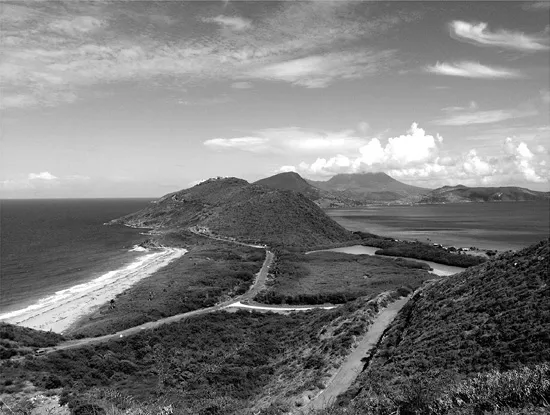
Figure 1.1 The winding roads of St. Kitts with Nevis in the background, its summit covered in clouds (Photo: Hamilton)
The driver, speaking in a strong Caribbean accent, was giving us a crash course in the islands’ local dialect, a type of creole spoken in a small area of the Lesser Antilles.
‘Wa gwaan?’ he had us repeat, a huge smile spread across his face, failing to contain his laughter at our struggled attempts to copy the simple phrase. ‘It means, “What’s going on, what’s up!”’
He dropped us off on a secluded sandy beach, and a speedboat soon arrived at the small wooden dock. ‘You are Jill and Dani!’ the two men aboard waved and called, wide smiles similarly spread across their faces. We smiled back as they pulled us aboard, handed us two local beers and sped off towards the lush, green island in the distance. ‘Welcome to Nevis.’
Oualie: Land of Beautiful Waters
Nevis, like numerous other islands in the Caribbean, is experiencing a decline in the health of its coral reefs (Bruckner & Williams, 2011), a phenomenon that could threaten not only the area’s tourism industry, but the livelihoods of local residents as well, many of whom depend on reef fishing for sustenance and income (Whittingham et al., 2013). During my time on Nevis, I conducted formal and field-based interviews with stakeholders in the marine tourism, fishing and conservation sectors, gathering stories of Nevisians’ relationship with the marine environment and seeking insight into culturally feasible ways in which the island’s coasts and waters could be sustainably managed.
I had first learned about Nevis from my professor at the University of Denver, Russell Fielding, who had conducted research on the island several years prior. He had told us of the local Nevisian norms and the welcoming, hospitable culture we would experience, having us jot down the ‘must see’ restaurants and bars on the island and introducing us electronically to the few people he knew there. Through our professor’s connections, we contacted a local SCUBA instructor, who kindly offered to let us stay with her free of charge during our time on the island – an accommodation that allowed us to afford travelling to Nevis on our tight research stipend, and to stay with an individual that our connections trusted.
Stepping off the boat onto Nevis’ Oualie Beach, we were welcomed by a group of smiling strangers, all of whom already knew our names. ‘The island is small, and you’ll make connections quickly’, I remembered our professor saying, similarly assuring me that my planned method of conducting interviews, a combination of snowball sampling and intercept interviews in the field, would be an easy feat in the small island community.
During my first few days on the island, I focused on meeting locals and learning who I should talk to about reef health, the islands fisheries and the history of marine management efforts. Many of these conversations happened organically, and people were willing and eager to share their knowledge and point me in the right direction. A list of repeated names began to emerge, and I was able to set up a first round of interviews from the suggestions I received.
Along with these beneficial connections and recommendations, however, came a different type of knowledge as well. A group of American scientists were conducting an annual assessment of the area’s coral reefs, and having conducted research on Nevis in the past, had a good understanding of the island’s local geography, culture and people. A few times after having conversations with various local men, I was pulled aside by female scientists and told to ‘Watch out for him’, or ‘Stay away from him’. From conversations with these scientists, I inferred that I needed to be somewhat cautious of who I interviewed and where I travelled while on the island, and concluded that most of my interviews would be more safely conducted with Dani present, rather than by myself.
As a young woman travelling with another young female, both of us having limited knowledge about the community we were temporarily a part of, I viewed any precautionary information provided to me as a form of valuable knowledge meant to keep us safe. I took note of the good-natured advice I received, using it as an extra reminder that even among the welcoming, hospitable culture and the beautiful island views, I still needed to be aware of my personal safety.
A Gendered View of Safety and Precaution
The type of thoughts and interactions I had during my first few days on Nevis – casual conversations regarding safety and precaution – were not new or unusual to me. Starting at a young age, women, myself included, are continually encouraged to think about personal safety and employ precautionary techniques to reduce risk in public spaces (Superle, 2013). Frequent reminders from family, friends, universities and the media for women to be aware of their surroundings, take precautionary actions whenever possible and to avoid situations that may put themselves at increased risk result in daily, often subconscious, strategies that are used to stay safe (Silva & Wright, 2009).
Perceived risk, and the subconscious or conscious actions that women take to mitigate these risks, is a gendered phenomenon that may contribute to bias in fieldwork. From selecting interview and data collection sites to choosing study participants, female researchers may be more aware of possible safety concerns than their male counterparts, resulting in possibly biased approaches to data collection. Furthermore, as experienced through the aforementioned conversations with female scientists on the island, ‘Women are more likely to be protected by their host communities, which in some cases … can result in less rather than more access to information’ (Warren, 1988: 45). Being more aware of possible risks may influence the level of precaution that a female takes in the field, compared to men.
Searching for a Local View of the Sea
Keeping the advice I had received in mind about safety on the island, I began my research. According to Warren (1988), ‘Living within a society, or visiting one as a fieldworker, presupposes a gendered interaction, a gendered conversation, and a gendered interpretation’ (1988: 10) – ideas that rang particularly true while conducting interviews on Nevis.
My mornings on Nevis were spent down at local docks and beaches, conducting intercept interviews with fishers as they prepared their boats for the day (Figure 1.2). In areas I knew well, or that had restaurants, hotels or SCUBA shops nearby, such as Oualie Beach, I conducted interviews alone, armed with a small notepad, a recording device and a stack of business cards showing my affiliation with my university. In more secluded areas, Dani joined me, helping to take notes or ask a few simple questions.
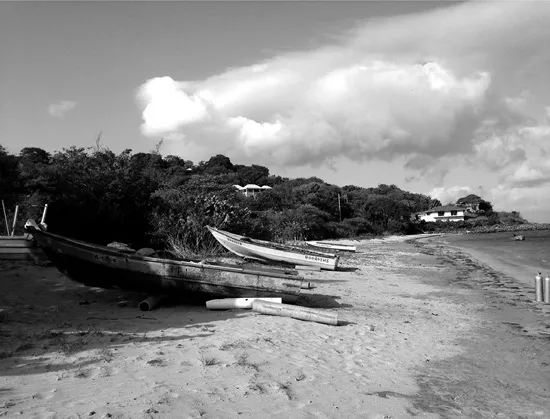
Figure 1.2 Fishing boats line Nevis’ Oualie Beach, ready to be taken to the island’s nearby reefs (Photo: Hamilton)
Approaching and talking to fishers, all of whom were male, never proved to be a significant challenge. I was often greeted with a smile and a wave, and a simple ‘hello’ was all it took to initiate a conversation. While flirtation from interviewees was something I experienced on several occasions, I found that as soon as I turned on my recorder and began the formal interview process, nearly all participants adopted a more serious tone, their view of me seeming to shift towards the task at hand and away from my gender, age or perhaps my whiteness – traits that may have influenced their initial willingness to participate.
While my concern for safety and the precautionary advice I had received may have limited my site selection and choice of interviewees, I found that the role of my gender shifted once I began actually interviewing individuals. When speaking with fishers, I felt that my gender and appearance – a friendly-faced, young female – was advantageous. I was not perceived as a threat, nuisance or figure of authority, but merely an interested individual, passionate about conservation and coral reefs. As argued by Warren (1988), women fieldworkers are often viewed as ‘more accessible and less threatening’ (1988: 45) than men, resulting in increased access to the information sought. The information I was able to obtain from the interviewees was plentiful and easily accessible. Nearly all fishers were willing to share their personal stories of how the reef and the number of fish they caught had changed over time. We discussed the challenges facing Nevisian fishers, the knowledge they had surrounding fish population cycles and the biology of the ecosystem, and solutions that they believed could help the reef stay healthy and resilient.
As I had learned from background research and my initial interviews with individuals on the island, illegal fishing was widespread and problematic off Nevisian coasts, and posed one of the biggest threats to the area’s reef health. Identified as a problem associated not only with the lack of enforcement of local fishing laws, but with cultural traditions, economic barriers and a general lack of education surrounding the consequences of overfishing, illegal fishing was a subject I knew I had to cover in my conversations with fishers. Transitioning from the flowing, easy conversations that defined the start of each of my interviews, I would eventually breach the topic of illegal fishing.
‘What are the local fishing laws? Do most people follow them?’ I would ask interviewees. The friendly, helpful answers that had previously been given to me would often stop abruptly. As interviews shifted towards more controversial subjects, any perceived advantages gained through my gender, age or appearance became less noticeable. Questions regarding laws and the legality of fishing practices on the island were almost always followed by a glance over the shoulder, an exchanged look of worry with a crewmate and a sharp change in the interviewee’s stance and tone. On some occasions, interviewees spoke openly and candidly about how few people followed these laws, sometimes even admitting that they themselves rarely followed regulations. But on most occasions, these questions marked a turning point in the interview.
‘Turn off your recorder’, I was sometimes told, followed quickly by another inquiry to confirm that the interviews would be kept completely anonymou...
Table of contents
- Cover-Page
- Half-Title
- Series
- Title
- Copyright
- Contents
- Foreword
- Preface
- Introduction – Issues in the Field: A Female Perspective
- 1. Safety First: The Biases of Gender and Precaution in Fieldwork
- 2. Negotiating Machismo as a Female Researcher and Volunteer Tourist in Cusco, Peru
- 3. The Married Life (as a Marine Tourism Researcher)
- 4. ‘Dale Chica!’: A Surfer Chick’s Reflections on Field Research in Central America
- 5. Early Motherhood and Research: From Bump to Baby in the Field
- 6. ‘Mummy, When Are We Getting to the Fields?’ Doing Fieldwork with Three Children
- 7. The Dissemination of the Feminine: An In-depth Analysis of Independent Travel
- 8. Gender Bias and Marine Mammal Tourism Research
- 9. The Effect of Motherhood on Tourism Fieldwork with Young Children: An Autoethnographic Approach
- 10. Subjectivities Implode: When ‘The Lone Male’ Ethnographer is Actually a Nursing Mother …
- 11. Icebreaker: Experiences of Conducting Fieldwork in Arctic Canada with my Infant Son
- 12. Researching in a Men’s Paradise: The Emotional Negotiations of Drunken Tourism Fieldwork
- 13. Motherhood within Family Tourism Research: Case Studies in New Zealand and Samoa
- Conclusion – Gender: A Variable and a Practice
- Index
Trusted by 375,005 students
Access to over 1.5 million titles for a fair monthly price.
Study more efficiently using our study tools.
Frequently asked questions
Yes, you can cancel anytime from the Subscription tab in your account settings on the Perlego website. Your subscription will stay active until the end of your current billing period. Learn how to cancel your subscription
No, books cannot be downloaded as external files, such as PDFs, for use outside of Perlego. However, you can download books within the Perlego app for offline reading on mobile or tablet. Learn how to download books offline
Perlego offers two plans: Essential and Complete
- Essential is ideal for learners and professionals who enjoy exploring a wide range of subjects. Access the Essential Library with 800,000+ trusted titles and best-sellers across business, personal growth, and the humanities. Includes unlimited reading time and Standard Read Aloud voice.
- Complete: Perfect for advanced learners and researchers needing full, unrestricted access. Unlock 1.5M+ books across hundreds of subjects, including academic and specialized titles. The Complete Plan also includes advanced features like Premium Read Aloud and Research Assistant.
We are an online textbook subscription service, where you can get access to an entire online library for less than the price of a single book per month. With over 1.5 million books across 990+ topics, we’ve got you covered! Learn about our mission
Look out for the read-aloud symbol on your next book to see if you can listen to it. The read-aloud tool reads text aloud for you, highlighting the text as it is being read. You can pause it, speed it up and slow it down. Learn more about Read Aloud
Yes! You can use the Perlego app on both iOS and Android devices to read anytime, anywhere — even offline. Perfect for commutes or when you’re on the go.
Please note we cannot support devices running on iOS 13 and Android 7 or earlier. Learn more about using the app
Please note we cannot support devices running on iOS 13 and Android 7 or earlier. Learn more about using the app
Yes, you can access Femininities in the Field by Brooke A. Porter, Heike A. Schänzel in PDF and/or ePUB format, as well as other popular books in Business & Hospitality, Travel & Tourism Industry. We have over 1.5 million books available in our catalogue for you to explore.