Aerobic Wastewater Treatment Processes
eBook - PDF

Aerobic Wastewater Treatment Processes

  1. 112 pages
  2. English
  3. PDF
  4. Available on iOS & Android
eBook - PDF

Aerobic Wastewater Treatment Processes

About this book

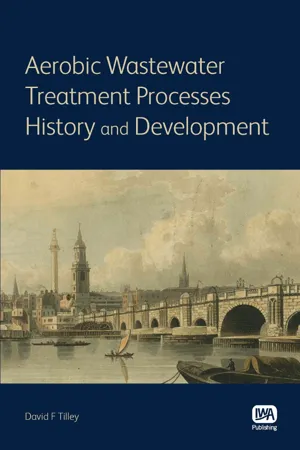
Aerobic Wastewater Treatment Processes: History and Development discusses the widely differing influences on the development of aerobic treatment such as water supply, toxic trade effluents, microscopy and population growth in urban areas. It covers the historical development of sewage treatment and the emergence of aerobic biological treatment from the early nineteenth century to the present day. The importance of water supply and the influence this had on the water-carriage system is examined, as is the consequent discharge of sewage into rivers.  The factors which govern process selection and process development are discussed. There is a continued impetus to reduce land area, capital costs, running costs, and to optimise performance and process control. The discovery of the activated sludge process is detailed including the development, in the early 1900s, of many forms of this process. Industrial wastes were discharged to biological treatment systems and the impact of such pollutants is reviewed. 

The work of Royal Commissions, River Boards and the National Rivers Authority is summarised, and the advances in chemical analysis and "on-line" measurement of chemical quality characteristics. Later developments such as reed beds and the use of hybrid treatment systems are covered. Examples are included such as the "fixed film" activated sludge process which has found application for small communities in package form, and also for large-scale municipal treatment plants. 

Aerobic Wastewater Treatment Processes: History and Development is valuable reading for students of the following courses on CIWEM Dip examination, WITA and B Tech and Environmental Science and Civil Engineering. 
Frequently asked questions

Yes, you can cancel anytime from the Subscription tab in your account settings on the Perlego website. Your subscription will stay active until the end of your current billing period. Learn how to cancel your subscription.
No, books cannot be downloaded as external files, such as PDFs, for use outside of Perlego. However, you can download books within the Perlego app for offline reading on mobile or tablet. Learn more here.
Perlego offers two plans: Essential and Complete
  • Essential is ideal for learners and professionals who enjoy exploring a wide range of subjects. Access the Essential Library with 800,000+ trusted titles and best-sellers across business, personal growth, and the humanities. Includes unlimited reading time and Standard Read Aloud voice.
  • Complete: Perfect for advanced learners and researchers needing full, unrestricted access. Unlock 1.4M+ books across hundreds of subjects, including academic and specialized titles. The Complete Plan also includes advanced features like Premium Read Aloud and Research Assistant.
Both plans are available with monthly, semester, or annual billing cycles.
We are an online textbook subscription service, where you can get access to an entire online library for less than the price of a single book per month. With over 1 million books across 1000+ topics, we’ve got you covered! Learn more here.
Look out for the read-aloud symbol on your next book to see if you can listen to it. The read-aloud tool reads text aloud for you, highlighting the text as it is being read. You can pause it, speed it up and slow it down. Learn more here.
Yes! You can use the Perlego app on both iOS or Android devices to read anytime, anywhere — even offline. Perfect for commutes or when you’re on the go.
Please note we cannot support devices running on iOS 13 and Android 7 or earlier. Learn more about using the app.
Yes, you can access Aerobic Wastewater Treatment Processes by David F. Tilley in PDF and/or ePUB format, as well as other popular books in Technology & Engineering & Environmental Science. We have over one million books available in our catalogue for you to explore.

Table of contents

  1. Cover page
  2. Half title page
  3. Title page
  4. Copyright page
  5. Contents
  6. About the author
  7. Acknowledgements
  8. Chapter 1
  9. Chapter 2
  10. Chapter 3
  11. Chapter 4
  12. Chapter 5
  13. Chapter 6
  14. Chapter 7
  15. Chapter 8
  16. Chapter 9
  17. Chapter 10
  18. References