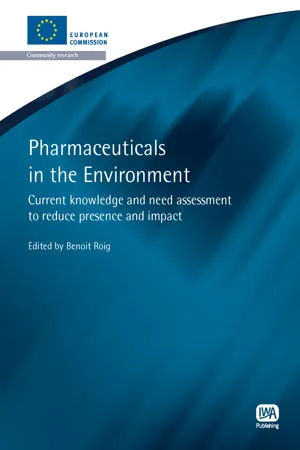
Pharmaceuticals in the Environment: current knowledge and need assessment to reduce presence and impact brings together results of previous and on-going EU projects with published data from both governmental sources and scientific literature and manufacturers' data on production and usage of pharmaceuticals. This book puts together the current knowledge and emphasises questions that deserve attention such as: What is the spectrum of most relevant pharmaceutical products (PPs) for the aquatic environment? Which indicators for supporting environmental managers, health authorities? What is the efficiency of urban and industrial sewage treatment plants over a year? What is the fate and behaviour of PPs in sewage treatment plants? If receiving waters are used for potable water supplies, does the presence of these compounds represent a potential hazard to human health? Could we solve some problems by environmental or cleaner technologies? What regulatory approaches, incentives, prevention actions can be implemented in order to lower PPs concentration in the environment? Does a European practical guidance can be developed? Can the impacts of PPs on the environment be reduced through the use of eco-pharmaco-stewardship approaches including the use of clean synthesis, classification and labelling, and better communication of methods of 'good practice'? How can we better monitor the environmental impact of a pharmaceutical once it has received a marketing authorisation?
- 216 pages
- English
- PDF
- Available on iOS & Android
eBook - PDF
Pharmaceuticals in the Environment
About this book
About 4000 medical compounds are being used in the drugs applied today. It is estimated that worldwide consumption of active compounds amounts to some 100,000 tons or more per year. Consequently, there is a need to highlight the most important questions and issues related to presence of pharmaceuticals in the environment.
Information
Table of contents
- Half title page
- Title page
- Copyright page
- Contents
- Acknowledgements
- Contributors
- Foreword: Pharmaceuticals in the environment – Why should we care?
- Chapter 1: Introduction
- Chapter 2: Policy framework at EU level
- Chapter 3: Exposure based on life cycle
- Chapter 4: Real situation: Occurrence of the main investigated PPs in water bodies
- Chapter 5: Performance of conventional treatment processes of the most resistant PPs
- Chapter 6: Biological monitoring and endpoints
- Chapter 7: Environmental risk assessment and prioritization strategies for human pharmaceuticals, review and discussion
- Chapter 8: Recommendations on research and development
- Chapter 9: Recommendations on communication and education
Trusted by 375,005 students
Access to over 1.5 million titles for a fair monthly price.
Study more efficiently using our study tools.
Frequently asked questions
Yes, you can cancel anytime from the Subscription tab in your account settings on the Perlego website. Your subscription will stay active until the end of your current billing period. Learn how to cancel your subscription
No, books cannot be downloaded as external files, such as PDFs, for use outside of Perlego. However, you can download books within the Perlego app for offline reading on mobile or tablet. Learn how to download books offline
Perlego offers two plans: Essential and Complete
- Essential is ideal for learners and professionals who enjoy exploring a wide range of subjects. Access the Essential Library with 800,000+ trusted titles and best-sellers across business, personal growth, and the humanities. Includes unlimited reading time and Standard Read Aloud voice.
- Complete: Perfect for advanced learners and researchers needing full, unrestricted access. Unlock 1.5M+ books across hundreds of subjects, including academic and specialized titles. The Complete Plan also includes advanced features like Premium Read Aloud and Research Assistant.
We are an online textbook subscription service, where you can get access to an entire online library for less than the price of a single book per month. With over 1.5 million books across 990+ topics, we’ve got you covered! Learn about our mission
Look out for the read-aloud symbol on your next book to see if you can listen to it. The read-aloud tool reads text aloud for you, highlighting the text as it is being read. You can pause it, speed it up and slow it down. Learn more about Read Aloud
Yes! You can use the Perlego app on both iOS and Android devices to read anytime, anywhere — even offline. Perfect for commutes or when you’re on the go.
Please note we cannot support devices running on iOS 13 and Android 7 or earlier. Learn more about using the app
Please note we cannot support devices running on iOS 13 and Android 7 or earlier. Learn more about using the app
Yes, you can access Pharmaceuticals in the Environment by Benoit Roig in PDF and/or ePUB format, as well as other popular books in Technology & Engineering & Environmental Science. We have over 1.5 million books available in our catalogue for you to explore.