- 365 pages
- English
- PDF
- Available on iOS & Android
eBook - PDF
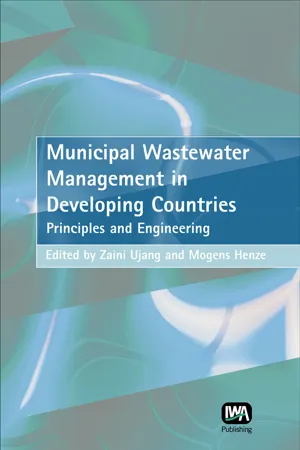
Municipal Wastewater Management in Developing Countries
About this book
Municipal Wastewater Management in Developing Countries discusses various approaches to municipal wastewater management in order to protect both public health and the environment, with the major focus being on waterborne diseases. Developing countries can be divided into two main categories, i.e. countries in transition with higher growth rates where industrialisation and urbanisation are taking place rapidly, and countries with slower growth rates. It is important, therefore, that approaches should be tailor-made and site-specific. In general, the major trends of water pollution control have significantly contributed to the development of ?conventional sanitation? approaches in terms of legal and financial frameworks, as well as technological enhancement. Despite advances in the science, engineering and legal frameworks, 95 per cent of the wastewater in the world is released into the environment without treatment. Only five per cent of global wastewater is properly treated using the ?standard? sanitation facilities, mainly in developed countries. As a result, the majority of the world?s population is still exposed to waterborne diseases, and the quality of water resources has been rapidly degraded, particularly in poor developing countries. The challenge now is to provide the world?s population, especially the poor, with adequate water and sanitation facilities. Despite billions of dollars of investment spent every year, billions of poor people are still suffering and dying because of poor sanitation. At the beginning of this century, about 1.1 billion people lived without access to clean water (compared to about the same number in 1990), 2.4 billion without appropriate sanitation (compared to 2.3 billion in 1990) and four billion without sound wastewater disposal. The future scenario, that water resources will be further depleted by a growing world population, will be coupled with environmental degradation due to poor pollution control, particularly in most of the developing countries. In order to address the issue of water and wastewater management in developing countries it is necessary to take into consideration the segments of the society itself, particularly the types of housing areas. The segments will indicate the level of socio-economic, mentality and knowledge, which is important for any planned changes in their life style and social engineering. It is also important to segregate the funding framework of any proposed projects. High-income urban communities, for instance, are generally willing to pay for sewerage services and higher water supply tariffs, therefore a designated system can be accordingly provided. Over the past 10 years, serious criticism has been given to the ?conventional sanitation? approach, consequently many definitions, concepts and characteristics have been proposed on ?sustainable sanitation?. Sustainable sanitation is a relevant concept in order to achieve the Millennium Development Goals by 2015 of providing water supply and adequate sanitation for developing countries. Sustainable sanitation is flexible in approach any community ? poor or rich, urban or rural, water-rich or water-poor country ? and requires lower investment costs compared to conventional sanitation approaches. It is also important to note that the framework of sustainable sanitation is much easier to adopt in developing countries where water supply and sanitation infrastructures are still in the developing stages. In some developing countries, no public facilities are available therefore it is an ideal condition to start a new infrastructure with a new framework. This comprehensive reference, prepared by leading international authorities, will provide an invaluable reference for all those concerned with the management of sanitation services in developing countries worldwide.
Information
Table of contents
- Contents
- Preface
- 1 Sustainable sanitation for developing countries
- 2 Setting effluent quality standards
- 3 Strategy and planning of sewerage infrastructures
- 4 Wastewater treatment technology
- 5 Collection systems - dry and wet weather performance
- 6 Conventional small and decentralised wastewater systems
- 7 Waste stabilization ponds
- 8 Design and operation of constructed wetlands for wastewater treatment and reuse
- 9 Innovation and technology for sustainability
- 10 Sludge treatment and management
- 11 Management of decentralised sewerage systems
Trusted by 375,005 students
Access to over 1.5 million titles for a fair monthly price.
Study more efficiently using our study tools.
Frequently asked questions
Yes, you can cancel anytime from the Subscription tab in your account settings on the Perlego website. Your subscription will stay active until the end of your current billing period. Learn how to cancel your subscription
No, books cannot be downloaded as external files, such as PDFs, for use outside of Perlego. However, you can download books within the Perlego app for offline reading on mobile or tablet. Learn how to download books offline
Perlego offers two plans: Essential and Complete
- Essential is ideal for learners and professionals who enjoy exploring a wide range of subjects. Access the Essential Library with 800,000+ trusted titles and best-sellers across business, personal growth, and the humanities. Includes unlimited reading time and Standard Read Aloud voice.
- Complete: Perfect for advanced learners and researchers needing full, unrestricted access. Unlock 1.5M+ books across hundreds of subjects, including academic and specialized titles. The Complete Plan also includes advanced features like Premium Read Aloud and Research Assistant.
We are an online textbook subscription service, where you can get access to an entire online library for less than the price of a single book per month. With over 1.5 million books across 990+ topics, we’ve got you covered! Learn about our mission
Look out for the read-aloud symbol on your next book to see if you can listen to it. The read-aloud tool reads text aloud for you, highlighting the text as it is being read. You can pause it, speed it up and slow it down. Learn more about Read Aloud
Yes! You can use the Perlego app on both iOS and Android devices to read anytime, anywhere — even offline. Perfect for commutes or when you’re on the go.
Please note we cannot support devices running on iOS 13 and Android 7 or earlier. Learn more about using the app
Please note we cannot support devices running on iOS 13 and Android 7 or earlier. Learn more about using the app
Yes, you can access Municipal Wastewater Management in Developing Countries by Zaini Ujang,Mogens Henze in PDF and/or ePUB format, as well as other popular books in Technology & Engineering & Environmental Science. We have over 1.5 million books available in our catalogue for you to explore.