eBook - ePub
Organic Waste Recycling: Technology, Management and Sustainability
- 600 pages
- English
- ePUB (mobile friendly)
- Available on iOS & Android
eBook - ePub
Organic Waste Recycling: Technology, Management and Sustainability
About this book
This fourth edition of Organic Waste Recycling is fully updated with new material to create a comprehensive and accessible textbook:
- New chapter on constructed wetlands for wastewater and faecal sludge stabilization.
- New sections on: waste recycling vs. climate change and water; faecal sludge and its characteristics; hydrothermal carbonization technology; up-to-date environmental criteria and legislation and environmental risk assessment.
- New case studies with emphasis on practices in both developed and developing countries have been included, along with more exercises at the end of chapters to help the readers understand the technical principles and their application.
- Novel concepts and strategies of waste management are presented.
- Up-to-date research findings and innovative technologies of waste recycling program are provided.
This textbook is intended for undergraduate and graduate students majoring in environmental sciences and engineering as well as researchers, professionals and policy makers who conduct research and practices in the related fields. It is essential reading for experts in environmental science and engineering and sustainable waste reuse and recycling in both developed and developing countries.
Information
Topic
Sciences biologiquesSubtopic
Sciences appliquées© IWA Publishing 2017. Chongrak Polprasert and Thammarat Koottatep. Organic Waste Recycling: Technology, Management and Sustainability. DOI: 10.2166/9781780408217_001
Chapter 1
Introduction
1.1 PROBLEMS AND NEED FOR ORGANIC WASTE RECYCLING
Organic waste should not be seen as an environmental problem, but rather a valuable resource that can be transformed into marketable products with tremendous environmental and economic opportunities (APO, 2007). Organic waste is an important and advantageous resource which, if not properly managed, can become a threat when sent to landfills or improperly treated. These can be in the form of greenhouse gases (GHGs), transmission of pathogenic micro-organisms, heavy metals, organic and inorganic substances which are inimical to public health and the environment (PWGSC, 2013). Generally, low and middle-income countries generate high percentage of organic waste of about 64% and 28% for high income-countries (ADB, 2011; World Bank, 2012; UNEP/ISWA, 2015). The East Asia Pacific region (EAP) has the highest percentage of organic waste composition followed by the Middle East & North Africa Countries and the Organization for Economic Co-operation and Development (OECD) Countries (Hoornweg & Bhada-Tata, 2012). The major sources of organic waste are municipal waste (restaurant and kitchen waste, domestic organic waste and sewage, and waste from the food processing industry), and agricultural and crop processing (crop and garden waste, sawdust and fruit waste, chicken and other animal manure and waste from abattoirs) (PWGSC, 2013).These classes of waste can either be reduced, recycled or transformed into organically beneficial products through the application of new and innovative approaches and technologies for energy, organic fertilizers, and animal feed.
Historically, organic wastes, along with other components of waste stream collected from residential and industrial, commercial, and institutional sectors, have been disposed in landfills and other similar facilities which can constitute serious environmental hazards, but the diversions of this class of waste can generate environmental and social benefits as well as presenting sizeable untapped potentials. The drivers for change for effective organic waste management include but not limited to: resource-recovery, revenue-earning, food security especially in addressing soil fertility, global warming in the reduction of the greenhouse gases, land scarcity in the extension of the life span of landfills sites, public health challenges and inadequate public finance for waste treatment and management (ADB, 2011).
Eliminating uncontrolled disposal is a public health priority as well as protecting the environmental quality. Even though high and upper-income countries have achieved 100% and 95% controlled disposal with an increased in organic waste recycled income, the contrast is the case in low-income countries with rates well below 50%, and 0% controlled disposal still common in the rural areas of many countries. It is estimated that at least 3 billion people worldwide still lack access to controlled waste disposal facilities (UNEP/ISWA, 2015). The challenge facing low and middle-income countries is how to modernize their organic waste treatment and management facilities as well as extend collection coverage to the unserved. The notions of the 70s where waste management was largely seen as a technical problem with engineering solutions are not relevant because from the 90s it became clear that waste could not be properly managed without active participation of the service users. Waste managers have learned that technologies depend on institutional, governance and policy frameworks (UN-Habitat, 2010) to achieve sustainability.
Inadequate wastewater management are directly responsible for the discharge of pathogens, organic compounds, synthetic chemicals, nutrients, organic matter and heavy metals into the ecosystem which negatively impact public health and biological diversity (Corcoran et al. 2010). It is estimated that a staggering 80–90% of all wastewater generated in developing countries is discharged directly into surface water bodies. This wastewater contaminants freshwater and coastal ecosystems, threatening food security, access to safe drinking water and sanitation facilities (UN Water, 2008). Currently, about 800 million people lack access to an improved water sources and 1.8 billion people globally use a source of drinking water that is faecally contaminated. Also, 2.5 billion people lack adequate sanitation facilities and over 1 billion practice open defecation, and if there is no significant policy change and investment, around 1.4 billion people are projected to be without access to sanitation in 2050 (WHO, 2000; UN-Water/WHO, 2014; UNDP, 2016; UNICEF/WHO, 2016). For drinking water and sanitation, majority without access now live in two developing regions of Sub-Saharan Africa and Southern Asia. As shown in Table 1.1, although the percentages of population served with adequate water supply and sanitation increased during the past decade, due to rapid population and urban growth, these percentages for the urban areas are not expected to increase much in the next decade, while a lot of improvement is needed for the rural areas.
Table 1.1 Water supply and sanitation coverage.
| Regions | Percentage Covered in Year | ||
| 1990 | 2002 | 2015 | |
Developing | |||
Urban water | 93 | 92 | 95 |
Rural water | 59 | 70 | 83 |
Total water | 71 | 79 | 89 |
Urban sanitation | 68 | 73 | 77 |
Rural sanitation | 16 | 31 | 47 |
Total sanitation | 34 | 49 | 62 |
Global | |||
Urban water | 95 | 95 | 96 |
Rural water | 63 | 72 | 84 |
Total water | 77 | 83 | 91 |
Urban sanitation | 79 | 81 | 82 |
Rural sanitation | 25 | 37 | 51 |
Total sanitation | 49 | 58 | 68 |
| Source: UN, 2005; WHO/UNICEF, 2015. | |||
Sanitation conditions in both urban and rural areas need to be much improved as large percentages of the population still and will lack these facilities (Table 1.1). The number of people without access to improved sanitation in rural areas has decreased by 15% and open defaecation rates have decreased from 38% to 25%. Despite the progress made during the Millennium Development Goals (MDGs) period (2000–2015), sanitation coverage in the rural areas continues to lag behind urban areas (UNICEF/WHO, 2016). The U.N. Sustainable Development Goal (SDG) 6 is deliberately designed to ensure the availability and sustainable management of water and sanitation for all as one of the 17 SDGs for the 2030 development agenda (UNDP, 2016). To meet the 2030 target, faster progress with innovative solutions will be needed to improve access to drinking water and sanitation services (Figure 1.1).
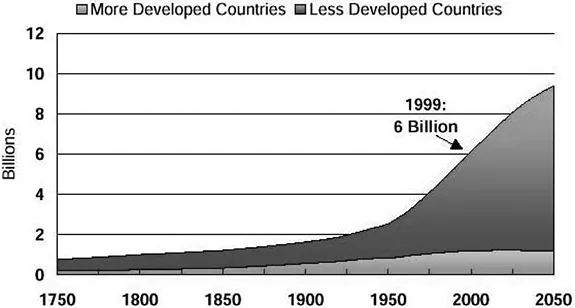
Figure 1.1 World population increases with human advances in science and technology (UN, 2005).
Providing reliable and affordable wastewater (sanitation) treatment system especially in the developing countries are challenged by the choice and adequacy of the technology selection. Studies have shown that the conventional centralized waste treatment systems which are costly to build, operate and manage in low and middle income-countries may not be the best applicable and appropriate solutions. The recommended alternative approaches are the decentralized waste treatment systems which allow for flexibility in operation and maintenance as well as in management (Massoud et al. 2009; Libralato et al. 2012; Chirisa et al. 2016). Other reasons for the failure to provide conventional ...
Table of contents
- Cover
- Half Title
- Title Page
- Copyright Page
- Contents
- About the authors
- Preface
- Abbreviations and symbols
- Atomic weight and number of elements
- Conversion factors for SI units
- Chapter 1: Introduction
- Chapter 2: Composition and characteristics of organic wastes
- Chapter 3: Composting
- Chapter 4: Bioenergy production
- Chapter 5: Algal production
- Chapter 6: Fish, chitin, and chitosan production
- Chapter 7: Aquatic weeds and their utilization
- Chapter 8: Constructed wetlands
- Chapter 9: Land treatment of wastewater
- Chapter 10: Land treatment of sludge
- Chapter 11: Organic waste recycling governance
- Index
Trusted by 375,005 students
Access to over 1.5 million titles for a fair monthly price.
Study more efficiently using our study tools.
Frequently asked questions
Yes, you can cancel anytime from the Subscription tab in your account settings on the Perlego website. Your subscription will stay active until the end of your current billing period. Learn how to cancel your subscription
No, books cannot be downloaded as external files, such as PDFs, for use outside of Perlego. However, you can download books within the Perlego app for offline reading on mobile or tablet. Learn how to download books offline
Perlego offers two plans: Essential and Complete
- Essential is ideal for learners and professionals who enjoy exploring a wide range of subjects. Access the Essential Library with 800,000+ trusted titles and best-sellers across business, personal growth, and the humanities. Includes unlimited reading time and Standard Read Aloud voice.
- Complete: Perfect for advanced learners and researchers needing full, unrestricted access. Unlock 1.5M+ books across hundreds of subjects, including academic and specialized titles. The Complete Plan also includes advanced features like Premium Read Aloud and Research Assistant.
We are an online textbook subscription service, where you can get access to an entire online library for less than the price of a single book per month. With over 1.5 million books across 990+ topics, we’ve got you covered! Learn about our mission
Look out for the read-aloud symbol on your next book to see if you can listen to it. The read-aloud tool reads text aloud for you, highlighting the text as it is being read. You can pause it, speed it up and slow it down. Learn more about Read Aloud
Yes! You can use the Perlego app on both iOS and Android devices to read anytime, anywhere — even offline. Perfect for commutes or when you’re on the go.
Please note we cannot support devices running on iOS 13 and Android 7 or earlier. Learn more about using the app
Please note we cannot support devices running on iOS 13 and Android 7 or earlier. Learn more about using the app
Yes, you can access Organic Waste Recycling: Technology, Management and Sustainability by Chongrak Polprasert,Thammarat Koottatep in PDF and/or ePUB format, as well as other popular books in Sciences biologiques & Sciences appliquées. We have over 1.5 million books available in our catalogue for you to explore.