eBook - ePub
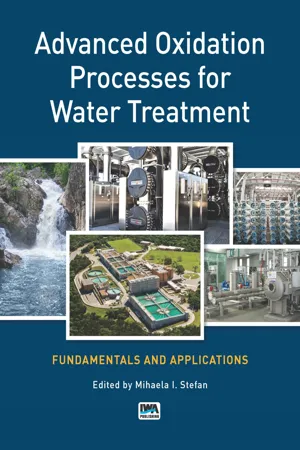
Advanced Oxidation Processes for Water Treatment
Fundamentals and Applications
- 710 pages
- English
- ePUB (mobile friendly)
- Available on iOS & Android
eBook - ePub
About this book
Advanced Oxidation Processes (AOPs) rely on the efficient generation of reactive radical species and are increasingly attractive options for water remediation from a wide variety of organic micropollutants of human health and/or environmental concern.
Advanced Oxidation Processes for Water Treatment covers the key advanced oxidation processes developed for chemical contaminant destruction in polluted water sources, some of which have been implemented successfully at water treatment plants around the world.
The book is structured in two sections; the first part is dedicated to the most relevant AOPs, whereas the topics covered in the second section include the photochemistry of chemical contaminants in the aquatic environment, advanced water treatment for water reuse, implementation of advanced treatment processes for drinking water production at a state-of-the art water treatment plant in Europe, advanced treatment of municipal and industrial wastewater, and green technologies for water remediation.
The advanced oxidation processes discussed in the book cover the following aspects:
- Process principles including the most recent scientific findings and interpretation.
- Classes of compounds suitable to AOP treatment and examples of reaction mechanisms.
- Chemical and photochemical degradation kinetics and modelling.
- Water quality impact on process performance and practical considerations on process parameter selection criteria.
- Process limitations and byproduct formation and strategies to mitigate any potential adverse effects on the treated water quality.
- AOP equipment design and economics considerations.
- Research studies and outcomes.
- Case studies relevant to process implementation to water treatment.
- Commercial applications.
- Future research needs.
Advanced Oxidation Processes for Water Treatment presents the most recent scientific and technological achievements in process understanding and implementation, and addresses to anyone interested in water remediation, including water industry professionals, consulting engineers, regulators, academics, students.
Editor: Mihaela I. Stefan - Trojan Technologies - Canada
Information
Subtopic
Applied SciencesIndex
Biological Sciences© IWA Publishing 2018. Mihaela I. Stefan. Advanced Oxidation Processes for Water Treatment: Fundamentals and Applications DOI: 10.2166/9781780407197_001
Chapter 1
A few words about Water
Mihaela I. Stefan
The first recorded evidence on “water management” in the history of humanity is considered the macehead of King Scorpion II of the Upper Egypt (ca. 2725–2671 B.C.), which also attests the existence of the king. The macehead discovered by the British archeologists James E. Quibell and Frederick W. Green in 1897–1898 illustrates the king holding a hoe, an ancient agricultural hand-tool, interpreted as being used in the ritual involving the pharaoh ceremonially opening the dikes to flood the fields for irrigation. About the same time (ca. 2500 B.C.), the most advanced urban settlement of ancient Indus civilization was built – Mohenjo-Daro, now a UNESCO Heritage Site in Larkana District, Pakistan’s Sindh Province. Aside from an impressive architectural urban planning, the city of Mohenjo-Daro had a sophisticated water network for providing fresh water to people and for effluent disposal. It was estimated that at least 700 wells were built vertically above or below the ground of wedge-shaped, standard size bricks and engineered to withstand the lateral pressure on 20 m or deeper wells. Most wells were located in private buildings, but one or more public wells were also constructed for each block of buildings, and could be accessed directly from the main streets (Jensen, 1989). The wells were covered to prevent water evaporation and salt crystallization. The wastewater and other sewage of almost every house were channeled into underground cylindrical pipes along the main streets. The archeological site revealed private baths paved with high quality bricks and surrounded by a low brick rim; the effluent was discharged either into a soak pit or to urban sewage drainage system. Jensen (1989) mentions that the Mohenjo-Daro waterworks (inner-urban water supply and effluent disposal system) “were developed to a perfection” which was surpassed only 2000 years later by Romans and “flowering of civil engineering and architecture in classical antiquity”.
The above brief note is meant to recognize not only the astonishing achievements of civilizations which existed more than 4500 years ago, but also people’s concern to ensure their self-sufficiency and survival through independent water supply and water conservation in a densely populated semi-arid climate.
In our era, water, the natural resource with no substitute, is under unprecedented increasing demand. Although three-quarters of the world is covered by water, over 97% of the planet’s water is salt water and less than 3% is fresh water. Approximately 70% of this fresh water is frozen in glaciers and polar ice caps, 29% is stored in underground aquifers and only ~1% of the world’s fresh water supply is in rivers, lakes and streams. The impact of climate change on water affects implicitly the Earth’s ecosystem, thus our society. Population growth, urbanization and higher standards of living, industrial expansion and agriculture, and regional imbalances will continue to increase the water demand globally, thus to diminish the fresh water availability. The water demand distribution among these factors varies largely from country to country. UNESCO estimated the cost of adapting to the climate change impact due to a 2°C rise in global average temperature to be from US$70 billion to US$100 billion per year between 2020 and 2050. (http://www.unesco.org/fileadmin/MULTIMEDIA/HQ/SC/pdf/WWDR4%20Background%20Briefing%20Note_ENG.pdf).
As of April 2017, the world’s population is believed to have reached 7.5 billion and it is predicted to increase to 10 billion by the year 2056. The population growth is paralleled by increasing global demand for food (e.g. expected to go up by 70% by 2050), with the livestock product demand trend ascending rapidly. Production of meat, dairy products and fish are more water (2.9-fold), energy (2.5-fold), fertilizer (13-fold) and pesticides (1.4-fold) demanding than production of vegetables (Angelakis et al. 2016).
Through Resolution 64/292 of July 28, 2010, the United Nations General Assembly explicitly recognized the access to water and sanitation as a human right (http://www.un.org/waterforlifedecade/human_right_to_water.shtml). The water should be sufficient for personal and domestic uses, safe (free from microorganisms, chemical substances and radiological hazards that constitute a health threat), acceptable with respect to color, odor and taste, physically accessible i.e. within or in the immediate vicinity of the household, educational, health or workplace institution, and affordable. About one billion people do not have access to safe drinking water and as reported in 2010, 2.6 billion people in the world did not have access to adequate sanitation facilities (http://www.unesco.org/fileadmin/MULTIMEDIA/HQ/SC/pdf/WWDR4%20Background%20Briefing%20Note_ENG.pdf). Approximately one-half of the world’s population depends on polluted water sources and ca. one billion people consume agricultural products originating from lands irrigated with raw or inadequately treated wastewater (Bougnom & Piddock, 2017).
In response to water scarcity trends, engineering solutions to augmentation of the existing supplies were implemented in various geographies around the world. Examples include seawater desalination, wastewater recycling, and bulk water transfer between catchments. Global and regional energy evaluation for water in the context of “water-energy nexus,” which links the water demand for energy production with the energy required supplying, treating, and to deliver the water, is the topic of numerous publications (e.g. Liu et al. 2016; & references therein). Lifecycle assessment (LCA) became a common tool for the evaluation of environmental sustainability of water and wastewater treatment technologies (Friedrich, 2002; Stokes & Horvath, 2006; Lyons et al. 2009; Law, 2016).
Currently there are approx. 15,000 water desalination plants in the world (Brookes et al. 2014). In the Middle East, desalination satisfies approx. 70% of the water needs in the region. Saudi Arabia is the largest producer of desalinated water, houses the world’s largest desalination plant operated with solar photovoltaic energy, and it is predicted that by 2019 all the country’s desalination plants will be powered by solar technology (https://www.fromthegrapevine.com/innovation/5-countries-cutting-edge-water-technology#).
Wastewater recycling became an alternative source of water around the world in regions impacted by drought, scarce fresh water resources, and high-water demand. The main purpose of reclaimed water is for direct or indirect potable reuse (groundwater recharge, surface water augmentation), or for non-potable reuse (e.g., landscape, golf course and agriculture irrigation, seawater barrier, industrial and commercial use, natural system restoration, wetlands and wildlife habitat, geothermal energy production). The earliest large water reclamation plant for direct potable reuse was built in Windhoek, Namibia, in 1968. In late 1990s, the plant was no longer technologically up-to-date. A new, larger plant was built and it has been into operation since 2002. The municipal wastewater secondary effluent which was held for 2–4 days into maturation ponds is mixed with surface water (9:1 ratio) then treated following the multiple barrier approach. The multi-step, fully-automated treatment train also includes advanced water treatment consisting of ozonation, biological and granular activated carbon filtration, and ultrafiltration prior to chlorination and distribution (21,000 m3/day). The water quality is extensively monitored daily along the entire treatment process and its values must adhere to a number of drinking water guidelines and standards, including WHO Guidelines, EU Drinking Water Directive, Rand Water (South Africa) Potable Water Quality Criteria and the Namibian Guidelines (NamWater). Treated water is also used for aquifer recharge (Lahnsteiner & Lempert, 2007).
According to the Australian Bureau of Statistics, in 2010/2011 the major water sources for public consumption were surface waters (92%) and groundwater; a small fraction was provided by water reclamation and desalination plants (Dolnicar et al. 2014). In Australia, 13% of households use rainwater from private collection tanks for potable purposes, mostly in the rural areas. Although the risk from consuming rainwater is low in most areas, it is acknowledged that the water from collection tanks is not as well managed and treated as the water from municipal network supplies. The high use of rainwater is linked to the public perception on the quality of water in the distribution network. Dolnicar et al.’s study (2014) on the ‘water case’ in Australia showed how widely the public’s perception of different kinds of water – bottled, recycled, desalinated, tap and rainwater – and of their attributes could be, in the context of public acceptance of water from alternative sources.
One common problem to all untreated water sources – natural or alternative – is microbial and chemical pollution. The worldwide occurrence of chemical pollutants at nanogram/L to microgram/L levels in the aquatic environment is well documented in the published literature, and the research on their fate and potential toxicity to the aquatic species expands rapidly. Surface waters and groundwater are impacted by both naturally occurring micropollutants and contaminants originating from human agricultural and industrial activities, and wastewater effluent discharge. Among the naturally occurring water contaminants are cyanotoxins and a wide range of taste-and-odor (T&O)-causing compounds which are released by algal cells (e.g. cyanobacteria and chrysophytes) during the algal bloom seasons which are favored by nutrient levels in the water, high air and water temperatures and sunlight. While most of the T&O compounds are non-toxic, yet impact the water aesthetics, cyanotoxins (e.g. microcystins, saxitoxins, cylindrospermopsin, anatoxin-a, domoic acid – a marine toxin, nodularins) are potent toxins and a potential health threat to humans. Inorganic species such as arsenic, chromium, manganese, iron, vanadium, etc. are among naturally occurring contamination originating from local geology and catchment conditions. Examples of other classes of water pollutants include pesticides (e.g. s-triazine pesticides and their metabolites, glyphosate, bromacil, chlortoluron, metaldehyde, linuron, mecoprop), industrial solvents (e.g. trichloroethene, tetrachloroethene, 1,4-dioxane, chlorinated and non-chlorinated aromatic compounds, methyl-tert-butylether), human and veterinary drugs, natural and synthetic hormones, ingredients in domestic and personal care products (e.g. caffeine, benzotriazoles, parabens), plasticizers, polyaromatic hydrocarbons, perfluorinated compounds.
Reclaimed water requires advanced treatment due to the presence of a plethora of low molecular weight, neutral molecules such as nitrosamines, 1,4-dioxane, disinfection byproducts, endocrine disruptors, etc. which pass through the membrane filtration steps.
Environmental protection agencies and public health organizations around the world issued quality standards for drinking water and, in many jurisdictions, for the wastewater effluents in order to control and prevent the pollution of receiving waters and to protect the aquatic environment, its habitats and biodiversity. In addition, quality standards specific to the reclaimed water are set and must be met. WHO Guidelines for drinking water quality provide the framework for public health protection and risk management recommendations. Under the Safe Drinking Water Act (SDWA) of 1996, the U.S. EPA enforces the national primary drinking water regulations for 91 contaminants, including microorganisms, disinfectants, disinfection byproducts, radionuclides, and other inorganic and organic compounds. The 1996 SDWA Amendments set the process for further contaminant regulations and standard setting through Contaminant Candidate Lists (CCLs) and subsequent Regulatory Determinations (RDs). Over 100 organic and inorganic compounds are currently listed on the latest CCL (CCL4) to be considered for regulation upon RD. CCL4 includes ~40 pesticides and their degradation products, ~30 industrial solvents, five N-nitrosamines, naturally occurring contaminants of which three cyanotoxins and five inorganic compounds, eight hormones or hormone-like compounds, two perfluorinated substances, as well as compounds from other classes such as explosives, ozonation byproducts, pharmaceuticals (human and veterinary drugs), food and cosmetics ingredients. A number of these contaminants already fall under federal or stat...
Table of contents
- Cover
- Half Title
- Title Page
- Copyright Page
- Dedication
- Contents
- About the Editor
- List of Contributors
- Preface
- Chapter 1: A few words about Water
- Chapter 2: UV/Hydrogen peroxide process
- Chapter 3: Application of ozone in water and wastewater treatment
- Chapter 4: Ozone/H2O2 and ozone/UV processes
- Chapter 5: Vacuum UV radiation-driven processes
- Chapter 6: Gamma-ray and electron beam-based AOPs
- Chapter 7: Fenton, photo-Fenton and Fenton-like processes
- Chapter 8: Photocatalysis as an effective advanced oxidation process
- Chapter 9: UV/Chlorine process
- Chapter 10: Sulfate radical ion – based AOPs
- Chapter 11: Ultrasound wave-based AOPs
- Chapter 12: Electrical discharge plasma for water treatment
- Chapter 13: The role of photochemistry in the transformation of pollutantsin surface waters
- Chapter 14: Advanced treatment for potable water reuse
- Chapter 15: Advanced treatment for drinking water production
- Chapter 16: AOPs for municipal and industrial wastewater treatment
- Chapter 17: Iron-based green technologies for water remediation
- Index
Trusted by 375,005 students
Access to over 1.5 million titles for a fair monthly price.
Study more efficiently using our study tools.
Frequently asked questions
Yes, you can cancel anytime from the Subscription tab in your account settings on the Perlego website. Your subscription will stay active until the end of your current billing period. Learn how to cancel your subscription
No, books cannot be downloaded as external files, such as PDFs, for use outside of Perlego. However, you can download books within the Perlego app for offline reading on mobile or tablet. Learn how to download books offline
Perlego offers two plans: Essential and Complete
- Essential is ideal for learners and professionals who enjoy exploring a wide range of subjects. Access the Essential Library with 800,000+ trusted titles and best-sellers across business, personal growth, and the humanities. Includes unlimited reading time and Standard Read Aloud voice.
- Complete: Perfect for advanced learners and researchers needing full, unrestricted access. Unlock 1.5M+ books across hundreds of subjects, including academic and specialized titles. The Complete Plan also includes advanced features like Premium Read Aloud and Research Assistant.
We are an online textbook subscription service, where you can get access to an entire online library for less than the price of a single book per month. With over 1.5 million books across 990+ topics, we’ve got you covered! Learn about our mission
Look out for the read-aloud symbol on your next book to see if you can listen to it. The read-aloud tool reads text aloud for you, highlighting the text as it is being read. You can pause it, speed it up and slow it down. Learn more about Read Aloud
Yes! You can use the Perlego app on both iOS and Android devices to read anytime, anywhere — even offline. Perfect for commutes or when you’re on the go.
Please note we cannot support devices running on iOS 13 and Android 7 or earlier. Learn more about using the app
Please note we cannot support devices running on iOS 13 and Android 7 or earlier. Learn more about using the app
Yes, you can access Advanced Oxidation Processes for Water Treatment by Mihaela I. Stefan in PDF and/or ePUB format, as well as other popular books in Biological Sciences & Applied Sciences. We have over 1.5 million books available in our catalogue for you to explore.