eBook - ePub
Available until 23 Dec |Learn more
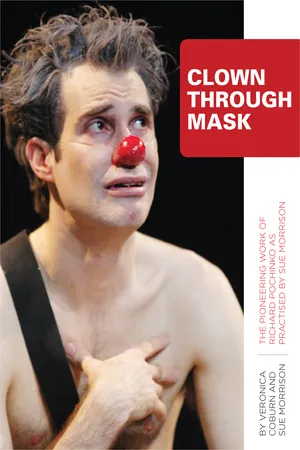
Clown Through Mask
The Pioneering Work of Richard Pochinko as Practised
This book is available to read until 23rd December, 2025
- 570 pages
- English
- ePUB (mobile friendly)
- Available on iOS & Android
eBook - ePub
Available until 23 Dec |Learn more
About this book
Richard Pochinko (1946–89) played a pioneering role in North American clown theater through the creation of an original pedagogy synthesizing modern European and indigenous Native American techniques. In Clown Through Mask, Veronica Coburn and onetime Pochinko apprentice Sue Morrison lay out the methodology of the Pochinko style of clowning and offer a bold philosophical framework for its interpretation. Morrison is today a leading teacher of Pochinko's Clown through Mask technique and this book extends significantly the literature on this underdocumented form of theater.
Frequently asked questions
Yes, you can cancel anytime from the Subscription tab in your account settings on the Perlego website. Your subscription will stay active until the end of your current billing period. Learn how to cancel your subscription.
At the moment all of our mobile-responsive ePub books are available to download via the app. Most of our PDFs are also available to download and we're working on making the final remaining ones downloadable now. Learn more here.
Perlego offers two plans: Essential and Complete
- Essential is ideal for learners and professionals who enjoy exploring a wide range of subjects. Access the Essential Library with 800,000+ trusted titles and best-sellers across business, personal growth, and the humanities. Includes unlimited reading time and Standard Read Aloud voice.
- Complete: Perfect for advanced learners and researchers needing full, unrestricted access. Unlock 1.4M+ books across hundreds of subjects, including academic and specialized titles. The Complete Plan also includes advanced features like Premium Read Aloud and Research Assistant.
We are an online textbook subscription service, where you can get access to an entire online library for less than the price of a single book per month. With over 1 million books across 1000+ topics, we’ve got you covered! Learn more here.
Look out for the read-aloud symbol on your next book to see if you can listen to it. The read-aloud tool reads text aloud for you, highlighting the text as it is being read. You can pause it, speed it up and slow it down. Learn more here.
Yes! You can use the Perlego app on both iOS or Android devices to read anytime, anywhere — even offline. Perfect for commutes or when you’re on the go.
Please note we cannot support devices running on iOS 13 and Android 7 or earlier. Learn more about using the app.
Please note we cannot support devices running on iOS 13 and Android 7 or earlier. Learn more about using the app.
Yes, you can access Clown Through Mask by Veronica Coburn,Sue Morrison in PDF and/or ePUB format, as well as other popular books in Media & Performing Arts & Performing Arts. We have over one million books available in our catalogue for you to explore.
Information
PART ONE
The Basics of Pochinko Clown
Man is least himself when he talks in his own person. Give him a mask and he will tell you the truth.
Oscar Wilde
Chapter 3
The First Day
Daughters Of Copperwoman: Clowns
But mostly the clowns were very serious about what they did. And the most famous clown was a woman who wasn’t even one of us. She lived on the other side of the island with the Salish people. Or maybe it was the Cowichan, I guess I’m not too clear about that. Must be gettin’ old. Anyway, this woman had been a clown all her life. Ever since she was a girl she’d been able to imitate people, how they walked, how they talked, so she was trained to do it properly for the right reasons, not just to get attention. The Christian people were dividin’ up the island. This bunch got this part and another bunch got another part, and they built their churches and set about gettin’ us into them. There’s people say that it used to be the Indians had the land and the white man had the Bible, now the Indians got the Bible and the white man’s got the land, and when you look at it, that’s not far wrong, except lots of us don’t even got the Bible. Anyway, they’d built this stone church on a hill, with a cross on top of it pointin’ up at the sky, and the preacher, he was gettin’ people to come by givin’ out little pictures and mirrors and such, things we didn’t have. Might not seem like much now, a mirror, but they were as rare as diamonds, and it bein’ rare makes a thing worth a lot. Like roses are worth more than dandelions because there aren’t as many of them, but they’re both flowers.
So the people started goin’ to this church, and pretty soon it was just like the same old story. They started gettin’ told what to do, and what to wear, and how to live, and this particular preacher, he was big on what they ought to wear. He didn’t want the men wearin’ kilts, he wanted ‘em in pants, and he didn’t want the women in anythin’ but long dresses that covered ‘em completely. And he kept tellin’ everyone to learn to live like the white man, dress like the white man.
Well, one Sunday didn’t the clown show up. She was wearin’ a big black hat, just like a white man, and a black jacket, just like a white man, and old rundown shoes some white man had thrown away. And nothin’ else. […]
Well, the white preacher, he just about had a fit! Here’s this woman more naked than not, walkin’ into his church, and what’s worse, the people in the church are all lookin’ at her real respectful, not mockin’ her or laughin’ or coverin’ their eyes so they wouldn’t see her nakedness. And she moved to the very front and sat there and waited for the church service to start.
Well, that preacher, he ranted and raved about nakedness, and naked women, and sin, and havin’ respect for God, and then he came down from that pulpit and he grabbed ahold of that clown to throw her out on her bum.
The people just about ripped him apart. You don’t put violent hands on a clown! But the clown, she stopped them from hurtin’ him, and then she went to the front where he’d been, and she spoke to the people in their own language. (Cameron 2002: pp. 110 – 112.)
Students are asked to arrive early on the first day to allow practical details to be dispensed with before class officially starts at 9.30 a.m. Since the TRC closed the physical doors of 317 Adelaide Street West in the mid 1990s, due to lack of funding, the work of L’Atelier Pochinko, the name under which Pochinko taught Clown Through Mask, continues under the auspices of canadianclowning.com in rented spaces throughout the city. The current home is The Centre of Gravity at 1300 Gerrard Street East. Teetering on the coast of Little India it is a fully equipped circus space that provides training for novices, is a daily training ground for professionals, and a venue for occasional performances. An old cinema, it is almost totally devoid of natural light, its plain black walls are enlivened by red velvet curtains and circular wall lights boldly emblazoned with G for Gravity.
The first student on the first day always arrives before the space is open. The choice facing the early bird or birds in January in Toronto is to wait outside and slowly freeze or go in search of coffee. Sue arrives shortly after 9.00 a.m. and the thawing process begins. The space that has been waiting patiently bursts into life. The idle trapezes look on as boxes, of costumes, of clay, are carried in. Raffia bags full of wooden boards clatter onto the cold concrete floor. Sue’s partner, Jeremy, here to take care of the practical details sets up a temporary office on one of the wobbly, Formica tables. The course is not paid for in advance. A booking deposit of $100 holds a place but the full course fee is not payable until the trainee clown crosses the threshold. As the space begins to fill with activity animation leaks into the bones of the nervous birds ignited by cries of recognition from Sue as e-mail names manifest themselves in actual people. For Sue it is the first time she sees some students, she is recognizable to all through her image on her website, and for others it is a reunion. Many of those who attend Clown Through Mask in Toronto have taken workshops with Sue in their home countries and as a result of that experience have made the pilgrimage to Clown Mecca.
The complete Clown Through Mask module takes five weeks working daily, Monday to Friday, from 9.30 a.m. to 1.30 p.m. It seems a short day but the work is intense and there is much attention paid to starting on time and a distinct lack of tolerance for coffee breaks and time wasting. Like all other details in this work the length of the working day is well thought out. The day is short because the work is intense. And if the idea of distance is important in the functioning of myth, students will build a system of stories called a personal mythology in the course of this work, then the trainee mythmakers require distance in the form of time and space to allow their experiences to breathe so that those experiences can become visible to them.
The core of this work is a vision quest and, like the indigenous ceremony that inspired it, it is better done away from the tribe. In a place removed. In a time removed. In this regard students who come from far away are at a huge advantage in taking the workshop. Removed from the demands and obligations of their everyday lives they have the opportunity in the temporary home that the city of Toronto becomes to fully immerse themselves in the work. They are not required to rush away after class to work the latter half of the day in regular employment. They do not go home in the evening to friends and loved ones who may expect an explanation. There is much luxury in the absence of casual conversation during this work. How did it go today? What did you do today? There is much value in having unencumbered time and space, physical time and emotional space, to let the work breathe. Expand. Daily class finishes at 1.30 p.m. but the work does not cease at that appointed hour.
The purpose of a vision quest is transformation. In Native quest the transformation is from girl to woman, boy to man, from childhood to adulthood, from a state of dependency to a position of power. Native quests require noviciates to envision, recognize and stand into their power. Clown Through Mask asks no less of its students. Students during the five weeks of Clown Through Mask will be asked to envision, recognize and stand into their power. Their power in a holistic sense for there is power in weakness, there is power in fallibility and there is supreme power in vulnerability. Vulnerability is the clown’s tool.
What is it that draws people to the art of clown? Certainly, a percentage of students gravitate towards it under misguided notions of instant hilarity and thigh slapping frivolousness. There is always hilarity and much laughter in a clown class but a clown class is not a frivolous place. The task, to discover for each student what they have to offer the art of clown, is serious and the working atmosphere more so. There is no handing out to each student at the beginning of class their guaranteed laughter kit complete with fake banana skin, squirting flower and funny shoes. Clowns have always had a function. They have always served a need. Need is different to desire. With desire there is choice. A need must be satisfied. If that need is small, not of an urgent nature, like the circus clowns’ need to release the tension after the trapeze act or their need to distract the audience while the next act is set, there is no great demand on how that duty is dispensed. Frivolity in the form of garish grease paint, buckets of paper water and cars that fall apart are apt modes of expression. If the need is profound, a question of survival, then a bold statement such as that of the Copperwoman is required, and an action of that importance should not be accompanied by garish costume or cheap laughter.
So, for the individual student of clown, on the first day of class, they face a process that will facilitate their discovery of what they have to offer this ancient art. They face a process that will provide information on how they individually will function as a clown. And the answer for each student will be different. No other clown but the Copperwoman could have made the choice to confront the white man’s preacher with her nakedness for her strength of conviction and courage was hers alone. It might not be found in another. So, for the individual student of clown on the first day of a quest that will last five weeks they stand on the threshold of discovery. And the knowledge of themselves that they will unearth will inform what and how they will communicate whilst wearing the clown’s nose. Some will stand before us and make us roar with laughter. Others will stand before us and we will be silenced by their gravity. Both are clown.
Pochinko described the excavation of the individual in preparation for their elevation to the status of clown as the discovery of what is beautiful about that individual person. What is beautiful about them in a holistic sense for there is beauty in weakness, there is beauty in fallibility. And there is beauty in vulnerability.
Vulnerability is the common ground where understanding occurs just as the clay that students will mould and pound to give birth to their personas is the common earth from which we all originate. In Clown Through Mask students will work with the earth of which they are physically made to understand that part of themselves that is not so tangible. The soul.
Chapter 4
Preparatory Exercises
The First Exercise
On the first day of the first of five weeks everybody is nervous. Anticipation is high. In Sue’s own words:
“The work begins when people sign up. When people decide to take the class they have already started the class.”
When outdoor layers are discarded, and outdoor layers are necessary in Toronto in January, and important preparations such as strategically placing a water bottle or balancing a pen atop an expectant notepad are complete, Sue calls the room to order. Up to now she has been meeting and greeting her new students as they stomp in out of the cold to pick up on online conversations that trail back over the previous months.
Her first words to the whole group are:
“Come stand in a circle.”
And Sue watches as the students gather. Who is the first to arrive? Who is the last?
“Okay, we’re just going to say hello. We’ll go around the circle and introduce ourselves. You can say why you’re here if you want to. Or anything else you feel is relevant. Or interesting.”
And so the stories begin. When it is someone’s turn to speak everyone is expected to listen. If someone indulges their desire for a whispered conversation they will meet with Morrison’s sharp tongue. She runs a disciplined room. It is a room based on respect. Respect yourself. Respect others. Respect the work. If someone likes the sound of their own voice she is quick to let them know how interesting they really are.
“Yeah, yeah, yeah, and…”
If someone is reluctant to speak she will encourage and enquire.
“So, how was your journey here?”
But most of all, during this first exercise, the exercise she calls Checking In, the first exercise of the five week workshop and the exercise that will be the first exercise of each and every day, Sue Morrison watches and listens to her students for it is in this sacred circle that she will keep track of the people in her care over the course of the workshop.
“It doesn’t matter what they say, you can see where people are at, what’s going on, not from the story they’re telling but from the story they’re not telling. You develop a nose for that the same way you learn to see beyond what people want you to see. You learn to see through masks.”
This daily forum is where people will say what they need to say. It will be their release valve. And, although the function of the circle is care, the tone is not always soft. Morrison consciously keeps the room off balance. Implementing the Native concept of wholeness it is necessary for a caring room to also house its opposite. Irreverence.
“Clown is sacred for me but nothing can be that sacred. Everything has to have the piss taken out of it. People must take this seriously so that they believe in their ability to have experiences that they can survive and articulate. But you don’t want people to get precious so you have to take the air out of it some days.”
It is Morrison who has elevated this first exercise to a daily ritual. According to her, Richard would only do one circle on the first day. Very often, she said, he would do that and one other exercise and then tell people that that was enough for the first day and send them home. He did so because the work that had been done was significant, the exercises fundamental, but sometimes some of his students, the ones with a more practical approach, didn’t always see it that way. If they complained that the class was shorter than advertised he was quick to offer them their money back.
The use of ritual, repetition, is an important feature of this work. This first exercise on the first day becomes a daily ritual, a comforting rite. With procedure: stand in a circle, listen when someone speaks, speak when it is your turn; and a function: to check in, to release if necessary, to be seen and heard. Ritual, repetitive processes are used throughout this work to provide equilibrium when all else may be out of kilter.
So, from the very first exercise on the very first day, in keeping with Native concepts of wholeness and opposites, an atmosphere of equilibrium is created and then that atmosphere is tempered with danger, in the smartness of a comment, the making of a joke or the irreverence of a reaction. Welcome to Sue Morrison’s world. Over the next five weeks Sue Morrison will bring the students who stand in the sacred circle for the first time, on the first day, into her world; a world of possibility, and in that world they will do things that they did not know they were capable of.
The last thing that Sue does to conclude the first circle on the first morning is to offer two explanations in one sentence. What clown is and what the students will be doing for the next five weeks.
CLOWN: The Native American approach is facing all six dir...
Table of contents
- Cover
- Title Page
- Copyright
- Contents
- Preface
- Introduction
- Background Information
- Part One: The Basics of Pochinko Clown
- Part Two: Building a Personal Mythology
- Part Three: Masks Two to Six
- Part Four: Performance
- Part Five: Joey & Auguste
- Part Six: Clown Theatre
- Afterword
- Bibliography