This book is available to read until 23rd December, 2025
- 310 pages
- English
- ePUB (mobile friendly)
- Available on iOS & Android
eBook - ePub
Available until 23 Dec |Learn more
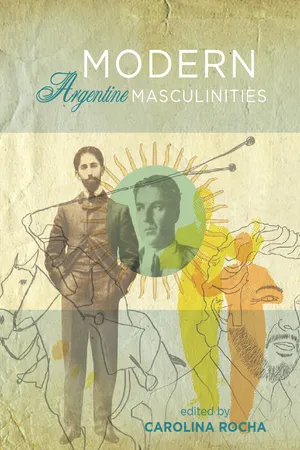
Modern Argentine Masculinities
About this book
Setting new standards in assessing how masculinity in Argentina has been represented in film, literature and music, this collection untangles Argentinian construction of masculinity, manhood and gendered difference from the nineteenth century to the present. With methodologies ranging from literary analysis of novels to historical approaches to the construction and performance of gender, these essays offer a dramatic, new multidisciplinary approach to modern Argentinian masculinity.
Frequently asked questions
Yes, you can cancel anytime from the Subscription tab in your account settings on the Perlego website. Your subscription will stay active until the end of your current billing period. Learn how to cancel your subscription.
No, books cannot be downloaded as external files, such as PDFs, for use outside of Perlego. However, you can download books within the Perlego app for offline reading on mobile or tablet. Learn more here.
Perlego offers two plans: Essential and Complete
- Essential is ideal for learners and professionals who enjoy exploring a wide range of subjects. Access the Essential Library with 800,000+ trusted titles and best-sellers across business, personal growth, and the humanities. Includes unlimited reading time and Standard Read Aloud voice.
- Complete: Perfect for advanced learners and researchers needing full, unrestricted access. Unlock 1.4M+ books across hundreds of subjects, including academic and specialized titles. The Complete Plan also includes advanced features like Premium Read Aloud and Research Assistant.
We are an online textbook subscription service, where you can get access to an entire online library for less than the price of a single book per month. With over 1 million books across 1000+ topics, we’ve got you covered! Learn more here.
Look out for the read-aloud symbol on your next book to see if you can listen to it. The read-aloud tool reads text aloud for you, highlighting the text as it is being read. You can pause it, speed it up and slow it down. Learn more here.
Yes! You can use the Perlego app on both iOS or Android devices to read anytime, anywhere — even offline. Perfect for commutes or when you’re on the go.
Please note we cannot support devices running on iOS 13 and Android 7 or earlier. Learn more about using the app.
Please note we cannot support devices running on iOS 13 and Android 7 or earlier. Learn more about using the app.
Yes, you can access Modern Argentine Masculinities by Carolina Rocha in PDF and/or ePUB format, as well as other popular books in Politics & International Relations & Science & Technology Public Policy. We have over one million books available in our catalogue for you to explore.
Information
Chapter 1
Imagining Male Subjects: Representing Argentine Masculinities in Nineteenth-Century Poetry Anthologies
After the wars of independence that spread throughout Spanish America in the first quarter of the nineteenth century, the various nation-building projects of the new republics were carried out by the male intellectuals of the time, the letrados.1 As Ángel Rama establishes in The Lettered City, the discourses that dominated the public sphere were those of the letrados, who controlled what Rama calls ‘The city of Letters’ in the colonial period and ‘The city of Protocols’ during the nineteenth century onwards. From their masculine standpoint, these men led the struggle to institute political independence through the constant production of written documents. In the case of Argentina, Nicholas Shumway elaborates in The Invention of Argentina how a very limited number of men organized and led the national public sphere during the entirety of the nineteenth century.
Among the vast amount of written documents produced to record and organize the birth of the nation, poetry collections and anthologies played an important role by being edited and circulated as a social mechanism of representation. Editors of these anthologies were conscious that they had a dual purpose: on the one hand, they served to showcase the literary works arising from the new nations, thus supporting the political process of independence through the argument of an existing ‘national’ cultural production; on the other hand, they also served to familiarize the citizens of these new nations with a shared set of texts and values, and educate them about their new socio-political spheres. Hugo Achugar refers to these works as ‘foundational parnasos,’ emphatically affirming that ‘no aparecen casi textos de mujeres, y por supuesto no hay prácticamente registro de voces indígenas o negras. La nación es blanca y masculina’ [we can barely find in them any text written by women, and there is of course practically no presence of indigenous or black voices. The nation is white and masculine] (1997: 19).2 Therefore, not only was the anthology a mirror of national manhood, but it was raced Caucasian as well. Indigenous, black and, additionally, female voices were obliterated for the most part, and any dissenting representation of a national masculinity that would challenge the hegemonic vision of the national male subject was made invisible. After all, nations are built upon the exclusion of certain groups of the population from exercising their legal rights.3
This chapter brings together a series of collections and anthologies of Argentinean poetry published between 1824 and 1914, written from both within Argentina and outside its borders, to analyze the ways in which editors of these works attempted to represent the Argentine ‘national masculinities’ of their time. By looking at this corpus of anthologies, we can observe how a dialogue emerges about the role of men at different stages of nineteenth-century Argentina, while witnessing the combination of word and image to instill in its readers a symbolic (as well as literal) ‘picture’ of the manhood/nationhood relationship through poetry. The chapter explores, therefore, how these national anthologies (liras, parnasos…) developed a conceptual representation of literary masculinities in the context of Argentine nationhood; that is, the ways in which they reproduced and articulated the literary project of a national masculine hegemony.
Collecting National Lyrical Production, 1824–1914
Throughout the nineteenth century and up until the Centennial celebrations of 1910, there was a continuing increase in publications of poetry anthologies in many Spanish American republics. Volumes such as La lira argentina of 1824, the first collection of Argentine poetry, served the purpose of showcasing the birth and development of national literatures, an American cultural production in opposition to the European (primarily Spanish) one. Clearly, these literary projects were aimed at buttressing and confirming an already-established independence in the political and administrative realms.4 Beatriz Gónzalez-Stephan’s literary historiography of Spanish America, Fundaciones: canon, historia y cultura nacional, illuminates the role that literature played within the new republics, as well as how the male voice maintained its hegemonic position since the initial stages of nation-building. According to Gónzalez-Stephan, the Argentinean writer Miguel Cané published a note in El Iniciador of Montevideo, during his exile in Uruguay, in which he established the need for the new republics to create ‘una literatura fuerte y varonil, como la política que las gobierna, y los brazos que las sostienen’ [a strong and virile literature, like the politics that govern them and the arms that support them] (2002: 189). This image—a triad of masculinity and nationhood represented by the male writer, the male politician and the military man—exemplifies for González-Stephan a synthesis of the foundational concept of literature in Spanish America:
‘La cúpula letrada vio las letras como un agenciamiento masculino (‘fuerte y varonil’) de la nacionalidad. La literatura que podía ‘retratar la individualidad de la nación’ estaría dada por la palabra de la razón (‘inteligencia’) masculina. La producción literaria era una cuestión de Estado, y el letrado un hombre político, que tenía por ‘sable’ las letras para inscribir el caos de la barbarie dentro del orden del discurso.’ (2002: 189)
[The educated elite saw literature as a masculine (‘strong and virile’) endeavor of nationhood. Literature that could ‘portray the nation’s individual character’ would be given by the word of masculine reason (‘intelligence’). Literary production was a State matter, and the letrado was a political man, who used his writings as his ‘saber’ to inscribe barbaric chaos within the order of discourse.]
In order for this masculine force of literature to be successful, it had to keep from the public eye, and therefore locked into obscurity and forgetfulness, those other forms that belonged to the ‘literature of beauty’; that is, the so-called female genres and forms (2002: 189–190). González-Stephan uses the reference to Cané’s conception of literature in the national project to support her study of the production of literary histories in Spanish America. Nevertheless, the same cultural ideal could be applied to the works that preceded them, namely poetry anthologies that began to be published right after the wars of independence and that constituted the first literary histories of the new republics.
The collections did not solely articulate the representations of the Argentine national male subject that dominated the public sphere, but rather challenged or questioned them at times. In a groundbreaking volume dedicated to representations of masculinities in nineteenth-century Spanish America, Entre hombres: Masculinidades del siglo XIX en América Latina, Ana Peluffo and Ignacio M. Sánchez Prado warn the reader about the dangers of falling into the temptation of constructing a chronology in which the heroic masculinity of the solider during the wars of independence gives way to other models of masculinity throughout the century (2010: 13). According to Peluffo and Sánchez Prado, different discourses around masculinity circulated at the same time in juxtaposition. However, while editors of anthologies selected poems in order to offer readers a portrait of a hegemonic masculinity at the time of publication, there were also ambiguous and clashing discourses with regard to notions of masculinity in the national realm.
Only two critical works have partially analyzed this phenomenon of anthological production in the context of Argentina: Augusto Gónzalez Castro’s incomplete Panorama de las antologías argentinas (1966) and Fernando Degiovanni’s first chapter of Los textos de la patria (2007).5 While González Castro’s work is a posthumously published catalogue with some data related to publication dates and the authors, Degiovanni explores their significance in the context of canon formation by considering these anthologies precursors to two multi-volume prose collections that appeared in Buenos Aires in the 1910s: Ricardo Rojas’ La Biblioteca Argentina (1915–1928) and José Ingenieros’ La Cultura Argentina (1915–1925). Degiovanni’s work is quite exhaustive, but he does not explore those anthologies in detail.
In this chapter, I survey seven collections—some of which have not yet been studied. La lira argentina (1824) was the first collection of Argentinean poetry ever printed. Edited by Ramón Díaz in Argentina, it was published in 1824 in Paris and contained all the poetry that had appeared in the newspapers of Buenos Aires during the wars of independence. After this collection, many others were put together until the Centennial of 1910.6 While La lira argentina was edited in Buenos Aires and printed abroad, many others of these works surfaced outside the nation’s borders, such as Parnaso arjentino by Chilean José Domingo Cortés (1873)—important, as I will make the case, for its visual elements that provided a different view of Argentine masculinity. Other anthologies analyzed are Álbum poético argentino (1877), three anthologies put out by the Spanish publisher Maucci between 1903 and 1914, and Antología de poetas argentinos by Juan de la Cruz Puig (1910). Following a literary historiographical approach, this specific selection of works showcases certain types of hegemonic masculinities at different stages of the development of the nation. These representations of masculinities, when portrayed for a reading public that expected to see the best selections from the nation’s bards, served the purpose of instilling in the citizens of the new nation a model for behavior as active participants in the public arena.
La lira argentina (1824) and the Celebration of a Foundational American Masculinity
The publication of La lira argentina by Ramón Díaz is tied to a very specific national moment right after the wars of independence in Argentina, when the national male prototype was undoubtedly identified with the soldier who fought in the wars defending the ‘fatherland.’ As Robert W. Connell, Jeff Hearn and Michael S. Kimmel affirm, ‘[m]asculinities do not exist in social and cultural vacuums but rather are constructed within specific institutional settings’ (2005: 8), and this is clearly observed in this initial collection. La lira is not strictly an anthology, in the sense of selection using a given aesthetic concept, but rather is a compilation that attempts to collect all poetry published in Buenos Aires during the wars of independence. In it, more than a hundred compositions are included which praise and celebrate the national hegemonic masculinity represented by national heroes, such as soldiers and generals.
In opposition to the imagery of military heroes, one might consider that the roles of the poet and the editor himself—as men of letters instead of war—could, to some extent, challenge the hegemonic masculinity of the time. However, poetry had a very political function at the time, as it exhorted citizens to fight by glorifying heroes and national triumphs; poetry was therefore militant and politically committed (Barcia 1982: lxx–lxxi). Indeed, some of the poets featured in La lira had also been soldiers who had alternated between the pen and the sword (Vicente López, Juan Ramón Rojas and Esteban de Luca, for example). By associating the pen with the sword, the masculinity of the poet is equated with that of the soldier and no longer represents a challenge to hegemonic national masculinity. The masculinity that the soldier represents and that the poet celebrates is based, as the original editor of La lira himself notes in the foreword, on their ‘bravery and bellicose temper’ (Barcia 1982: 8). The first compositions that appear in La lira contain a particular symbology repeated throughout the entire collection: an emphasis on the strong masculine body suited for armed battle. In this way, while the ‘Marcha Patriótica’ by Vicente López opens the compilation because it had become the national anthem, it also served as a way to delineate the nation’s masculinity:
| Mas los bravos, que unidos juraron | [But the brave men, who united swore |
| su feliz libertad sostener, | to keep their merry freedom, |
| a estos tigres sedientos de sangre | to those tigers thirsty for blood |
| fuertes pechos sabrán oponer. | with strong chests will know how to oppose. |
| El valiente argentino a las armas | The valiant Argentine runs to his arms, |
| corre, ardiendo con brío y valor. | Burning with zeal and bravery. |
| […] | […] |
| y con brazos robustos desgarran | and with robust arms they tear |
| al ibérico altivo León. (41–46; 51–52) | the haughty Iberian Lion.] |
In this praise of national heroes, Argentine soldiers are characterized by their ‘bravery’ and ‘zeal,’ while they are at the same time physically (and visually) portrayed through their ‘strong chests’ and ‘robust arms.’ The masculine body symbolically becomes a rhetorical representation of the national body. As Michael Kimmel affirms, ‘cuando un sujeto masculino pone en escena su hombría, lo hace para impresionar a los pares y para distanciarse ...
Table of contents
- Cover Page
- Title Page
- Copyright
- Dedication
- Contents
- Acknowledgments
- Introduction
- Chapter 1: Imagining Male Subjects: Representing Argentine Masculinities in Nineteenth-Century Poetry Anthologies
- Chapter 2: Maricas and Lunfardos in Buenos Aires: A Critique of the Latino-Mediterranean Model of Sexuality
- Chapter 3: Masculinities, Modernity and the City in Roberto Arlt’s El juguete rabioso
- Chapter 4: Afro-Argentines, Papás, Malevos and Patotas: Characterizing Masculinity on the Stages and in the Audiences of Buenos Aires, 1880–1920
- Chapter 5: Pariahs in the Wilderness: Abject Masculinity in Horacio Quiroga
- Chapter 6: The Military, Movies and Masculinity: Su mejor alumno and Pampa bárbara
- Chapter 7: Masculinity, Performance and Peronist Nationalism in La traición de Rita Hayworth
- Chapter 8: Marginalized Masculinity and Spaces of the Delinquent in Early New Argentine Cinema
- Chapter 9: From Competing Masculinities to Male Bonding: Father–Son Relationships and Nation in Three Argentine Films
- Chapter 10: Money to Burn, Burnt Money: Crime, Violence and Nonheteronormative Masculinities
- Chapter 11: Middle-Class Masculinities in Juan José Campanella’s El hijo de la novia and Luna de Avellaneda
- Chapter 12: Vulnerable Beings/Vulnerable Subjectivities: An Approach to Masculinities in the Narrative of Rodolfo Fogwill
- Chapter 13: Melting Masculinities in Carlos Busqued’s Bajo este sol tremendo
- Chapter 14: Masculinities at War: The Military versus the Neoliberal in Accounts of the Falklands/Malvinas War
- Chapter 15: Basic Instincts, Violence and Sex-Driven Creatures: New Argentine Masculinity or Old ‘Macho’ Culture?
- Chapter 16: Popular Music and Macho Representation: The Case of Cumbia Villera
- Contributors
- Back Page