![]()
PART I
Chic Formations: The Cinematically Historical Underpinnings of Vienna’s Urban Imaginary
In his introduction to World Film Locations: Vienna, Robert Dassanovsky claims that “Vienna, much like Paris, is a film city obsessed with love” (5). More accurate would have been to note that this obsession is with obsession itself, something he would seem to acknowledge in the qualification that follows, that “this attitude presents a somewhat thornier prospect in the city of Freud, as the recent A Dangerous Method (David Cronenberg, 2011) aptly underscores” (5). In this vein, when asked to name traditional Viennese designers for a new publication on “what’s in” in Vienna, the newly appointed Director of the Museumsquartier, Christian Strasser, responded: “One such brand is Tiberius for sure, which is celebrating its 20 year anniversary this year [2012] and has become a benchmark for the Viennese fashion scene in the past few years” (Kropf 20). That a fashion designer known for bringing fetish-wear into the twenty-first century would be singled out for his influence is not unrelated to the image of Vienna that emerges when one turns to films associated with the city. Not coincidentally, Tiberius’s lifestyle concept store, located in a Biedermeier building in the 7th district and designed by BEHF Architekten, is described as being “a set right out of a David Cronenberg film.”1 From the Kinopioniere collection of material from the years 1908–18, which opens with “Das eitle Stubenmädchen” (The Vain Parlourmaid) disrobing and comparing herself with a sculpture, to Cronenberg’s biopic about Sabina Spielrein’s role in the development of psychoanalysis, the red thread running through films associated with Vienna is a weave of eros and thanatos that underscores the challenge of establishing gratifying relationships given the difficulties, desires, and impermanence inherent in the human condition: the parlourmaid flees from her employer, who eagerly follows her out of the room, while Spielrein returned to the Soviet Union, where in 1942 she was among the Jewish victims of the SS.
What we offer in this section is not a broad survey of the kind done by film scholars such as Dassanovsky and those associated with the 2010 “Wien im Film” exhibition at the Wien Museum, which ably deal with the twisted relations, Weltekel (disgust with the world) and Fremdschämen (feeling embarrassed for others) so predominant in the larger entities of Austrian cinema and culture. As Lutter notes, “this ambivalent imagery of Vienna – nostalgically glorified on the one hand, critically morbid on the other – has a long tradition in its own right that starts neither with Thomas Bernhard nor with the biting comments of Karl Kraus more than half a century earlier” (471, italics added). Rather, we are interested in this section in how the cinematic has contributed to making Vienna chic, and to that end we have identified a series of chics (Baroque Chic, Ringstrasse Chic, Prolo Chic and Ausländer Chic) that allow us to account for the various facets that have come to dominate Vienna’s urban imaginary. In charting the distance between this imaginary’s historical underpinnings and films that have drawn on these underpinnings to “chicify” the city for the twenty-first century, our analyses necessarily involve the emergence of globalization.
Defined by Roland Robertson as “the compression of the world and the intensification of the consciousness of the world as a whole” (Robertson 8), the globalization that followed upon the fall of the Wall, the ensuing demise of the Warsaw Pact and the enlargements of the EU irrevocably re-situated Vienna in the minds of filmgoers. While Vienna has never shaken the “fantasy imperial image… [that began] with operetta themes in silent film, which were popular in export” (Moser 8–9) and continued on both at home, most prominently by Willi Forst before and during the Nazi era, and in Hollywood by expats like Erich von Stroheim (The Wedding March, 1928) and Billy Wilder (The Emperor Waltz, 1948), that fantasy was re-spatialized and re-historicized with the effects of globalization, something our readings of Before Sunrise (Richard Linklater, 1995) and Eyes Wide Shut (Stanley Kubrick, 1999) bring out. We then show a parallel internal development in Prolo Chic and Ausländer Chic by analysing Blutrausch (Thomas Roth, 1997) and I Love Vienna (Houchang Allahyari, 1991). Given that the Baroque and Ringstrasse varieties of chic seem to have had much more of a global impact than the more local Prolo and Ausländer ones, one can see an overall conformity to the “global-local” expectations of globality, which in this case can more accurately be termed “glurbanity” to draw attention to the fact that we are dealing with a decidedly urban imaginary. After first providing the historical background which underpins the memes/clichés/imag[o]es in question, we then turn in each of the following four chapters in this part to the fashioning they have undergone in film.
Note
1 From the write-up in the “Unlike” guide: http://unlike.net/vienna/shop/tiberius, accessed 7 June 2013.
![]()
Chapter 1
Baroque Chic: Fashioning Courtly Spaces
The Habsburgs come to town: Establishing Vienna’s baroque imaginary
“When I walk along the Ring I always get the feeling that a modern Potemkin has wanted to create, in the visitor to Vienna, the impression of a city exclusively inhabited by nobles.”
(Adolf Loos, cited in Stewart 78)
Vienna’s global imaginary might be shaped by the imperial grandeur that is part of its baroque legacy, but Vienna was not always a court city. Nor has it ever been a court city like any other. As the seat of the Holy Roman Emperor, it hosted, for several centuries, the largest court in the European realm (Kauffmann 31), and that court determined the city’s character more intensively and for a longer period of time than is true of other European court cities, whether London, Paris, St. Petersburg, or Madrid; only in the Istanbul of the Ottomans do we find something of comparable length and impact. The Habsburg legacy in Vienna is complex and motivates our decision to translate the designation Residenzstadt as court city rather than imperial city. The Driver and Gilbert edited collection Imperial Cities, which explores “the role of imperialism in the cultural history of the modern European metropolis” (Driver and Gilbert 3), is indicative of the tendency in contemporary, especially postcolonial, scholarship to focus on the colonial empires of the modern period rather than their ancient, medieval or early modern predecessors. Vienna’s Habsburg heritage seamlessly bridges the city’s pre-modern and modern pasts and requires a designation that sidesteps the danger of reducing that heritage to its baroque glory. One can see this tendency to blend the pre-modern and modern in the exhibition that Diana Vreeland spearheaded at the Metropolitan Museum of Art from December 1979 to August 1980 on “Fashions of the Hapsburg [sic] Era: Austria-Hungary.” The catalogue of the exhibition opens with an essay by Joseph Wechsberg on the “Glory of Vienna” that, in turn, opens with “[t]he oldest known relic, a small figure of a woman, known as ‘Venus of Willendorf’ [that] was found northwest of Vienna [… and] is believed to date from the Old Stone Age, from about 20,000 BC [sic]” (Cone 21). Wechsberg proceeds to rattle off the city’s accomplishments but soon finds himself caught up in the city’s legendary taste culture. Vienna’s past becomes a blur of music and bonhomie à la Musner: “Even in those days the Viennese liked music and celebrations. The city became known as a place for good living. Many nobles ‘stayed much longer than their affairs demanded.’ Same as today” (21). The days in question refer to Ottokar II’s occupation of the city in the thirteenth century, but one sees how easily the city’s courtly traditions can be dehistoricized and used to reduce past and present to a dreamlike fantasy of the splendiferous style that has come to be associated with the Habsburgs.
Although Vienna was first settled by the Celts in 500 BCE and called “Vindobona” by the Romans, for whom the Danube served as the northeastern border of their empire, it was not until the late Middle Ages that Vienna began to acquire the accoutrements that later became determinative for its urban mythology (ibid.). During the Early and High Middle Ages the predecessors of the Habsburgs as Austrian rulers, the Babenberg family, held itinerant courts, as was customary for the period, with Vienna being just one among other, equally important, central places of residence such as Innsbruck and Wiener Neustadt.1 Only in the late Middle Ages under the newly established dynasty of the Habsburgs did Vienna emerge as the most important city in this territory. The power vacuum created when the last Babenberger, the appositely named Friedrich der Streitbare (the Quarrelsome) who fell in battle with the Hungarians in 1246, was filled first by Ottokar II of Bohemia and then challenged by Rudolph I of Habsburg. Ottokar is credited with rebuilding the city after it was devastated twice by fire and with moving the court from Am Hof to the Hofburg (Lehne and Johnson 15), while Rudolph, who deposed him after a five-week siege in 1276, established what ended up being over 600 years of more or less uninterrupted Habsburg presence in the city, something that got off to a rather rocky start with further destructive fires and bouts of the Black Death. The rivalry that developed in the second half of the fourteenth century between the archduke Rudolph IV, who was withheld the honour of becoming an Elector in the Holy Roman Empire, and his father-in-law in Prague, the Wittelsbacher Holy Roman Emperor Karl IV, and the concomitant vying for prestige of the two powerful dynasties, left its impact on Vienna’s urban fabric in the form of the Stephansdom and the founding of the university, the “Alma Mater Rudolphina 1365” (Vocelka 2001, 14), offsetting Prague’s hegemonic status as a centre. Subsequently, the practice of the Habsburgs dividing their lands among their heirs led to political turmoil, factionalism, and a generally confusing situation during the late Middle Ages, with Graz and Innsbruck competing with Vienna as residences of branches of the Habsburgs, and the citizens of Vienna demonstrating their independence and political weight. This situation did not altogether change with the unification of the lands under Maximilian I (1493–1519), for whom Vienna was again just one among other places of residence, with Innsbruck his favourite. By 1510, all Vienna had become was the permanent place of assembly of the diets of what is now Lower Austria (Vocelka 2001, 15).
The situation changed when the Bohemian Crown and a smaller part of the Hungarian lands fell to the Habsburgs through the death of Louis Jagiello in 1526 at the important Battle of Mohács, which in many respects was far more influential for future Central European developments than the (vastly overrated) Peace of Westphalia of 1648. Maximilian’s successor Ferdinand I (1522–64) became the ruler over a multinational empire (in 1556 he was also elected emperor of the Reich, establishing a tradition that would last until 1806), with centralized institutions and a constantly increasing imperial household and opportunities for the nobility to gain status and wealth by “being around.” Vienna was the logical choice as court centre for Ferdinand, and during the sixteenth century the central agencies of the Austrian lands as well as the Reich were moved there. Ferdinand had already broken any political resistance on the part of Vienna’s citizenry in 1522 (the Blutgericht – bloody court), and, after the successful defence against an Ottoman siege in 1529, he set up the Habsburg court there in 1533 and began fortifying the inner city with bastions to replace the heavily damaged medieval walls that Suleiman the Magnificent and his troops had left behind, the expense of which contributed to the paucity of Renaissance architecture in Vienna (Lehne and Johnson 27). The lasting threat from the Ottomans, firmly established in the greater part of Hungary, with constant border skirmishes interrupted by a few full-fledged wars, greatly damaged the reputation of Vienna and made Prague an obvious and much less dangerous alternative. In 1583, Rudolf II (1576–1612) moved the court to Prague, and Vienna was reduced to a fairly provincial status for the next decades.
It was only after the defeat of the Bohemian estates in the battle of White Mountain in 1620 that the importance of Prague was curtailed and Vienna became the undisputed court centre of the Habsburg Empire. The ultra-catholic Ferdinand II (1578–1637) permanently moved his court to Vienna, a city that had turned to Protestantism at the outset of the Thirty Years War. Spearheading the Counter-Reformation, Ferdinand II, together with supporters such as the Viennese Mayor Daniel Moser and Bishop Melchior Khlesl, forced upon the city a “monastery offensive,” which visibly changed the city’s complexion: “between 1603 and 1638 13 Catholic orders competed in an ecclesiastical building boom of monasteries and churches [… in a] style of triumphant Catholicism which turned churches into palaces: Baroque” (Lehne and Johnson 29). By the time the Ottomans returned for their second siege of the city in 1683, and were again sent packing, this time with the help of the Polish-Lithuanian Commonwealth and the much improved city fortifications, the Habsburgs had given up their residences in Prague and Graz, made Vienna their own and started a breathless land-grab of territories previously held by the sultan, while the Ottoman Empire started its rapid decline. With the centralization of power around court centres that is characteristic of the early modern period, where royal power was consolidated by creating a centralized bureaucracy, a hierarchical state apparatus, and processes of decision-making that required nobility to be in the vicinity of the emperor, the Habsburgs permeated Viennese society with the pomp and theatricality of their absolutist courtly presence. The consequent establishment of the Habsburg Empire as a major European power in the late seventeenth and eighteenth centuries was mirrored in the splendour and size of the Habsburg court in Vienna, which now became renowned for its festivities, cultural activities, and court ceremonial, and grew from a size of about 500 under Ferdinand I to well over 2000 under Karl VI (1711–40).
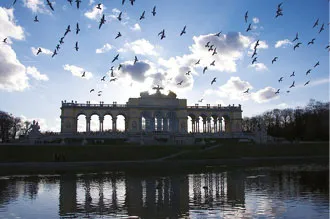
Vienna then underwent a baroque building boom that led to dramatic growth and a change in the inner city’s fabric and also that of its surroundings. Architects Johann Bernhard Fischer von Erlach, his son Joseph Emanuel Fischer von Erlach and Lukas von Hildebrandt led the way in erecting palaces around the Habsburg’s Hofburg2 as well as aristocratic summer residences beyond the city’s gates, beginning with one for the Habsburgs at Schönbrunn [Figure 1.1], while a preliminary form of public sphere in the form of a lively coffeehouse culture – in later periods one of the signature images of the city – began to flourish [Figure 1.2].3
Figure 1.1: The Gloriette at Schönbrunn (P...