eBook - ePub
Available until 23 Dec |Learn more
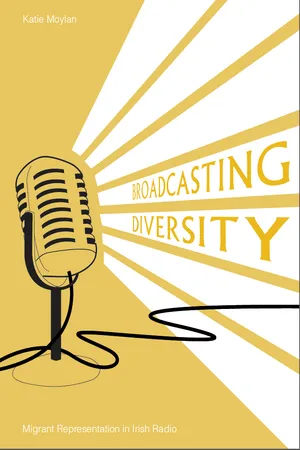
Broadcasting Diversity
Migrant Representation in Irish Radio
This book is available to read until 23rd December, 2025
- 186 pages
- English
- ePUB (mobile friendly)
- Available on iOS & Android
eBook - ePub
Available until 23 Dec |Learn more
About this book
Broadcasting Diversity explores modes of migrant representation and participation in Irish radio, focusing on the national public broadcaster Raidió Teilifís Éireann and Dublin community stations and examining the opportunities provided for voicing migrant experience in transcultural program production. Investigating the intersection between an established Irish culture on the one hand and the nascent emergence of a transnational culture on the other, this book focuses on the ways in which migrant representation and self-representation have been variously effected in the Irish public sphere via the medium of radio.
Frequently asked questions
Yes, you can cancel anytime from the Subscription tab in your account settings on the Perlego website. Your subscription will stay active until the end of your current billing period. Learn how to cancel your subscription.
No, books cannot be downloaded as external files, such as PDFs, for use outside of Perlego. However, you can download books within the Perlego app for offline reading on mobile or tablet. Learn more here.
Perlego offers two plans: Essential and Complete
- Essential is ideal for learners and professionals who enjoy exploring a wide range of subjects. Access the Essential Library with 800,000+ trusted titles and best-sellers across business, personal growth, and the humanities. Includes unlimited reading time and Standard Read Aloud voice.
- Complete: Perfect for advanced learners and researchers needing full, unrestricted access. Unlock 1.4M+ books across hundreds of subjects, including academic and specialized titles. The Complete Plan also includes advanced features like Premium Read Aloud and Research Assistant.
We are an online textbook subscription service, where you can get access to an entire online library for less than the price of a single book per month. With over 1 million books across 1000+ topics, we’ve got you covered! Learn more here.
Look out for the read-aloud symbol on your next book to see if you can listen to it. The read-aloud tool reads text aloud for you, highlighting the text as it is being read. You can pause it, speed it up and slow it down. Learn more here.
Yes! You can use the Perlego app on both iOS or Android devices to read anytime, anywhere — even offline. Perfect for commutes or when you’re on the go.
Please note we cannot support devices running on iOS 13 and Android 7 or earlier. Learn more about using the app.
Please note we cannot support devices running on iOS 13 and Android 7 or earlier. Learn more about using the app.
Yes, you can access Broadcasting Diversity by Katie Moylan in PDF and/or ePUB format, as well as other popular books in Media & Performing Arts & Radio. We have over one million books available in our catalogue for you to explore.
Information
Chapter 1
‘Validating Difference’: Representing Diversity across Broadcasting Policy
[I]n the new discursive context ‘cultural diversity’ has come to be regarded, not any longer in the limited – and problematical – terms of the otherness resented by minorities, but as a constitutive aspect of all cultural orders and spaces… it has made it possible to see difference and complexity, no longer as problematical phenomena, but actually as a positive asset and resource for any cultural order. It has validated difference.
(Kevin Robins 2006: 12)
The term ‘diversity’, like ‘multiculturalism’ before it, is commonly used as anecdotal shorthand for raced or ethnic difference in public initiatives or media representations. ‘Diversity’ is today perhaps more obscurantist again than multiculturalism in its deployment, as it was previously used in broadcasting language to communicate difference in programming provision as it related to niche audiences defined by region or class. The programmes under scrutiny in the following chapters produced by the Irish national public service broadcaster were devised at least in part in relation to that broadcaster’s remit for representing such diversity. Consequently, how this term is understood warrants further study in advance of examining modes of delivery and articulation in programme content. The requirement for ‘representing diversity’ is commonly, arguably automatically, enshrined in most broadcaster remits; its inclusion is today an inherent element of both public service broadcasting (PSB) discourses and of national and Europe-wide broadcasting legislation. Modes of representation informed and facilitated (in part and in theory) by policy statements are explored in depth in the chapters that follow; this chapter provides the context for the production of such representations in policy discourses. ‘Managing’ the representation of diversity is inherent to the problematized project of multiculturalism identified in the Introduction. In providing a brief overview of the ways in which representation of ‘diversity’ has been mandated and provided for in selected broadcast media, this chapter seeks to demonstrate the ways in which the contested notion of ‘diversity’ has been mobilized in relation to PSB remits, the ways in which these work to frame understandings of nation, and in turn how these understandings function alongside an often normative multiculturalist project. Following this, I attempt to contrast representations of diversity located within a national framework characteristic – and legislated for – by European PSB with the identification and analysis of the aims of community radio and its ideals of community empowerment, and the ways in which these also promote diversity, albeit in different ways. Both PSB and community media policies have historically and centrally incorporated provision for the representation of diversity; in the case of PSB this provision originally derived from a historical emphasis on pluralism, while community media policy was originally formulated (informed by different national and regional contexts) on foregrounding opportunities for the self-representation of marginalized communities, including ethnic or migrant communities.
Historicizing ‘Inclusiveness’ in PSB Discourse
It can be argued that PSB, in its founding principles, has made provision for multicultural programming since its inception. Conceived of as a way of regulating the budding broadcasting industry from the beginning, particularly in relation to the allocation of spectrum space and financing mechanisms, PSB principles emerged in direct reference to managing these and other pragmatic concerns (Scannell 1995). In the British context, which was to prove influential for conceptualizing and developing ideas about PSB more broadly due to the relative international success of the BBC as a PSB broadcaster, the emphasis was on providing a ‘national service in the public interest’ (Scannell 1995). A representative role at the level of nation was thus built into PSB discourse from the start, and a stated need for programme diversity was conceived of to serve this mandate more thoroughly (Scannell 1995: 3). Yet while concepts such as diversity have thus been built into PSB discourse from the beginning, it should be emphasized that definitions of what constitutes diversity have remained contested ever since. The related concepts of ‘pluralism’ and ‘access’ are also key concepts in PSB; pluralism initially referred to ‘media pluralism’, meaning a variety of different types of programmes (entertainment, educational, informative), and ‘access’ was used in reference to tangible public access to broadcasting services. The embedding of these concepts in PSB discourse ultimately facilitated the promotion of multicultural programming, as such dedicated programming can be introduced to address stated public concerns around representing community diversity and promoting cultural pluralism. These discourses of inclusiveness have historically been situated within a top-down model of PSB characterized by a paternalist approach embodied in the stated imperative to ‘educate and inform’ audiences.
Cinzia Padovani and Michael Tracey (2003) chart the development of PSB in relation to informing cultural and national contexts, suggesting that PSB institutions have been historically situated within what Tracey (1996) called the ‘post-war settlement … of western industrial society … based on a concept of the world being a place of full employment, stable currencies, perpetual growth, coherent nation states’ (Tracey 1996: 26). The centrality of the national context in PSB discourse should not be underestimated in relation to the ways in which this informed the ways concepts such as inclusiveness, and later diversity as it related to new and marginalized communities, have been framed in these discourses. Earlier in the history of PSB, particularly in Britain, representing the nation was seen as preferable to representing anything ‘foreign’ (Raboy 1995: 5). This earlier conception of PSB was characterized by paternalism and a pedagogical project (Bardoel and d’Haenens 2008; also Barnard 2000), which meant that in the western European context, PSB was conceived of as promoting the protection of cultural identity through a unifying approach to representing that cultural identity. The faultlines dividing the British public in early PSB discourse of the BBC were primarily based on region and class (Scannell 1995) and the goal of plurality in British programming was consequently designed to represent and address audiences across class and regional lines, as part of PSB’s stated project of social inclusion. Yet fluid terms such as pluralism and access, already part of the lexicon of PSB, opened up conceptual possibilities for wider social inclusion. Kevin Robins (2006) also historicizes the role played by PSB with reference to a nationally centred media landscape in Europe, arguing that PSB’s provision of mixed programming on national television and radio channels has been inherent to its remit of constructing and sustaining a sense of national unity, and observing that from the post-war years onward ‘it was broadcasting that became the central mechanism for constructing this collective life and culture of the nation’ (Robins 2006: 143). Robins’ analysis is located firmly within a critique of nation building:
Historically, then, broadcasting assumed a dual role, serving both as the political public sphere of the nation state, and as the focus for national cultural identification. We can say that broadcasting has been one of the key institutions through which listeners and viewers have come to imagine themselves as members of the national community.
(2006: 143)
The historical broadcasting context that first produced PSB discourses has of course since attenuated (as discussed by Jakubowicz, 2008, amongst others) as it referenced a then-emergent media form that was technologically limited and broadcasted to a smaller and more homogenous listenership. Consequently, the scope of PSB discourse has shifted considerably since its inception, as have the arguments and parameters for incorporating inclusiveness and for promoting cultural diversity. A 2008 UNESCO Report, produced in collaboration with the International Association of Media and Communication Research (IAMCR), argues for a research framework designed in part to chart changes in the digital media landscape and to locate opportunities for greater participation in an increasingly transnational society. The report insists the ‘highest priority’ for such a research framework is to ‘mobilise research that challenges dominant paradigms that envisage the emergence of a homogenous knowledge society’ (UNESCO 2008: 4). The report stresses the importance of moving beyond a model defined by a singular, universalist approach and towards greater recognition of the possibilities within multiple media platforms, embodied by growing numbers of amateur producers utilizing these platforms and the potential for ‘new communities and civil society actions to emerge within mediated environments’ (UNESCO 2008: 6). This proposed movement beyond a singular approach based on a universalist (and attenuating) concept of identity can be read as symptomatic of the need identified by Robins to transcend a singularity, which continues to inform PSB discourse – albeit alongside policy provisions for ‘representing diversity’. Across increasingly multiethnic European countries, demand for programmes that can address the needs and experiences of diverse communities continues to grow, not least in the context of increasing digital options. Bardoel and d’Haenens (2008) make the point that communities, including migrants and children, are ‘drifting away’ from PSB programming.
Critiques of PSB from the past decade have focused on the increase of programming opportunities offered by technological options, particularly the advent of digital television and radio but also the potential broadcasting spaces offered by mobile phone networks and the Internet (Titley 2003; McNair 2005; Sussman 2003). Digital broadcasting and its offshoots offer a double-edged sword: on one hand, the increased multiplicity of channels provides new platforms from which to broadcast multicultural programmes and programmes of special interest to marginalized communities. With reference to Graham and Davies (1997), Brian McNair describes the possibilities for addressing diversity through use of these increased platforms:
[T]he multi-channel possibilities of cable, satellite and digital technology had the potential, it was argued, to liberate the notion of public service, refreshing and renewing it for a new century. This would be a century in which, while individuals still want to occupy some common cultural space with their neighbours, difference and diversity would be celebrated as never before. This was an era in which there was not one public, but many publics to serve.
(McNair 2005: 103)
On the other hand, such a proliferation of channels could provide viewers with a disincentive for continuing to pay a license fee to their national broadcaster when their viewing needs could be met by the plethora of new speciality channels on offer (McNair 2005); digital broadcasting from this perspective offers a consumer-led service, where more channels equals more viewer choice. McNair argues that
There will be a lightening, if not abandonment of public service requirements on commercial terrestrial broadcasters as they seek to make the transition to looming digitalisation.
(2005: 110)
The advent of more choice may reduce pressure on PSB to produce multicultural and special interest programmes as, in theory, these could conceivably be commissioned, produced and broadcast by dedicated multicultural digital stations.
Robins points out that ‘both “public service” and “global” are fluid and changing categories’ (2006: 144). The proliferation of broadcasting as well as access technologies alongside the commercial creation of new markets has led to a greater variety of broadcast spaces, including national, local-regional and transnational. Within this emergent broadcasting landscape, Robins notes: ‘[T]he imperative to effect some kind of distancing from the national imagination and the national paradigm if we are to develop a media policy that is sensitive to the new cultural diversity of the continent’ (2006: 144).
The ideological shifts within PSB are, in many ways, intrinsically linked to changing conceptions of nation. Movement away from a top-down, paternalist model of PSB predicated on a singular conception of nation and nation-hood has led to a bottom-up approach (Jakubowicz 2007, 2008; Robins 2006), characterized by multiple approaches to broadcast production to reflect the emergence of multiple media platforms in addition to terrestrial television and radio that can be utilized to address increasingly wide-ranging audience needs and preferences – including those of migrant and marginalized communities.
Framing ‘Diversity’ in Irish Public Service Broadcasting
The principles of PSB and, in particular, their embodiment in British PSB discourse, have centrally informed the development of Radio Telefis Éireann (RTÉ) from its inception. John Horgan (2001) suggests that broadcasting in Ireland has historically been characterized by close relationships between Irish broadcasting, politicians and governments. RTÉ is somewhat anomalous as a public service broadcaster as it receives funding from the license fee, which is standard for a national broadcaster, but also from advertising, in a model similar to the Canadian Broadcasting Corporation (CBC) and Radiotelevisione Italiana (RAI).1 In 1995, a broadcasting Green Paper in Ireland introduced discussion around the representation of diversity in Irish broadcasting. The Green Paper on Broadcasting2 was a comprehensive attempt to situate the future of Irish broadcasting in the context of globalization (Horgan 2001). According to Farrel Corcoran, who contributed to the Green Paper, the Green Paper was an attempt at reframing RTÉ’s goals and focus in the context of globalization and in response to resultant changes to the ‘vexed continent’ of Europe, which he suggested could be achieved by
re-focusing the national broadcaster in the context of basic values: cultural diversity, broadcasting as a public good, the linkage between broadcasting and democracy and the need to put Irish broadcasting on a sound legislative footing at a time of intense change in a vexed continent, flooded with virtually instantaneous information circulated by ever more sophisticated technologies.
(Corcoran 2004: 48)
The Green Paper ultimately did not serve to inform or otherwise lead to the creation of new broadcasting legislation, although it suggested new beginnings; Jack Byrne (2007) notes a change in the context of governmental authority in broadcasting at the time the Green Paper was published, observing that ‘[t]he government department charged with overseeing broadcasting had moved from Posts and Telegraphs, through Communications and now to Culture, so that human communication was now seen as a cultural imperative’ (Byrne 2007: 15). The Green Paper’s ‘Introduction’ emphasizes the importance of retaining a national character in Irish broadcasting, and argues persuasively for the retention of national sovereignty as against globalization’s provision of free flows of information transcending national borders. The following...
Table of contents
- Cover Page
- Title Page
- Copyright
- Contents
- Acknowledgements
- Introduction: Exploring ‘Diversity’ in Irish Radio
- Chapter 1: ‘Validating Difference’: Representing Diversity across Broadcasting Policy
- Chapter 2: Representing Diversity on RTÉ Radio: Multiculturalism’s Limitations
- Chapter 3: Discourses of Difference and Cultural Relativism: Multiculturalism’s Compromises
- Chapter 4: Facilitating Migrant-Produced Programming
- Chapter 5: Migrant Production and the Accented Voice
- Conclusion
- Bibliography
- Back Page