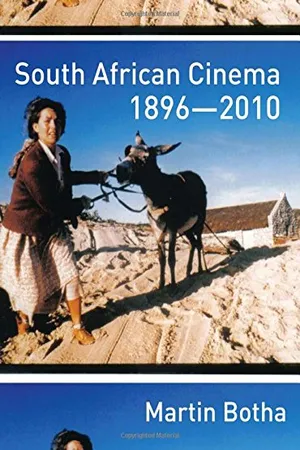
Taking an inclusive approach to South African film history, this volume represents an ambitious attempt to analyze and place in appropriate sociopolitical context the aesthetic highlights of South African cinema from 1896 to the present. Thoroughly researched and fully documented by renowned film scholar Martin Botha, the book focuses on the many highly creative uses of cinematic form, style, and genre as set against South Africa's complex and often turbulent social and political landscape. Included are more than two hundred illustrations and a look at many aspects of South African film history that haven't been previously documented.
- 314 pages
- English
- ePUB (mobile friendly)
- Available on iOS & Android
eBook - ePub
South African Cinema 1896-2010
About this book
Information
Chapter 1
Early South African cinema: 1895–1948
In order to understand the state of cinema in South Africa after the end of apartheid in 1994, one needs to contextualize the recent developments in our film industry against a brief history of film production during the colonial and apartheid years.1
The South African film industry is one of the oldest in the world. The kinetoscope, invented by Thomas A. Edison, had reached Johannesburg by 4 April 1895, only six years after its introduction in New York (Gutsche 1972: 8). It was opened to the South African public on 19 April 1895.
The first projected motion pictures were shown in May 1896 in South Africa at the Empire Palace of Varieties, which was managed by Edgar Hyman. Between 1896 and 1909 mainly British and American films reached many parts of South Africa by means of mobile bioscopes. The term ‘bioscope’ became the standard term for anything to do with moving pictures (Gutsche 1972: 27).
From 1896 to 1899 Hyman shot short non-fiction films for the Warwick Trading Company of London, many of which were shown in Johannesburg and throughout the world. These short films consisted mostly of images of Johannesburg taken from the front of a tram. Hyman also shot images of the then-president of the Transvaal Republic, Paul Kruger, leaving his home. The footage was sent to England to be processed and printed and was included in the Warwick Trading Company’s catalogues. Other Hyman films of this period included A Rickshaw Ride in Commissioner Street, The Cyanide Plant on the Crown Deep and others. Hyman shot film footage wherever he went.
Two independent Boer republics at the time (Transvaal and Orange Free State) and two British colonies constituted the geographical area referred to as South Africa today. A fierce war between the British Empire and the two Boer states erupted after Cecil Rhodes came to know that the two sovereign republics were the owners of potentially the world’s richest gold and diamond mines. The Anglo-Boer War or South African War (11 October 1899 to 31 May 1902) was systematically documented by various companies in Britain, including the Warwick Trading Company. Edgar Hyman served as its war correspondent (Gutsche 1972: 42). The nature of the military conflict, however, gave cameramen little or no opportunity to film anything other than troop movements or military installations (Barnes 1992). In this war there was no front line in the accepted sense, such as existed in the First World War. Military action consisted of brief and swift skirmishes of the type usually associated with modern guerrilla warfare. This situation made the actual conflict nearly impossible to film unless the camera person happened to be in the right place at the right time by chance. As a result film-makers in England began to produce reconstructions purporting to be based on actual incidents in the South African War (Barnes 1992). The former head of the South African National Film, Video and Sound Archives, Johan de Lange (1991), produced a valuable catalogue of the films shot during the war period, indicating which films were ‘real’ and which mere reconstructions. The potential for propaganda was enormous. The traumatic memory of this war was to become an important theme in several post-apartheid productions such as Herman Binge’s documentary Scorched Earth (2001), which examines the British concentration camp strategy during the war period, as well as director Katinka Heyns’s The Feast of the Uninvited (2008). Both productions are discussed in Chapter 12.

Feast of the Uninvited. Garth Meyer, M-Net
Film historians consider The Great Kimberley Diamond Robbery (1910) to be the first feature to be produced in South Africa (Gutsche 1972). It was shot by the Springbok Film Company, which was based outside South Africa. The country was a British Dominion with General Louis Botha as prime minister. According to Thompson (2001) the population of the Union of South Africa included 4 million Africans, 300,000 ‘coloureds’, 150,000 Indians and 1,275,000 whites. The film was the first of many to be produced by non-South African directors and companies during the 113-year history of South African cinema.2
The first permanent cinema was built in 1909 by Electric Theatres Limited in Durban, and it opened on 29 July 1909. In December 1909 another cinema was opened on the corner of Grey and Alice streets in Durban for ‘non-white’ audiences. Racial segregation, which was a reality of South African cinemas till 1985, was now part of the exhibition system. Over the next 5 years several film distribution companies built cinemas across the country, which led to serious competition (Gutsche 1972). By the end of the 1930s a widespread circuit of cinemas existed all over South Africa, including in small towns (Gutsche 1972: 256). Sadly, since the 1990s many of these venues have disappeared (Blignaut & Botha 1992), and currently exhibition sites are characterized by a limited concentration of theatres in metropolitan areas, especially in the form of multiplexes in shopping malls.
Isadore William Schlesinger and African film productions
By 1913, New York-born Isadore William Schlesinger brought all film distributors under the control of his company, African Theatres Trust Ltd. Schlesinger was born in 1877 and at the age of 17 sailed from the United States to South Africa. He arrived in 1894 practically penniless, and after various challenges he succeeded in establishing himself in the insurance business. From 1904 onwards he managed to become a significant figure in the insurance world (Gutsche 1972). Schlesinger developed massive investments in land and real estate. Although the first ever newsreels were filmed at the front during the Anglo-Boer War (1899–1902), Schlesinger started a tradition of newsreel production in the form of The African Mirror, the world’s longest running newsreel (1913–1984). In the course of the next six decades The African Mirror captured current affairs in South Africa, but in a rather superficial manner, and from 1948 it was used as a propaganda tool to support the dominant practice of apartheid.
Schlesinger was also responsible for the building of extensive and substantial studios at Killarney, a suburb of Johannesburg and at that time located outside an urban milieu (Gutsche 1972). Several feature films, some of them epic in scope, were also made between 1916 and 1922 by Schlesinger’s production company, African Film Productions Ltd. These films included De Voortrekkers/Winning a Continent (1916), Allan Quartermain (1919), King Solomon’s Mines (1918) and Symbol of Sacrifice (1918). The financial success of African Film Productions Ltd, however, was largely contingent on the market outside South Africa. The country itself offered far too small a cinema-going public to guarantee anything but the production costs of a film (Gutsche 1972: 320). The Blue Lagoon (1923) marked the end of local fiction film production in the 1920s by Schlesinger’s company because of the film’s poor performance at the South African box office. Between 1910 and 1925 as many as 43 features were shot in South Africa.
De Voortrekkers (1916) has received substantial attention by various academic scholars (Davis 1996; Gutsche 1972; Hees 2003; Maingard 2007; Tomaselli 2006; Van Zyl 1980). This historical epic is based on the so-called Great Trek. A small group of white Afrikaner farmers of Dutch descent who were known as the Voortrekkers migrated from British rule at the Cape Colony during the 1830s.3 Harold Shaw, producer for Vitagraph and London Films, was hired to direct the film and he came to the Union of South Africa, while an Afrikaner historian, Dr. Gustav Preller, wrote the script based on his interpretation of the events that had led to the Battle of Blood River, a clash between Voortrekkers and Zulu warriors in the nineteenth century. De Voortrekkers deals almost exclusively with the last years of the Voortrekker leader Piet Retief, who signed a land treaty with the Zulu King Dingaan. After the murder of Retief and his men by Dingaan’s warriors, the Voortrekkers vowed to avenge Retief ’s death. They also vowed to commemorate the day of their victory over the Zulus. On 16 December 1838 the Battle of Blood River resulted in victory for the Voortrekkers under the leadership of Andries Pretorius. For more than 150 years the Day of the Covenant or Dingaan’s Day was a religious public holiday in South Africa. Even after the 1994 democratic elections some white Afrikaner groups still celebrate it, and in many ways it is one of the foundations of Afrikaner nationalism.4 According to Hees (2003), the screenwriter Gustav Preller created the popular image of the Great Trek by giving it a heroic, mythical and even sacred dimension. Preller regarded the migration of the white farmers away from imperial control at the Cape Colony as an act of Afrikaner nation-building. In Preller’s account the viewer experiences the conquest of black ‘barbarism’ by the noble forces of a white, Christian civilization (Hees 2003: 53).

Symbol of Sacrifice. M-Net

De Voortrekkers. M-Net
De Voortrekkers created and sustained the myth of the Voortrekkers as the founding fathers of a new nation. The film also used black people to represent the negative qualities against which whiteness and real civilization are defined (Hees 2003: 55). Dingaan, for example, is presented as the archetypal savage ruler.
Preller insisted on absolute ‘realism’ in his account of the historical events. Attempts were made to ensure authenticity; for example, 20,000 assegais and other Zulu war paraphernalia, as well as 500 rifles from the period, were collected. As many as 40 wagons and costumes were specially made for the production (Gutsche 1972). From an artistic viewpoint the sheer logistics, as well as the art direction and costume design, are impressive. The script, however, reduced the Great Trek to a few scenes where Voortrekkers try to cross a river, the events in Dingaan’s camp, the massacre of Voortrekkers at Weenen and the Battle of Blood River.

De Voortrekkers. M-Net
The first screening of De Voortrekkers took place on 16 December 1916 in Krugerdorp. General Louis Botha and an audience of Afrikaners greeted the film with ‘wholehearted acclamation’ (Gutsche 1972: 315). Subsequently the film was screened throughout the Union of South Africa to large audiences. ‘Thence onwards the showing of De Voortrekkers on Dingaan’s Day of every year became a national institution’ (Gutsche 1972: 316).
For the next 43 years Schlesinger had the monopoly of film distribution from the Cape to the Zambezi. By 1930 Schlesinger owned African Consolidated Theatres Ltd and African Consolidated Films Ltd after having temporarily lost control of distribution when sound films were introduced in South Africa (Gutsche 1972).
The growth of Afrikaner nationalism and birth of the apartheid state
Sarie Marais, the first South African film with sound, was produced by African Film Productions Ltd in 1931, after which local films gained in popularity. Sarie Marais as well as Moedertjie (1931) heralded the beginning of a decade in which Afrikaner5 nationalism would grow in Afrikaans-language films (Maingard 2007; Van Staden & Sevenhuysen 2009). Sarie Marais could be described as a featurette that tells the story of a Boer sent as prisoner of war to Ceylon. Moedertjie is based on a one-act play In die Wagkamer/In the Waiting Room by J. F. W. Grosskopf, a well-known playwright. The film was directed by Joseph Albrecht and featured the talented young actor Pierre De W...
Table of contents
- Cover
- Dedication
- Title Page
- Copyright
- Contents
- Acknowledgements
- Introduction
- Chapter 1: Early South African cinema: 1895–1948
- Chapter 2: A few liberal voices in the 1950s
- Chapter 3: Pierre de Wet, Jamie Uys and Afrikaans cinema in the 1950s and 1960s
- Chapter 4: Jans Rautenbach
- Chapter 5: Manie Van Rensburg
- Chapter 6: Ross Devenish
- Chapter 7: B Scheme films
- Chapter 8: The voices of the 1980s
- Chapter 9: Oppositional film-making in the 1980s
- Chapter 10: Attempts to create a national film commission
- Chapter 11: Post-apartheid cinema
- Chapter 12: Themes and aesthetics of post-apartheid cinema
- Bibliography
- Filmography
- Index
Trusted by 375,005 students
Access to over 1.5 million titles for a fair monthly price.
Study more efficiently using our study tools.
Frequently asked questions
Yes, you can cancel anytime from the Subscription tab in your account settings on the Perlego website. Your subscription will stay active until the end of your current billing period. Learn how to cancel your subscription
No, books cannot be downloaded as external files, such as PDFs, for use outside of Perlego. However, you can download books within the Perlego app for offline reading on mobile or tablet. Learn how to download books offline
Perlego offers two plans: Essential and Complete
- Essential is ideal for learners and professionals who enjoy exploring a wide range of subjects. Access the Essential Library with 800,000+ trusted titles and best-sellers across business, personal growth, and the humanities. Includes unlimited reading time and Standard Read Aloud voice.
- Complete: Perfect for advanced learners and researchers needing full, unrestricted access. Unlock 1.5M+ books across hundreds of subjects, including academic and specialized titles. The Complete Plan also includes advanced features like Premium Read Aloud and Research Assistant.
We are an online textbook subscription service, where you can get access to an entire online library for less than the price of a single book per month. With over 1.5 million books across 990+ topics, we’ve got you covered! Learn about our mission
Look out for the read-aloud symbol on your next book to see if you can listen to it. The read-aloud tool reads text aloud for you, highlighting the text as it is being read. You can pause it, speed it up and slow it down. Learn more about Read Aloud
Yes! You can use the Perlego app on both iOS and Android devices to read anytime, anywhere — even offline. Perfect for commutes or when you’re on the go.
Please note we cannot support devices running on iOS 13 and Android 7 or earlier. Learn more about using the app
Please note we cannot support devices running on iOS 13 and Android 7 or earlier. Learn more about using the app
Yes, you can access South African Cinema 1896-2010 by Martin Botha in PDF and/or ePUB format, as well as other popular books in Media & Performing Arts & Film & Video. We have over 1.5 million books available in our catalogue for you to explore.