eBook - ePub
Available until 23 Dec |Learn more
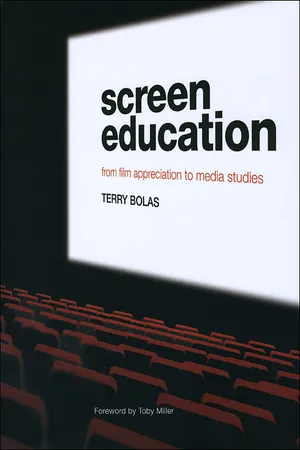
Screen Education
From Film Appreciation to Media Studies
This book is available to read until 23rd December, 2025
- 434 pages
- English
- ePUB (mobile friendly)
- Available on iOS & Android
eBook - ePub
Available until 23 Dec |Learn more
About this book
Film and media studies now attract large numbers of students in schools, colleges and universities. However the setting up of these courses came after many decades of pioneering work at the educational margins in the post-war period. Bolas' account focuses particularly on the voluntary efforts of activists in the Society for Education in Film and Television and on that Society's interchanging relationship with the British Film Institute's Education Department, set up in the 1930s. It draws on recent interviews with many of the individuals who contributed to the raising of the status of film, TV and media study. Through detailed examination of the scattered but surviving documentary record, the author seeks to challenge versions of the received history.
Frequently asked questions
Yes, you can cancel anytime from the Subscription tab in your account settings on the Perlego website. Your subscription will stay active until the end of your current billing period. Learn how to cancel your subscription.
No, books cannot be downloaded as external files, such as PDFs, for use outside of Perlego. However, you can download books within the Perlego app for offline reading on mobile or tablet. Learn more here.
Perlego offers two plans: Essential and Complete
- Essential is ideal for learners and professionals who enjoy exploring a wide range of subjects. Access the Essential Library with 800,000+ trusted titles and best-sellers across business, personal growth, and the humanities. Includes unlimited reading time and Standard Read Aloud voice.
- Complete: Perfect for advanced learners and researchers needing full, unrestricted access. Unlock 1.4M+ books across hundreds of subjects, including academic and specialized titles. The Complete Plan also includes advanced features like Premium Read Aloud and Research Assistant.
We are an online textbook subscription service, where you can get access to an entire online library for less than the price of a single book per month. With over 1 million books across 1000+ topics, we’ve got you covered! Learn more here.
Look out for the read-aloud symbol on your next book to see if you can listen to it. The read-aloud tool reads text aloud for you, highlighting the text as it is being read. You can pause it, speed it up and slow it down. Learn more here.
Yes! You can use the Perlego app on both iOS or Android devices to read anytime, anywhere — even offline. Perfect for commutes or when you’re on the go.
Please note we cannot support devices running on iOS 13 and Android 7 or earlier. Learn more about using the app.
Please note we cannot support devices running on iOS 13 and Android 7 or earlier. Learn more about using the app.
Yes, you can access Screen Education by Terry Bolas in PDF and/or ePUB format, as well as other popular books in Media & Performing Arts & Film & Video. We have over one million books available in our catalogue for you to explore.
Information
1
Cinema under Scrutiny
It is a paradox to realize the great power of the commercial cinema and then to introduce the cinema into the schools bereft of its essential characteristics.
E Francis Mills, Demonstrator, London School of Economics 1936
During the 1930s mass entertainment for the working class provided in the cinemas is widely perceived as having the potential to do harm. Children in particular are identified as vulnerable and civil society is roused on their behalf. The concerned voices are not those of the teachers in the state elementary schools who are generally silent, while others in more socially prestigious employment make the running. Teachers in the private sector however start to investigate the educational potential of what films have to offer. The British Film Institute through Sight and Sound provides space for the writing-up of their experiments and then offers some holiday time teacher training.
The aim of this investigation is, put simply, to trace the part played by a small-scale teachers’ organisation in the evolution of media education in Britain, where, given the separate national identities it embraces, ‘Britain’ has to be a flexible concept. The Society of Film Teachers was founded in October 1950, but this particular date is not the appropriate starting point for this account. The momentum for such an organisation was developing in the 1930s and, had a war not intervened, SFT might have started sooner. Subsequently pre-war pioneers were able to continue their work, albeit at more influential levels, in the post-war period. They were then joined by ex-service personnel whose wartime introduction to the power of film had been very immediate. However recognition of the potential for education in media or, more accurately for the period, the case for film appreciation had been established with the coming of the talking pictures and of the dream palaces which showed them.
The Film in National Life
Although the term ‘film appreciation’ acquired only passing importance in the history of film and media studies, its gradual introduction during the 1930s and 1940s was an important feature of the coming to terms with film that preoccupied influential elements in British society and some educationists. During the 1930s children, education, film, the institution of cinema and their interrelationships were repeatedly described and interpreted. When the decade began, ‘film appreciation’ was absent from the work of those who wrote about the cinema. That there was an interest in the cinema and its programmes and in the wider use of film is indicated by a number of events and publications, the most significant and influential of which was the Commission on Educational and Cultural Films and its 1933 report The Film in National Life which led to the formation of the British Film Institute and the attendant quarterly Sight and Sound.1 The Commission, funded by the Carnegie Institute, was an unofficial grouping of educationists from the British Institute of Adult Education and its creation was part of their campaign
…to encourage the use of film as a visual aid in formal education as well as to raise the general standard of film appreciation among the public.2
In fact the specific term ‘film appreciation’ is absent from the text of the Report. When not directly considering the visual aid use of film, the Commission is concerned about the ‘public appreciation of film’ and the shaping of ‘taste’. It seems possible that the spread of sound cinema in the late 1920s and early 1930s became the catalyst for increased interest in the cinema as a social phenomenon. However, there persisted a lasting and unhelpful legacy of attitudes that persisted from the era of ‘silent’ films.
The terms of the relationship between the cinema and society in the United Kingdom had been set out in stark detail in The Cinema: Its present position and future possibilities published in 1917 by the National Council of Public Morals, described in the Introduction by its own Director and Secretary, James Marchant as ‘one of those unofficial organisations which are the pride of English endeavour’.3 Essentially setting out to investigate the cinema as an institution, the Commission also delved into the world of education and the role that the film might play there. On the basis that ‘the lure of the pictures is universal’, the Commission considered nothing to be off-limits so that its report could state in the opening paragraph that
…we leave our labours with a deep conviction that no social problem of the day demands more earnest attention. The cinema, under wise guidance, may be made a powerful influence for good; if neglected, if its abuse is unchecked, its potentialities for evil are manifold.4
The cinema’s potential for doing harm was to persist as a notion that successive generations would have to address. Fear of this potential would be manifested in a variety of ways. The cinema as a venue would be seen as presenting problems by its very nature: it would be perceived as harbouring disease, providing the cover of darkness for illicit activity and as keeping children from their beds while harming their eyesight. The films shown in the cinemas would be denounced as requiring censorship, lest they entice the young into delinquency or inflict psychological damage on them by terrorising them with horrific sights. Furthermore, films, and in particular sound films, in the classroom might usurp the role of the teacher by undermining control. Probably the most lasting legacy of the Commission was that it became a model for the many separate inquiries that would be set in train by public bodies, which would each individually seek to investigate certain aspects of cinema. Perhaps for politicians, involvement in such an inquiry would provide a convincing demonstration of their integrity in the face of these presumed threats to society. Undoubtedly these extra-curricular activities presented early film educationists with the additional problem – beyond that of identifying their object of study – of also having to try to retrieve film from its many dubious associations.
From the 1930s to the 1960s film educationists were few while others who wished to promulgate their views on the cinema were plentiful. Not only were members of the clergy, politicians and journalists eager to comment but their vigilance was endorsed by numerous voluntary societies that existed to represent specific interest groups and attitudes, particularly among the middle classes. Such bodies were to continue over the next two decades, persistent in their involvement, striking attitudes and taking positions about popular culture and the media. Nowhere would the survival of such groups be better demonstrated than by the organisations represented in the attendance list of the 1960 National Union of Teachers’ Conference on ‘Popular Culture and Personal Responsibility’.5 At that conference, as in so many of the debates before then, the voice of the teacher would barely be heard.6
For a screen educationist in the 1930s, not only was there a need to be heard among the clamour of voices that wanted to pronounce on the cinema but there was also a need to distinguish clearly the ways in which film and education interrelated. The debates in the 1930s began to be considered separately. There was the relationship between children and the cinema; there was the use of film in classrooms and then there was the study of film for itself. The first of these was the one which was most conspicuous to everyone: huge numbers of children were going frequently to the cinema, as was adult society. Consequently, even in depression hit Britain, cinemas were a growth area.
Children and the Cinema
The mid-1930s in the United Kingdom saw a great expansion of cinemas. During the decade the number of cinema-goers attending on a regular basis increased as more accommodation became available in new cinemas. A significant proportion of this expanded audience was young. Oscar Deutsch went from owning one cinema in 1933 to having 220 under the Odeon brand in 1937 with a further 35 under construction.7 As a consequence, by 1939, Deutsch was one of the first exhibitors to offer a cinema club for children: the Odeon’s Mickey Mouse Club. Most children were educated in elementary schools, which they left at age 14 and potentially then were wage earners. In the literature of the time those still at elementary school were usually referred to as children, those at work and under 21 as adolescents. The two categories were distinguished in the minds of the cinema operators so that the groups attending children’s matinées or Saturday morning pictures were essentially those that would now be regarded as of primary school age. Though references were regularly made to the relationship between adolescents and the cinema, in practice in the 1930s when conferences met or groups convened to investigate ‘children and the cinema’, it was generally to the issues around the attendance of the younger group that they addressed themselves. In post-war Britain, with the raising of the school leaving age and consequent enlargement of the school population, the perceived issue of adolescents and the cinema would be addressed more directly.
In November 1936 the British Film Institute, held a two-day conference on ‘Films for Children’.8 To judge from the Foreword to the Conference Report, published in January 1937, the event had been organised to counter an earlier conference in summer 1936, organised by the Cinema Christian Council and the Public Morality Council.9 The BFI’s event was ‘to summon a further and fuller conference representative of all shades of opinion’,10 with the clear implication that the nature of the organizers of the previous event had perhaps guaranteed a predictable, if unhelpful, outcome. The shades of opinion deemed by the BFI as appropriate to speak formally were: the Home Office, a film renter, a child psychiatrist, two exhibitors, the Mothers’ Union, a Director of Education and a member of the National Union of Teachers’ Executive.
The positions taken were generally unsurprising, though the Home Office speaker (S W Harris, later to become Chairman of the British Board of Film Censors) introduced proceedings and advanced the idea that the young should be introduced to the ‘art of film appreciation...
Table of contents
- Cover
- Title Page
- Copyright
- Contents
- Acknowledgements
- Foreword
- Prologue
- 1. Cinema under Scrutiny
- 2. Film Appreciation
- 3. Searching for Room at the Top
- 4. Discrimination and Popular Culture
- 5. Film in Education – The Back of Beyond
- 6. The University in Old Compton Street
- 7. The Felt Intervention of Screen
- 8. Screen Saviours
- 9. SEFT Limited
- 10. A Moral Panic Averted
- 11. Comedia delves arbitrarily
- Epilogue
- Screen education: a timeline 1930–1993
- Expansion of media studies – the statistics
- Bibliography
- Index