This book is available to read until 23rd December, 2025
- 154 pages
- English
- ePUB (mobile friendly)
- Available on iOS & Android
eBook - ePub
Available until 23 Dec |Learn more
About this book
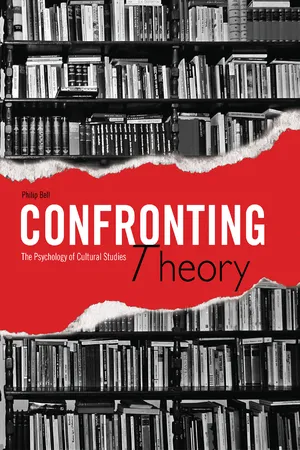
Confronting Theory presents a methodological (philosophical) and educational evaluation and critique of what has come to be known as Theory ('with a capital-T') in cross-disciplinary humanities education. Rather than merely dismissing Theory writing as risibly pretentious and abstract, Confronting Theory examines its principal concepts from the perspective of academic psychology and shows that, although 'Theory that only dogs can hear' may sound like revolutionary psychological analysis it is frequently incoherent and/or has few, if any, empirical implications that students can evaluate.
Frequently asked questions
Yes, you can cancel anytime from the Subscription tab in your account settings on the Perlego website. Your subscription will stay active until the end of your current billing period. Learn how to cancel your subscription.
At the moment all of our mobile-responsive ePub books are available to download via the app. Most of our PDFs are also available to download and we're working on making the final remaining ones downloadable now. Learn more here.
Perlego offers two plans: Essential and Complete
- Essential is ideal for learners and professionals who enjoy exploring a wide range of subjects. Access the Essential Library with 800,000+ trusted titles and best-sellers across business, personal growth, and the humanities. Includes unlimited reading time and Standard Read Aloud voice.
- Complete: Perfect for advanced learners and researchers needing full, unrestricted access. Unlock 1.4M+ books across hundreds of subjects, including academic and specialized titles. The Complete Plan also includes advanced features like Premium Read Aloud and Research Assistant.
We are an online textbook subscription service, where you can get access to an entire online library for less than the price of a single book per month. With over 1 million books across 1000+ topics, we’ve got you covered! Learn more here.
Look out for the read-aloud symbol on your next book to see if you can listen to it. The read-aloud tool reads text aloud for you, highlighting the text as it is being read. You can pause it, speed it up and slow it down. Learn more here.
Yes! You can use the Perlego app on both iOS or Android devices to read anytime, anywhere — even offline. Perfect for commutes or when you’re on the go.
Please note we cannot support devices running on iOS 13 and Android 7 or earlier. Learn more about using the app.
Please note we cannot support devices running on iOS 13 and Android 7 or earlier. Learn more about using the app.
Yes, you can access Confronting Theory by Philip Bell in PDF and/or ePUB format, as well as other popular books in Politics & International Relations & Science & Technology Public Policy. We have over one million books available in our catalogue for you to explore.
Information
Chapter 1
Cultural Studies and Capital-T Theory
The desire to understand the world is, they think, an outdated folly.
Bertrand Russell
The Problem of ‘Theory’
Five hundred years have elapsed since Erasmus complained that the writings of his contemporaries were ‘[f]ull of big words, and newly invented terms … [a] wall of imposing definitions, conclusions, corollaries, and explicit and implicit propositions protects them’ (Erasmus [1509]2008). Clearly, a Renaissance scholar could not have anticipated the rise of the empirical sciences, including social sciences such as Psychology. On the other hand, Erasmus might not have been surprised to learn that obscure rhetoric and opaque neologisms confound students in the twenty-first century as readily as they did in the sixteenth.
Of the various strands of meta-theory in Anglophone interdisciplinary writing that melds the humanities and the social sciences, anti-realist epistemology, arbitrary relativisms and, most recently, the assumption of ‘new realities’ have re-emerged as the most dominant. Today, students of Cultural Studies are asked to read and write about ‘infra-empirical’ phenomena, about processes of such abstraction that they seem to refer to no material entities, such as ‘affect’, ‘becomings’ and ‘intensities’. Sometimes these terms are referred to as ‘concepts’, although they often lack precise definition. They sound like many terms found in the vocabulary of academic psychology, but they are seldom used in psychologically realist ways – or so I propose to argue in the pages that follow.
I want to begin with a paragraph of prose by a prominent Cultural Studies Theorist. I am aware that I am presenting it out of context, and I shall return later to consider its source in detail. For the moment it is meant only to illustrate the linguistic ecstasy that is common in ‘Theory’ writing – writing that purports to be about real psychological processes, situations and events, and therefore to refer to actual phenomena. The author appears to be discussing emotion and ‘affect’. And it is not unfair, I think, to say that he invokes psychological-sounding terms to create a kind of incantatory effect. His field is perennial issues in academic psychology: here he defines what, following the philosophers Spinoza and Deleuze, he calls ‘affect’. Now, please read on, but slowly:
Reserve the term ‘emotion’ for the personalized content, and affect for its continuation. Emotion is contextual. Affect is situational: event fully ingressive into context. Serially so: affect is trans-situational. As processional it is precessional, affect inhabits the passage … It [affect] is pre- and post-contextual, pre- and post-personal, an excess of continuity invested only in the ongoing: its own. Self-continuity across the gaps. Impersonal affect is the continuing thread of experience. It is the invisible glue that holds the world together. In event. The world-glue of affect is an autonomy of event-connection continuing across its own serialized capture in context. (Massumi 2002: 217)
I shall return to this kind of psychological-sounding capital-T Theory in later chapters. Let me merely note here that this passage is typical of the book from which it is taken, a monograph hailed by many prominent Cultural Studies academics as a ‘brilliant achievement’, ‘an extraordinary work of scholarship’. Significantly, for my concerns in what follows, another prominent cultural Theorist, Isabel Stengers, praises Brian Massumi’s work as continuing the ‘great radical-empiricist protest against naïve objectivism and naïve subjectivism … bringing wonder back into everyday experience.’
Immediately after the passage quoted above, Massumi explores the metaphysical problem of the subject/object distinction. I want to quote this passage too, as it illustrates the way in which Theory writing often presents philosophical positions (here, on epistemological and ontological issues) as part of its casually-personified, reader-friendly profundity:
The true duality is not the metaphysical opposition between the subject and object. Subject and object always come together in context. They tightly embrace each other in their reciprocal definition in discourse, as the owner and the ownable of conventional content. The true duality is between continuity and discontinuity (trans-situation and context). This is not a metaphysical opposition. It is processural rhythm, in and of the world, expressing an ontological tension between manipulable objectivity and elusive ongoing qualitative activity (becoming). (Massumi 2002: 217)
Although a work of Cultural Studies and ‘Theory’ – I shall return to these labels – this book addresses epistemological issues (of objectivism, empiricism, etc.) and postulates a novel kind of ontological realm (which consists of processes rather than objects, for example). Such an ontology seems to demand of the hapless undergraduate sophisticated knowledge of both analytical (Anglo-American) philosophy and European traditions, especially of Bergson and those French writers of the 1960s and 1970s labelled ‘post-structuralist’. But, unsurprisingly, few, if any, postgraduates, let alone undergraduates in cross-disciplinary studies, can claim such erudition. It is more than likely that students reading Massumi in Cultural Studies 301 would quote without understanding and engage in a kind of academic ‘bluffing’ that commits them to uncritical acceptance of Theory’s metaphysics. Alternatively, they may just turn away, adopting instead the naïve epistemologies that Massumi and his commentators deride.
It is not just students who are befuddled and intimidated by such Theory, by the background knowledge it assumes – and, of course, in Massumi’s case, by the willful failure to specify grammatical subjects for the predicates he invents. The cross-disciplinary academic teacher is also likely to feel weak at the knees when reading such intimidating verbiage. But they can at least seek help at conferences that deal with the epistemological paradigm shift that seems to have revolutionized the humanities during the past two decades: ‘While the myth of knowledge as objective appears to have been debunked, a question remains unresolved: if not objective, then what?’ This teasing question publicized a 2006 conference entitled ‘Inside Knowledge’. The blurb went on to discuss the epistemological options facing current transdisciplinary scholarship:
[A]cademic disciplines today often find themselves trapped between relativist and essentialist tendencies. Faced with the new multiple and complex realities of globalization, cross-cultural encounters and conflicts, the inadequacy of old approaches to knowledge underscores the need for radical revisions of traditional modes of knowledge production, or alternative ways of doing and thinking knowledge. Disciplines therefore appear to be in need of specific methodologies, which could function across disciplinary borders and provide (tentative) grounds for inter- or trans-disciplinary communication. (‘Inside Knowledge’ Conference 2006)
New ways of ‘doing and thinking knowledge’ sound pretty exciting: the invitation to throw out the old disciplines of the twentieth-century academy is hard to resist. Yet this challenge to academics working across the humanities assumes no more than what has become conventional wisdom in English-language Arts faculties in the new millennium: pace Massumi, this wisdom includes the following:
• All knowledge claims are relative to those making them
• Epistemological certainty based on empirical observation and generalization is a charade
• Only theoretical or conceptually-grounded interpretation is possible
This is because
• The foundations of Western metaphysics, including the assumed reality of the psychological subject, are untenable.
The day-to-day context in which students study culture, the media, sociological theory, and in which they must make psychological assumptions about the people who embody culture, has become a theoretical minefield. Even teachers can make only guarded, self-conscious propositions about what is the case. Many fear that their naïvely ‘realist’ versions of what it means for a person to ‘know’ something are philosophically untenable. Nor are they wrong to be intimidated about their metaphysical correctness. Analysts like Massumi write as though actual people who think they know something about pre-existing material phenomena, people who believe that the world is populated by more or less permanent material entities, are philosophically ignorant. Like realist social scientists, they are fundamentally mistaken about what exists (their tacit ontology) and naïve about how to justify their claims to know or describe it (their epistemology). Old-fashioned disciplines may even be judged as unethical because they necessarily ‘objectify’ (or, as Theory has it, ‘essentialize’) people and other phenomena. By contrast, Theory provides the conceptual apparatus for criticizing and re-writing the humanities and social sciences that became established in Anglophone universities from the 1950s.
So, the ‘Inside Knowledge’ conference blurb challenges new millennium academics to ‘perform’ or ‘do’ knowledge (or ‘knowledge’ in quotation marks) differently. They must practise ‘capital-T Theory’. As I shall demonstrate throughout this book, this practice may take many forms, but most involve developing conceptual abstractions that do not refer directly to any actual things or situations in the world. Rather they designate at best other concepts by which to interpret other interpretations (as ‘texts’). This limited aspiration follows not only from the idea that ‘unmediated’ knowledge of the material world is impossible, but also from the assumption that knowledge claims, being verbal, are usually, if not always, exclusively about language itself. So ‘extreme’ – or, as I call it, ‘ecstatic’ – Theory refers to those modes of writing that propose conceptualizations whose metaphysical orientations must be accepted on faith by undergraduates.
Theory offers largely self-referring bodies of abstract concepts and propositions. Rather than low-level theories in the plural, such as, say, Freudian theory or Marxist historical accounts of the factors causing the rise of fascism, capital-T Theory presents radically different ways of writing. Theory returns to what, in other technical vocabularies, are more or less empirical terms, but its proponents make few original proposals about what is the case. This is because ‘what is the case’ is assumed as a kind of ‘given’, albeit a given that social scientists and traditional scholars misunderstand. To enlighten them, Theory asks that its texts be read as revelations of unexpected dimensions of ‘the real’ (usually in scare quotes so as not to imply naïvety), or of new relations amongst Theory’s own terms. Without recourse to observation of anything other than ‘texts’, by means of analysis and creative invention of concepts, Theorists mount new arguments about what their readers think they already know, what they take for granted or accept as ‘commonsense’.
Sometimes, for example when the narratives known as the ‘Oedipus complex’ are rewritten as a kind of general theory of human ‘un-freedom’, as accounts of universal ‘oppression’ by language or by ideology themselves, one can see a kind of general empirical claim being made. But Theory in Cultural Studies contexts usually ‘rewrites’ taken-for-granted concepts and knowledge claims, albeit without any expectation that the new version of the phenomena in question should be tested empirically as an alternative putative ‘explanation’. Discussing people’s pleasure in music, dance, or the perception and experience of cinematic close-ups can produce a neo-phenomenological exuberance centred on words like ‘intensity’, ‘affect’ or ‘faciality’. These are posed as illuminating concepts, but, as we shall discover in later chapters, their psychological (even their grammatical) status may be unclear at best.
I contend that no method is available to compare the adequacy of one account (‘Theory text’) against another. This is because Theory (to personify this body of work) refers to modes of writing that ask to be evaluated otherwise than in terms of truth or probability. This results from the scope of the conceptual assumptions of Theory: its ambition within Cultural Studies seems to be to rewrite the whole of post-Enlightenment Western metaphysics. While many have criticized the epistemological implications of much that is labelled ‘Theory’, it is the ontological assumptions it imports into Cultural Studies and into the empirical disciplines subsumed by Cultural Studies that render Theory so problematic.
My critique of Theory and of its infiltration into many areas of post-disciplinary discourse will not merely argue that it is sometimes obscure, pretentiously abstract, or conceptually muddled. This may be true – but it would only be a criticism if Theory failed to generate any genuine insights or knowledge. And this is my position: I shall argue that Theory writing becomes hypocritical when its metaphysical ‘discourse’ sits side by side with more banal claims that rely on the reader assuming the very things that Theory denies, including the physical and psychological reality of actual human beings. I shall try to show that Theory is often no more than an elaborate gloss, or ‘translation’ into new terms, of the many specific beliefs warranted by evidence and example that are documented in the literature of its disciplinary predecessors in the humanities. These are, of course, the very disciplines that Theory seeks to help students to critique, indeed, to transcend.
‘Ecstatic’ is the word I use to describe much of the transcendental abstraction that confounds my students. Here is a passage from a prominent ‘post-structuralist’ English-language commentator on French Theorists Gilles Deleuze and Pierre-Félix Guattari. It reads as a series of stipulative definitions, of ‘the subject’ etc., and is clearly (or fuzzily) a rewriting of some psychoanalytic ideas. But it mixes apparently empirical and therefore contingent propositions about bodies and ‘subjects’ with idiosyncratic definitional stipulations:
The subject is the actualization of desire on the surface of bodies. It is in sense [sic] through an inscription of desire that bodies become subjects … Deleuze and Guattari make it clear that the problem of the subject is a problem of the ‘subjectification’ of desire, of inscribing breaks and flows of energy, joining and disjoining bodies (or partial bodies – the mouth, the breast, the anus, but also sounds and words and food, even the sun). The subject is not the body, but a composition (and effect) of bodies – a variable collection of organs, membranes, nerves and physiochemical processes, but also tools, means of nourishment and shelter and transport, the materials of production and consumption, etc. – a collection that somehow makes sense. ([sic] Bogard 1998: 67)
This sounds like a definitional paragraph. The author wants to stipulate that the word ‘subject’ will be used to refer to bodies causally related to their environments, and to others’ bodies, perhaps. But it also sounds like a claim that ‘the subject’ is a newly ‘discovered’ entity, new to the way in which psychologists and sociologists think, at least. ‘New’ because, if you think of ‘subjects’ as William Bogard does, then you will learn something that you would not otherwise have known (in this case about the subjectification of people’s bodies by society). A simple-minded reader might think they have learned something about actual babies becoming ‘subjects’ of society, and might even ask how this complex process works in relation to food or the sun. A naïve reader might worry about the use of ‘etcetera’ to avoid all the other possible factors that could be involved in ’subjectification’. But Theory is Theory, they might allow, not empirical description. Anyway, Bogard segues immediately to society:
This is also the problem of society. Every society is a society of subjects fashioned from bodies, from an ‘anorganic’ plenum, from the assembly and disassembly of desiring-machines. Why ‘machines’? Because this is literally [sic] what they are, assemblages that transfer, amplify or dissipate energy (but just as bodies must not be equated with organisms, machines must not be identified with inorganic, or non-living forms). Every sociology, from this point of view, is a sociology of desiring machines, and beyond that, of how those machineries are segmented and stratified, how bodies and their forces are distributed, coordinated, functionalized, and regimented to produce subjects. (Bogard 1998: 67–8)
This passage is also more stipulative than descriptive. Hence the proviso ‘from this point of view’, which implies that Bogard’s general postulates and vocabulary be accepted as a precondition for making any empirical sense of the analysis. This is clear from what follows, which is literally an ecstatic pronouncement that the model of ‘subjectivation’ sketched in the earlier quote is part of a sociology of ‘becoming – how to escape … to dismantle rigid segments that individualize and bind the subject contingently to this body, this assemblage of bodies, these desires and habits’. So the writer returns to prosaic psychology, but now allows himself a Theoretical escape clause via the new-age promise of ‘becoming’. (I shall consider the ubiquitous Cultural Studies notion of ‘becoming’ in detail in later chapters.)
Bogard uses Theory as a way of explaining more or less opposite outcomes at the sociological level. He asserts that ‘the subject is always a matter of “selection”’, which seems completely voluntary and free-willed, as he does not specify what or who does the selecting. On the other hand, ‘it can be – potentially, virtually – a force of “absolute deterritorialization”, of radical freedom, but also a force of the worst reaction and nihilism’. I will return to this apparently contradictory mix of romantic voluntarism and narrow determinism in later chapters. Here I want to acknowledge that, so far, I have been citing Theory as though it constituted one coherent body of...
Table of contents
- Cover
- Title Page
- Copyright
- Contents
- Preface
- Chapter 1: Cultural Studies and Capital-T Theory
- Chapter 2: What is Theory About?
- Chapter 3: Different Things
- Chapter 4: Theory, People and ‘Subjects’
- Chapter 5: ‘Post-Human’ Theory and Cultural Studies
- Chapter 6: Affecting Ontologies
- Chapter 7: Real experience, Un-real Science
- Chapter 8: Theory and Education
- References
- Index