eBook - ePub
Available until 23 Dec |Learn more
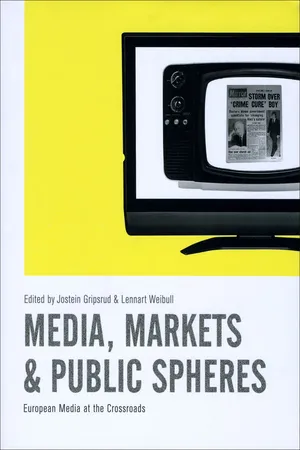
Media, Markets and Public Spheres
European Media at the Crossroads
This book is available to read until 23rd December, 2025
- 327 pages
- English
- ePUB (mobile friendly)
- Available on iOS & Android
eBook - ePub
Available until 23 Dec |Learn more
Media, Markets and Public Spheres
European Media at the Crossroads
About this book
Using a sample of European newspapers and their TV listings as a stepping stone, Media, Markets and Public Spheres presents an overview of changes in European public spheres over the last fifty years. With in-depth analyses of structural changes in press and broadcasting, changing relations between media, and changes in media policies, this book explores how and why the media decisively influence most aspects of society. Media, Markets and Public Spheres will be useful to students in media and communication studies and European studies, as well as for those studying sociology and political science.
Frequently asked questions
Yes, you can cancel anytime from the Subscription tab in your account settings on the Perlego website. Your subscription will stay active until the end of your current billing period. Learn how to cancel your subscription.
At the moment all of our mobile-responsive ePub books are available to download via the app. Most of our PDFs are also available to download and we're working on making the final remaining ones downloadable now. Learn more here.
Perlego offers two plans: Essential and Complete
- Essential is ideal for learners and professionals who enjoy exploring a wide range of subjects. Access the Essential Library with 800,000+ trusted titles and best-sellers across business, personal growth, and the humanities. Includes unlimited reading time and Standard Read Aloud voice.
- Complete: Perfect for advanced learners and researchers needing full, unrestricted access. Unlock 1.4M+ books across hundreds of subjects, including academic and specialized titles. The Complete Plan also includes advanced features like Premium Read Aloud and Research Assistant.
We are an online textbook subscription service, where you can get access to an entire online library for less than the price of a single book per month. With over 1 million books across 1000+ topics, we’ve got you covered! Learn more here.
Look out for the read-aloud symbol on your next book to see if you can listen to it. The read-aloud tool reads text aloud for you, highlighting the text as it is being read. You can pause it, speed it up and slow it down. Learn more here.
Yes! You can use the Perlego app on both iOS or Android devices to read anytime, anywhere — even offline. Perfect for commutes or when you’re on the go.
Please note we cannot support devices running on iOS 13 and Android 7 or earlier. Learn more about using the app.
Please note we cannot support devices running on iOS 13 and Android 7 or earlier. Learn more about using the app.
Yes, you can access Media, Markets and Public Spheres by Jostein Gripsrud, Lennart Weibull, Jostein Gripsrud,Lennart Weibull in PDF and/or ePUB format, as well as other popular books in Social Sciences & Media Studies. We have over one million books available in our catalogue for you to explore.
Information
Part I
A Theoretical Perspective
Chapter 1
Public Spheres, Societal Shifts and Media Modulations
Working with a wide brush and broad strokes, this chapter aims to sketch a few key themes in the evolution of mediated public spheres in Europe in the period between 1960 and 2000. The perspective taken will set these changes against the background of structural alterations within European society, with an emphasis on the health of democracy. The period 1960–2000 incorporates many different national narratives within Europe, and here I will only be able at best to make reference to a few prominent vectors of social change. Yet, we will still be able to elucidate important patterns of evolution within the public spheres and the mass media’s role within them.
I begin by briefly retracing the original arguments of Jürgen Habermas in regard to the public sphere to have as a sort of analytic yardstick to apply in the following discussion. From there I sketch some of the more significant features of transformation in the social landscape. Thereafter I turn to structural themes in the development of the media. The latter part of the presentation looks at the character of democratic politics in relation to the mediated public spheres of several countries, and I conclude with some reflections on the historical present. The chapters that follow pursue some of these themes in nationally more specific analyses: UK (John Corner), France, (Josiane Jouët), Poland (Wieslaw Godzic), and Turkey (Mina Gencel Bek).
Public spheres: the Habermasian floor plan
While general notions of the public sphere appear in a variety of ways in the writings of many authors in the twentieth century, such as Walter Lippman (1922), Hannah Arendt (1998) and John Dewey (1954), most people today associate the concept with Jürgen Habermas’ particular version. What is all the more interesting for our purposes here is that his book appears almost at the very start of the period we have under scrutiny here, in 1962. Though the full text was not translated into English until 1989 (Habermas 1989), his concept had by the 1970s come to play an important role in the critical analysis of the media in the English-speaking world. Since the translation, use of the concept has grown considerably. Over the years there have been many critical interventions around the concept (see Calhoun 1992, for an excellent collection, including a reply by Habermas; Eriksen and Weigård 2003; Crossley and Roberts 2004; the processes of globalization have also entered into discussions of the public sphere, and some authors now underscore its transnational dimension, e.g. Drache 2008). While Habermas has not attempted a full-scale reformulation of the public sphere, it is clear that his view of the concept is evolving as his work in other areas develops (Habermas 1996, 2006); in brief, today he is more disposed to include many nontraditional and cultural manifestations in the media as legitimate expressions of the public sphere, signalling a more resilient frame of analysis.
In its original formulation, the public sphere is seen by Habermas to consist of two basic domains. The first is the political public sphere, which is our concern here. Yet we should not forget that Habermas also addresses the cultural public sphere, a domain constituted by the circulation of – and discussion of – literary and artistic works. Certainly in today’s mediated world the cultural public sphere is of enormous import. All media output cannot be reduced to politics and, though Habermas did not develop the notion of the cultural public sphere as much as he did the political one, it still can be enormously fruitful to approach the mediation of culture from this conceptual angle. Not least, we should bear in mind that the boundary line between the political and the cultural is not something that we can take for granted, especially today when there are new forms of public engagement emerging (see below) that challenge traditional conceptions of what constitutes politics.
The political public sphere is comprised of the institutional space where political will-formation takes place, via the unfettered flow of relevant information and ideas. This space is constituted by both mediated communication and face-to-face interaction. That is, while in the modern world the institutions of the media are the structural core of the public sphere, it is the face-to-face interaction, the ongoing talk between citizens, where the public sphere comes alive, so to speak, and where we find the actual bedrock of democracy. In recent of years, of course, such civic interaction also takes place via the newer interactive digital media.
After an extensive historical overview, Habermas surmises that a public sphere began to emerge within the bourgeois classes of Western Europe in the late eighteenth and early nineteenth centuries. The institutional basis for this public sphere consisted of an array of milieu and media, such as clubs, salons, coffee houses, newspapers, books and pamphlets, all of which in various (though incomplete) ways manifested Enlightenment ideals of the human pursuit of knowledge and freedom. For Habermas, the key here was not only the institutional basis but also the manner in which communication took place in this burgeoning public sphere. However imperfect it may have been, he saw that interaction in this social space embodied the ideals of reason, i.e. the Enlightenment goals of rational thinking, argument and discussion. In this notion of the public as a rational, dialogic process, Habermas’ account of communication and democracy bears similarities with that of John Dewey.
As he continues with his historical narrative, Habermas sees the public sphere growing and deepening in the first few decades of the nineteenth century with the spread of mass literacy and the press. Then gradually the decay sets in. Journalism increasingly loses its claim to reason; public discourse degenerates into public relations. As the logic of commercialism increasingly shapes the operations of the media, the domain of rationality diminishes. Moving into the twentieth century, Habermas observes with pessimism the trivialization of politics, not least in the electronic media, the industrialization of public opinion, the transformation of publics from discursive to consuming collectivities, and an array of other ills that many critics have often noted.
Observers have noted that this historical account bears many of the markings of the original Frankfurt School of Critical Theory. With Adorno as his supervisor, it is not surprising that Habermas in his analysis shares many of the attributes of the leftist high cultural critique of ‘mass society’, while at the same time anchoring himself in a neo-Marxian perspective of advanced capitalism and the cultural industries. There is also a decidedly nostalgic quality to the analysis, the sense that there once was an historical opening which then became closed off. Habermas certainly sees the limits of this bourgeois public sphere, not least in class terms – and feminists have been quick to point out the gender limitations – but there remains something powerfully compelling for him (and many of his readers) about this budding public sphere and its significance for Western democracy.
Here it is suitable to mention that there is some ambiguity with the concept: it is not fully clear whether what Habermas describes is an empirical reality of an historical situation, or whether he is fundamentally presenting the reader with a normative vision. Most readers conclude that it is both. He describes the structural mechanisms that erode the public sphere, yet at the same time he – and many of his readers – continue to be inspired by the vision of a robust public sphere serving a well-functioning democracy. Indeed, the idea of the public sphere has gravitated away from its neo-Marxian origins and joined mainstream discussions about media performance, journalistic quality, and the conditions of democracy. In practical terms, the normative horizons from the liberal or progressive traditions that promote ‘good journalism’ or ‘information in the public interest’ are not so different from ideals about the media inspired by the framework of the public sphere. Yet, Fraser (2007) reminds us of the importance of retaining the critical core of the public sphere concept: that its legitimacy and efficacy reside in its capacity to facilitate genuine, i.e. non-manipulated, public opinion. As has often been said in the past, the genuine realization of even liberal ideals would have truly radical implications for society.
In the present context, then, the notion of the public sphere invites us to look at the media empirically, but also with a normative eye on the character of democracy. Reality suggests that we should actually speak of public spheres, i.e. in the plural, not only because we are dealing with different European countries but also because within any one country we find an array of distinct, even if overlapping, social spaces that constitute different public spheres, for different publics. The major mass media of a society can be seen as creating the dominant public sphere, while smaller media outlets can generate clusters of smaller spheres defined by interests, gender, ethnicity, etc. This tendency is certainly growing with the Internet. Yet, because of both linguistic convenience and the fact that we are dealing here with precisely dominant mass media, we will continue to use the singular form. So as we, in the chapters ahead, compare the situation between 1960 and 2000, what do we find? Does Habermas’ account of the structural changes in the media hold relevance for this period? Is his conceptual framework of use? What has changed during these four decades, and how shall we view these changes in the light of the normative visions of the public sphere? And not least, what relevance does the concept have in societies that have had a very different history from the Western European one on which Habermas’ analysis builds? The chapters on Poland and Turkey take up this theme.
Power drifts, cultural shifts, and evolving democracies
In focusing attention on the fundamental power alignments of European society, we see in this four decade period a trajectory of change, accelerating with each decade. Capitalism has been a precondition for liberal democracy and yet remains perpetually problematic for it, in that it generates social power (economic-financial) that lies beyond democratic control. The post-war welfare state structures and the Keynesian policies associated with them were a successful strategy in their time for dealing with such tensions; the various shades of social democratic measures generally serving to extend democracy and citizenship in Western Europe. By the early 1970s this model was encountering serious difficulties. Since then, particularly during the 1980s, we have witnessed in Western democracies a political turn where market forces and private enterprise have been given much greater reign to define the social landscape, with a concomitant retreat of the state and a general decline in democratic accountability. This has led, in turn, to a shifting of the ideological climate to emphasize the congruence between democracy and capitalism while downplaying the dilemmas. While observers with a neo-Marxian background were quick to problematize these difficulties, the new neo-liberalism also became the concern of ‘traditional’ liberals (cf. Frank 2002; Hertz 2001; Self 2000).
In Central and Eastern Europe the major changes have been of course all the more dramatic, with the demise of the communist system and the reconstruction of the societies using the templates of liberal democracy and market forces. In several of these countries it may be still premature to write a history of the epoch; certainly we can observe differences in, say, the capacity to anchor a democratic culture or establish a minimal regulatory environment for private enterprise. The transition of power in some cases has been more complete, while in other cases remnants of the old guard, in new dress, are still present. The extension of rights and liberties has gone far in a formal sense, yet it is unrealistic to expect that between 1989 and 2000 all the mechanisms for social justice could be in place. Change, however, has been rapid and deep-rooted, and even if the introduction of market forces has not turned out to be the societal panacea some originally hoped for, it has served to trigger a societal development that has generated optimism on many fronts.
During these four decades, the formal political systems of Western Europe have become increasingly stagnant, reactive rather than proactive, eclipsed by developments in the realms of large-scale capitalism and technological innovations and outpaced by socio-cultural developments. The margins of governmental manoeuverability are narrowing. Institutions central to democratic life, in particular political parties, have become unresponsive in the face of the major changes of late modernity. The sovereignty of the nation-state itself is being downsized in the face of global circumstances; in particular the role of transnational corporations as well as – in the European context – the EU. In the case of the latter, this opens up the challenge of developing democracy at the regional level. In Central and Eastern Europe, there has been both wide-spread democratic engagement and political apathy among citizens as the new democratic institutions struggle to take root. In the late 1990s, many of these countries were knocking on the door of the EU (successfully, it proved), which takes a positive view of expansion. Also, in the present decade, Turkey is looking westward, albeit with ambivalence, as it is met with mixed responses in regard to EU membership. From within and from abroad comes movement to encourage enhanced democratization of Turkish society, though in some areas the power structure is slow to respond.
Among citizens, the arena of official politics similarly has witnessed a decline in support and participation. These trends became very apparent during the 1990s, when the ‘crisis of democracy’ discourses began to take hold. Voter turnouts are decreasing, even in countries such as Sweden, which has had considerable stability in its electoral patterns over the earlier post-war decades. Party loyalty is in decline, especially among the young. One sees signs of a growing contempt for the political class. A corrosive climate of cynicism is emerging in some places. The extensive disenchantment with formal politics and the crisis of citizenship and civic culture is a theme addressed by many (see Blumler & Gurevitch, 1995, for a summary statement from that decade). Economic insecurity, unemployment, low wages, declining social services, growing class cleavages, global financial crises, ecological dilemmas, and a sense of powerlessness among many citizens are all part of the picture.
At the same time, we have evidence of alternative developments, a more optimistic renewal of democracy largely outside the parliamentarian context that can be said to represent a form of ‘new politics’ (Giddens, 1991, speaks of ‘life polities’). If we look beyond formal electoral politics, we can see various signs that suggest that many people have not abandoned engagement with the political but have rather refocused their political attention in new arenas, or they are in the process of redefining just what constitutes the political, often within the context of social movements. The boundaries between politics, cultural values, identity processes and local self-reliance measures become fluid (Beck 1997); civil and political society becomes less differentiated from each other. Politics becomes not only an instrumental activity for achieving concrete goals but also an expressive and performative activity.
This new politics is to a great extent a phenomenon that emerges at the end of this period. While such activity has long been a part of democratic societies, it is safe to say that they took a big step forward starting in the mid-1990s and are, not surprisingly, associated to some extent with the rise of the Internet (see Castells 1997; van de Donk et al. 2005;). These new, alternative politics are characterized by personalized rather than collective engagement, and by a stronger emphasis on single issues than on overarching platforms or ideologies, and often attract younger citizens (Bennett 2003a, 2003b; Dahlgren 2007; Loader 2007). Some claim that part of this development can be understood as a move away from politics based on production to one focused on consumption; political attention is geared more towards the needs of clients, customers and consumers than in the past (Gibbens and Reimer 1999). Further, political activity within the new politics is more ad hoc, less dependent on traditional organizations and on elites mobilizing their standing cadres of supporters. Whether or not these developments are genuinely fruitful for the enhancement of democracy is under debate, but they do open the door for new ways to think about the contemporary political landscape in Western Europe.
Finally, the people, the citizens of Europe, are becoming more heterogeneous and, seen sociologically, are to some extent fragmenting. Boggs (2000) in the US context speaks of a ‘great retreat’ from the arena of common concerns and politics; while less pronounced in Europe, we still observe here some patterns of withdrawal into ‘enclave consciousness’, away...
Table of contents
- Cover
- Title Page
- Copyright
- Contents
- Foreword
- Preface
- Part I: A Theoretical Perspective
- Part II: Structures
- Part III: Intermedia
- Part IV: Policies
- Part V: Records of Cultural Change
- Appendices
- Index