![]()
Chapter 1
Defining the Propaganda of Peace
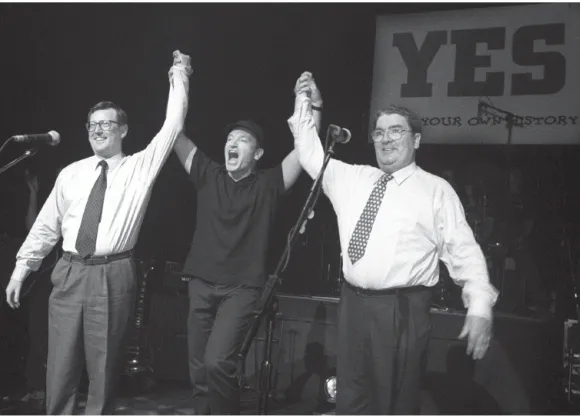
Bono, Trimble and Hume. Pacemaker Press International Limited
This book is about the propaganda of peace in Northern Ireland that was mobilised during the period that led to the ratification of the Good Friday Agreement 1998, and that has helped to sustain the peace process ever since. The propaganda of peace is the work of a variety of social forces through a range of media and cultural forms, and its purpose is to bring society, culture or nation behind a core idea or principle, in this case, the promise of peace and its economic dividends after decades of conflict. It is therefore a conception of propaganda that is broader than that usually associated with war, when it tends to be systematically organised by the state, the national military or paramilitary organisations. While institutions of the state play a key role in the propaganda of peace, they act in concert with other hegemonic social forces, such as local businesses and political elites, trade unions, the voluntary and community sector, academia and the media. Persuading for peace is no less propaganda because of its association with civil society and its apparently benign intentions, for it displays a coherent set of ideas and values that seek to mobilise people to act and behave in the interests of power.
A good illustration of this is the image opposite, widely circulated by the media just three days before the referendum that would ratify the Good Friday Agreement in 1998. The moment: global superstar Bono of U2 holds aloft the arms of David Trimble and John Hume, leaders of unionism and nationalism respectively, like they are two triumphant prize-fighters; at long last, after thirty years of conflict, they are working together as ‘persuaders for peace’. The occasion: a peace concert in Belfast, hastily staged by a local entertainments promoter in support of the Yes Campaign. The venue: the new Waterfront Hall, status symbol of the economic and cultural regeneration of Belfast. The audience: a selection of high-schoolchildren from across the sectarian divide in the city who, although too young to vote in the referendum, stand as a poignant, optimistic symbol of the future.
The appearance of Trimble and Hume together on stage with Bono was a rapturous moment but one that has since served as shorthand for the essential meaning of the peace process. Writing on the tenth anniversary of the concert, Stuart Bailie, a local broadcaster and music journalist, reflected on its significance:
I occasionally ask myself that if Bono hadn’t encouraged Trimble and Hume to shake hands ten years ago, would we currently have peace in Northern Ireland? This might seem like a facetious idea, but really, if the ‘Yes’ referendum had died back then, the centre ground might also have perished. We could still be living in a mean, fractious place. We might not have witnessed the housing boom, the construction fever and the arrival of Wagamama. (Bailie 2008)1
Bailie is certain that the moment saved the Agreement and Northern Ireland from an ‘uncertain nightmare’ but his association of political accord with rising property prices and the arrival of international retail chains is just as interesting as his bold claims about the impact of the concert. In this he is not alone. A constant refrain in public debate about the peace process was the ‘peace dividend’: the promise of economic prosperity and the consumer nirvana that would ensue from a political settlement. The propaganda of peace, then, was only partly about encouraging accord between unionism and nationalism. It had another purpose: to prepare Northern Ireland for integration into global capitalism, something barely acknowledged in public debate where the Good Friday Agreement was rarely considered as anything other than a self-evident good.
Political context: The Good Friday Agreement
The consociational arrangements the Agreement provided for, and within which Ulster unionists and Irish nationalists share power, are seen as an historic compromise; a peace settlement; a blueprint for the resolution of conflicts elsewhere; and the precursor to prosperity. Those who oppose the Agreement usually do so because they see it as a betrayal of either Ulster unionist or Irish republican principle. However, when we consider the context within which the Agreement was forged we get a clearer picture of what it represents.
A starting point for this might be comments made by the then British Prime Minister, Tony Blair, in July 1999, during negotiations aimed at implementing the Agreement. The negotiations had stalled on the issue of republican decommissioning and the inclusion of Sinn Féin in a power-sharing executive. Frustrated by the lack of progress, Blair told reporters that: ‘The entire civilised world will not understand if we can’t put this together and make it work. They simply won’t understand and rightly’.2 Of course, the ‘civilised world’ he referred to emerged at the end of the Cold War, a new world order that accepted the triumph of capitalism and liberal democracy. Ben-Porat highlights the proliferation of peace studies during this period and ‘the attempts of regional and core powers to devise and influence peace in local, off-centre yet important conflicts’ such as those the Middle East and Northern Ireland. Crucial to this was the link between peace and economic growth. The promise of a ‘peace dividend’ in the form of global integration motivated business communities and their allies actively to support efforts towards political settlement.
There were other political pressures brought to bear on the conflict in Northern Ireland specifically. The antagonism that once existed between the Irish and British establishments subsided as the two states became partners in Europe. The growing European Union combined with globalisation put into question the very idea of national sovereignty, which impacted upon Northern Ireland’s conflicting national allegiances. In response, moderates like those in the Social Democratic and Labour Party (SDLP) began to think about a possible resolution to the conflict in decidedly post-nationalist terms, proposing that Northern Ireland’s identity crisis could be resolved within a ‘Europe of the regions’. Similar ideas accompanied devolution in Scotland and Wales, where the economic success of the Republic of Ireland within Europe acted as an inspiration. Also, the rise of the Celtic Tiger, ‘the break up of Britain’, as well as the assumed erosion of national sovereignty, undermined the constitutional and economic logic of Ulster unionism, which was slower than nationalism to respond to, or embrace, the new times. It is precisely this conjuncture of political and historical specifics that made the Good Friday Agreement possible. The political raison d’être of Irish nationalism and Ulster unionism in Northern Ireland was no longer sustainable or containable.
Research context
It is in this context that we examine the role of media and cultural representation in Northern Ireland during the period of the peace process, a time when its image and reputation changed remarkably. Pictures and stories of interminable conflict were replaced by representations apparently more befitting a place undergoing the transition from violent conflict to peace; from a democratic deficit to a working democratic settlement; and from over-dependence on government subvention to enterprise economy. However, there is a paradox here in that these extraordinary transformations in Northern Irish society have been attended by the truncation of political debate and the impoverishment of the cultural imagination. In the course of a peace process that has been called ‘the only show in town’, dissenting voices have been marginalised or maligned, political activism viewed as disruptive of the social order and pacified domesticity presented as the preferred model of citizenship. Our purpose, therefore, is not merely to describe or catalogue media representations of peace but to unpack and expose the tensions and contradictions contained within them.
Much of the academic literature on the media’s role in representing the conflict in Northern Ireland serves to illuminate but also sometimes constrict our understanding of the media’s deeper, ideological role. With perhaps the exceptions of Televising ‘Terrorism’ (Schlesinger et al 1983), Miller’s edited collection Rethinking Northern Ireland (1998) and Rolston’s series on political murals, Drawing Support (1992, 1995 and 2003), this work is focused rather narrowly on the news media, the assumption being that they are the most significant in terms of propaganda and censorship, shaping public understanding and facilitating political debate.3 Other scholars have looked at film and television representations of Ireland, including Northern Ireland;4 or specifically Northern Ireland.5
While valuable in its own right, this body of research rather underestimates or neglects the role and significance of other media and cultural forms, not just in terms of their particular representations but also in how they work in symphony to communicate a propaganda message. The critical departure for this book is that it considers not just news, current affairs and government propaganda but also other representations found in film, television drama and situation comedy, public exhibitions, public access broadcasting and alternative media.
The virtue of looking across a broad cross-section of media and cultural forms is that it allows us to understand how propaganda is found in the relatively ‘closed’ forms of news and current affairs, where state intervention is most obvious, but is also complemented by more ‘open’ forms such as drama and comedy. Indeed its location in these ‘open’ forms is precisely what might make it all the more persuasive because of its assumed distance from ‘official’ thinking (Schlesinger et al 1983). Nevertheless what this study highlights is the unity and coherence of the propaganda of peace whatever its source. We are not suggesting that there is a conspiracy or an entirely self-conscious effort to sue for a particular version of peace. Rather we are suggesting that cultural forms and conventions can articulate an emerging ‘structure of feeling’ at a particular historical moment (Williams 1961, 1977 and 1979). This is a concept we will return to in our concluding chapter.
Outline
Our analysis begins in chapter 2 by setting the concept of ‘the propaganda of peace’ in the context of news reporting of the negotiations towards a political settlement: the so-called ‘first draft of history’. It examines how the local press responded to key moments of crisis and breakthrough in the process since the Good Friday Agreement, and identifies in their reporting the development of a particular narrative, one that entirely accepted the government’s view that there was ‘no plan B’ should the process fail. The Northern Ireland daily newspapers all recommended a Yes vote in the referendum of 1998 to copper-fasten the Agreement, fearing as the only alternative a return to conflict. In this respect, the ‘first draft of history’ was linear, didactic and predetermined, thus serving to constrict public debate and marginalise alternative points of view.
While chapter 2 looks at the ‘first draft of history’ as laid down in news and journalism, chapter 3 examines how the past serves the ideological needs of the present. This is not just a question of history and its narrative. The form of its public exhibition is also critical, as illustrated by the commemoration of the 1798 United Irish rebellion at the Ulster Museum. The Up in Arms exhibition opened at the start of April 1998, days before the signing of the Agreement and offered a version of the past conducive to the peace process. Crucially it was an ‘official’, institutionalised history, encouraging an ‘objective’ gaze at the past. However, a subsequent exhibition at the museum has preferred a variety of subjective accounts, drawing upon the testimonies and reflections of selected individuals. This personal perspective may seem more democratic on the surface but it does raise the question: what will become of public history if it is presented as competing but equally legitimate personal points of view? The role and representation of the personal is central to the concerns of the two subsequent chapters.
Chapter 4 addresses one of the key problems for all those involved in resolving the conflict: how to transform negative public perceptions of the paramilitaries. The British government took a lead in this by changing the tone of its official propaganda, projecting the paramilitaries in a relatively more positive light than during the 1970s and 1980s. It prepared the public for the inclusion in the political process of one-time combatants and simultaneously sent a clear message to the paramilitaries that they could be part of a political settlement. Set in historical context, the transformation of the paramilitaries’ image and reputation is remarkable. For instance, when in 1985 Martin McGuinness appeared in the BBC’s Real Lives documentary, ‘At the Edge of the Union’ (BBC 1985), his portrayal as a ‘family man’ provoked public controversy. However by the early 1990s and with the emergence of the peace process, current affairs broadcasting, films (The Boxer – Sheridan 1997) and TV dramas (Love Lies Bleeding – Winterbottom 1993) transformed the image of paramilitaries from psychotic pariahs to politicians or ‘ordinary people’ in more familiar, domestic contexts. The chapter will consider the problems and contradictions that these changing images present for those searching for a clear understanding of the transition from war to peace.
The category of ‘ordinary people’ is commonly seen as incidental to the conflict in Northern Ireland. Yet, not only has it been critical in transforming the image of the paramilitary, it has also helped define the quality and constitution of the peace. Chapter 5 considers fictional and non-fictional media representations of apparently ‘ordinary people’ caught up in the conflict. Films such as Some Mother’s Son (George 1996), Titanic Town (Michell 1998) and Divorcing Jack (Caffrey 1998), and TV dramas such as Holy Cross (Brozel 2003) all feature lead protagonists who must extricate themselves from political or sectarian violence and return to a private, domestic space apparently free of politics. The implications of this narrative closure are instructive: peace is the absence of politics rather than the re-imagination of political and democratic arrangements. Ho...