This book is available to read until 23rd December, 2025
- 234 pages
- English
- ePUB (mobile friendly)
- Available on iOS & Android
eBook - ePub
Available until 23 Dec |Learn more
About this book
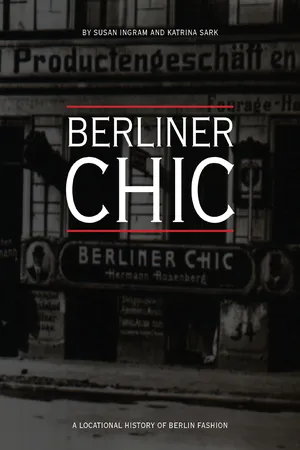
Since becoming the capital of reunited Germany, Berlin has had a dose of global money and international style added to its already impressive cultural veneer. Once home to emperors and dictators, peddlers and spies, it is now a fashion showplace that attracts the young and hip. Moving beyond descriptions of Berlin's fashion industry and its ready-to-wear clothing, Berliner Chic charts the turbulent stories of entrepreneurially-savvy manufacturers and cultural workers striving to establish their city as a fashion capital, and being repeatedly interrupted by politics, ideology, and war. There are many stories to tell about Berlin's fashion industry and Berliner Chic tells them all with considerable expertise.
Frequently asked questions
Yes, you can cancel anytime from the Subscription tab in your account settings on the Perlego website. Your subscription will stay active until the end of your current billing period. Learn how to cancel your subscription.
No, books cannot be downloaded as external files, such as PDFs, for use outside of Perlego. However, you can download books within the Perlego app for offline reading on mobile or tablet. Learn more here.
Perlego offers two plans: Essential and Complete
- Essential is ideal for learners and professionals who enjoy exploring a wide range of subjects. Access the Essential Library with 800,000+ trusted titles and best-sellers across business, personal growth, and the humanities. Includes unlimited reading time and Standard Read Aloud voice.
- Complete: Perfect for advanced learners and researchers needing full, unrestricted access. Unlock 1.4M+ books across hundreds of subjects, including academic and specialized titles. The Complete Plan also includes advanced features like Premium Read Aloud and Research Assistant.
We are an online textbook subscription service, where you can get access to an entire online library for less than the price of a single book per month. With over 1 million books across 1000+ topics, we’ve got you covered! Learn more here.
Look out for the read-aloud symbol on your next book to see if you can listen to it. The read-aloud tool reads text aloud for you, highlighting the text as it is being read. You can pause it, speed it up and slow it down. Learn more here.
Yes! You can use the Perlego app on both iOS or Android devices to read anytime, anywhere — even offline. Perfect for commutes or when you’re on the go.
Please note we cannot support devices running on iOS 13 and Android 7 or earlier. Learn more about using the app.
Please note we cannot support devices running on iOS 13 and Android 7 or earlier. Learn more about using the app.
Yes, you can access Berliner Chic by Susan Ingram,Katrina Sark, Susan Ingram in PDF and/or ePUB format, as well as other popular books in History & German History. We have over one million books available in our catalogue for you to explore.
Information
Chapter 1
Berliner Chic in Museums
“The very project of modernity is born out of the desire for a world without surprises, a safe world, a world without fear.”
(Bauman and Galecki)
“The museal gaze thus may be said to revoke the Weberian disenchantment of the world in modernity and to reclaim a sense of non-synchronicity and the past.”
(Huyssen 1995, 34)
Museums have been much maligned. Since their revolutionary beginnings in late eighteenth-century Paris, they have been accused of rendering objects inauthentic and crepuscular, of disciplining or interpellating class-based (but not class-conscious) national subjects, of showcasing the trophies of imperial war and conquest, and, more recently, of succumbing to the seductive forces of the market.1 Given that the museum has become an increasingly important site for fashion (Steele 8), it is perhaps to be expected that fashion would be implicated in these critiques. In 1983, Yves Saint-Laurent became the first living fashion designer to be honored by the Metropolitan Museum of Art with a solo exhibition, and Diana Vreeland’s exhibition became a lightning rod for controversy, a fate shared by subsequent blockbuster exhibits, such as the Armani exhibit organized by the Guggenheim, designed by Robert Wilson and sponsored by Mercedes-Benz, which opened in New York in 2000, travelled to Bilbao in 2001 and the Neue Nationalgalerie in Berlin in 2003 before proceeding on to London, Rome, Tokyo, and Las Vegas, garnering criticism as well as kudos along the way.2
As this chapter reveals, fashion has not only been implicated in but has also provided the impetus for a particular strand of this criticism. Since entering the Berlin landscape towards the end of the nineteenth century, fashion has served to work against the prevailing assumptions about museums as the proper public places for the display of art treasures, i.e., precisely those items that have drawn the wrath of the older sociological critiques of the museum “as an institution that saw its function as reinforcing ‘among some people the feeling of belonging and among others the feeling of exclusion’” (Huyssen 1995, 15). Adorno once noted that museum and mausoleum are connected by more than phonetic association (175), but as Andreas Huyssen points out in Twilight Memories, museums have also acted as iterations or translations that promote the living-on (the survival) of objects and the memories they carry with them, as “a life-enhancing rather than mummifying institution in an age bent on the destructive denial of death: the museum thus as a site and testing ground for reflections on temporality and subjectivity, identity and alterity” (16). Moreover, it is not only that this older critique “does not seem to be quite pertinent any longer for the current museum scene which has buried the museum as temple for the muses in order to resurrect it as a hybrid space somewhere between public fair and department store” (15). As we hope to establish here, the conjugation of fashion (in which, as laid out in the Introduction, we follow Elizabeth Wilson in understanding in terms of rapidly changing styles of dress) and Berlin museum culture establishes a much longer historical trajectory for this type of hybridity than previously assumed and encourages a thoroughgoing rethinking of the relationship between fashion and the museum. Huyssen may have thought it was hyperbolic to claim in Twilight Memories that “the museum is no longer simply the guardian of treasures and artifacts from the past discreetly exhibited for a the select group of experts and connoisseurs; no longer is its position in the eye of the storm, nor do its walls provide a barrier against the world outside” (21). The history of Berlin’s fashion collections and exhibitions shows that museums were never solely guardians but also educators and equalizers, providing historical support for Ursula Link-Heer’s argument that fashion itself operates museally (146). It is not only, as Huyssen argues, that “[t]he quality argument collapses once the documentation of everyday life and of regional cultures, the collecting of industrial and technological artifacts, furniture, toys, clothes and so forth becomes an ever more legitimate museal project” (22); fashion in Berlin has long given itself the mission of revaluing musealizing practices and underscoring the questioning of who has been in a position to determine what counts as legitimate. As we trace its history here, first laying out the Berlin museum landscape and then turning to the city’s main fashion-related collections – the Lipperheidesche Kostümbibliothek (Lipperheide Costume Library); an early twentieth-century attempt by the Berlin Fashion Museum Society to establish a fashion museum; another, similarly unsuccessful attempt toward the century’s end by the Fashion Department of the Stadtmuseum to do the same thing; and the prestigious Kamer/Ruf collection, acquired in 2003 – we draw specific attention to the locations, both social and geographic, of the legitimacy that was being challenged.3
The Establishment of the Berlin Museum Landscape
The museal tradition in which Berlin fashion has been able to provide a counter-hegemonic challenge to traditional high-culture aspirations is bound up in one of those endearingly untranslatable concepts that Germany seems to take pride in producing: Kunstgewerbe.4 Like Bildung, “whose range of meanings includes (and combines) formal education, aesthetic cultivation and character formation” (Sheehan 115), Kunstgewerbe also covers a particular spectrum, in its case, of handiwork practices that include (and combine) a range of skills and talents that have their roots in the medieval guild system but that had to readjust to modern developments in aesthetics (artistic autonomy) and industrial production. As late as the 1873 Grimm Dictionary and the 1908 Meyer’s Konversationslexikon, it was considered a synonym of “art industry” (Kunstindustrie) and deemed to be an “abomination” (Unding) that didn’t exist: “These days there is no such thing as ‘art-craft,’ there are those who work, who are at the same time artists; there are also artists, who understand how to do a good business with their art! Alone an ‘art-craft’ is an abomination” (Franke 167).5 John Maciuika has also lamented this “confusing array of terms,” noting that the terminological slipperiness reflects “the chaotic state of the relationship between crafts and industry in the nineteenth and early twentieth centuries” (112). Evers attributes the blossoming of Kunstgewerbe museums in the middle of the nineteenth century to “an optimistic trust in their ability to overcome the division of art and craft that was experienced by some as painful and felt to have led to a decline in taste and a loss of craft-oriented abilities” (8), and as we will see in this chapter, Kunstgewerbe in Berlin provided a unique terrain on which fashion has been able to assert itself ever since.
The “confusing,” “chaotic,” generally intense and intimate relations between art, crafts and industry in the nineteenth century spilled over into and helped to shape Berlin’s museum landscape. Some see this tradition stretching back to Friedrich the Great (1712–1786), the enlightened absolutist monarch who transformed Prussia from a European backwater into a politically reformed and economically and militarily strong state and first made some of the Prussian art treasures available by opening the picture galleries at Sanssouci, his summer palace in Potsdam, to the public (Gaehtgens 14). However, to get a sense of the early struggles to institutionally delimit this area, it is better to go back to his grandfather, Friedrich III Elector of Brandenburg, who in 1696 founded both a Prussian Academy of Arts as well as an Akademie der bildenden Künste und der mechanischen Wissenschaften (Academy of Fine Arts and Mechanical Sciences) (Mislin 41), and who, five short years later, became the first king in and of Prussia and moved the Prussian capital from Königsberg to Berlin. The Prussian Academy of Arts followed the model of the French académie des beaux-arts, provided training in the fine arts of painting, sculpture and architecture (but, unlike the French, not music)6 and led to the development of similar academies “for painting, sculpture and architecture” in Munich (1770), Düsseldorf (1773) and Kassel (1777). In contrast, the Akademie der bildenden Künste und der mechanischen Wissenschaften brings out the root meaning of the bildende arts, shifting it away from its usual translation of “fine” in the direction of “formative” or “forming/molding.” While the failure of this academy was perhaps to be expected, given the disjunctive nature of its undertaking, it led to the founding, in 1799, of the Bauakademie, which took over the education of architects and engineers and established a Prussian tradition of conveying institutional value to the industrial arts in the manner of the British. Upon its founding in 1754, the British institution that went on to be known as the Royal Society of Arts after 1847 was called “The Society for the Encouragement of Arts, Manufactures and Commerce,” and at the exhibitions the Society began holding in 1760 “paintings, sculptures, architectural models, pumps, ploughshares and weaving looms were displayed together under the communal heading of ‘inventions,’ for the edification of the membership and the enlightenment of farmers, manufacturers and businessmen. Experimentation was encouraged, as was the ideal of making the various branches of intellectual endeavour work in harmony” (Greenhalgh 7–8).7
The imperially influenced kernels that went into Berlin museum-making were thus already in place by the time of the French Revolution. What ended up sprouting first was a series of art museums, aided considerably by the French precedent for an art museum (the Louvre) and the fact that, by 1796, each of the other German-speaking states already had a public collection “in which art could be visited, copied, and discussed; should not Berlin be on a list that included Dresden, Vienna, Munich, Mannheim, Düsseldorf, and many lesser capitals?” (Sheehan 54). This mounting interest in art museums among European powers received a further boost with the return, in 1815, of the Prussian artworks that had been looted by Napoleon.8 Because these had come to be seen, in the wars against Napoleon, as German treasures and not merely the Prussian king’s possessions, Friedrich Wilhelm III was pressured to make them available to the public and to erect a suitable building for this purpose (cf. Sheehan 70–80; Crimp).
This building, the first of five museums to be erected on the northern part of the island formed by the Spree in the center of Berlin, was decisive for the shape that art museums took in the nineteenth and twentieth centuries (Vogtherr). Previously, as Klonk has shown in her work on the National Gallery in London, museum visitors were encouraged by presentation techniques to attend to “a universal standard of art that transcended whatever was presented to the senses” (343). Now, however, “the autonomy of subjective experience came to be emphasised both in the production of art and in its reception… Instead of fixed ideals, what was now valued was the expression of distinctness and individuality, be it in individual artists, periods, or countries” (343–4). Moreover, this new form of cultural space did not only develop parallel to “the roughly contemporary emergence of the prison, the asylum and the clinic” but rather, as Tony Bennett corrects Douglas Crimp, reversed it, aiming “not at the sequestration of populations but, precisely, at the mixing and intermingling of publics – elite and popular – which had hitherto tended towards separate forms of assembly” (Bennett 93). The debate that ensued over what to call the new structure is indicative of this aim. While the Romantic poet Ludwig Tieck proposed “a monument of peace for works of fine art” to immortalize the peace that had returned to Europe with the Congress of Vienna, and philologist Friedrich Schleiermacher favored “a treasury for sculptures and painting distinguished by their age and their art” (Crimp 262), the suggestion to win favor and be inscribed in the new building was by an archeologist and member of the Academy of Arts who had been active in the 1799 founding of the Bauakademie, Alois Hirt.9 Rather than a monument or a treasury, Hirt chose to call the building a “museum” and to designate its purpose with the word “studio,” which recollected “the so-called original museum of Ptolemy of Alexandria, which was indeed a place of study, […a] residence for scholars, containing a library and collections of artifacts…as one of the memor...
Table of contents
- Cover
- Title Page
- Copyright
- Contents
- List of Illustrations
- Dedication
- Acknowledgements
- Introduction: Locating Berliner Chic
- Chapter 1: Berliner Chic in Museums
- Chapter 2: Berliner Chic and Historiography
- Chapter 3: Berliner Chic and Photography
- Chapter 4: Berliner Chic on the Silver Screen
- Chapter 5: Berlin Calling: Sex and Drugs and Punk and Techno
- Chapter 6: Becoming Berlin: The Flux of Corporate Luxe
- Chapter 7: Conclusion – Where Fashion Lives Today, Battleground Berlin
- References